


GCSE Grading System Explained: Your Complete Guide to UK GCSE Grades (2026)
If you have ever stared at a GCSE results slip and wondered what the numbers actually mean, you are certainly not alone. Thousands of students, parents and adult learners across the UK find the current grading system confusing, particularly those who grew up with the old A* to G letter grades. With GCSE results day 2026 confirmed for Thursday, 20 August 2026, understanding what those grades mean has never been more important.
Whether you are a Year 11 student preparing for your exams, a parent trying to make sense of predicted grades, or an adult looking to resit qualifications, this guide walks you through everything clearly. We cover the full GCSE grading scale, what each grade is worth, how marks convert to grades, Foundation vs Higher tier differences and what your results mean for Sixth Form, university and employment. If you are currently getting support through coursework help, assignment writing, or exam preparation, knowing the grading system inside out gives you a clear target to aim for.
What Is the UK GCSE Grading System?
GCSE stands for General Certificate of Secondary Education. It is the main qualification taken by students in England, Wales and Northern Ireland at the end of Year 11, typically at age 15 to 16. Most students sit between eight and ten subjects, ranging from core subjects like Maths and English Language to optional subjects such as History, Geography, Modern Foreign Languages and the Arts.
The UK GCSE grading system was reformed between 2015 and 2017 by Ofqual, the Office of Qualifications and Examinations Regulation. Before that reform, grades ran from A* down to G, with U for ungraded. The new numerical system replaced those letters with grades running from 9 (highest) down to 1 (lowest). The switch was introduced to raise academic standards, make qualifications more challenging and give universities and employers a better way to distinguish between high-achieving students.
The phased rollout happened as follows:
- 2017 – English Language, English Literature and Maths were the first subjects to use the 9–1 scale
- 2018 – A further 20 subjects moved across, including History, Geography and the Sciences
- 2019 – Another 25 subjects followed
- 2020 – All remaining GCSEs fully adopted the new number grading system
By 2026, the 9–1 system is firmly established across all GCSE subjects and all awarding bodies, including AQA, Edexcel (Pearson), OCR and WJEC.
Read More: Grading System in UK Universities: A Complete Guide for Students
The GCSE Grading Scale: Full Chart and Grade Comparison
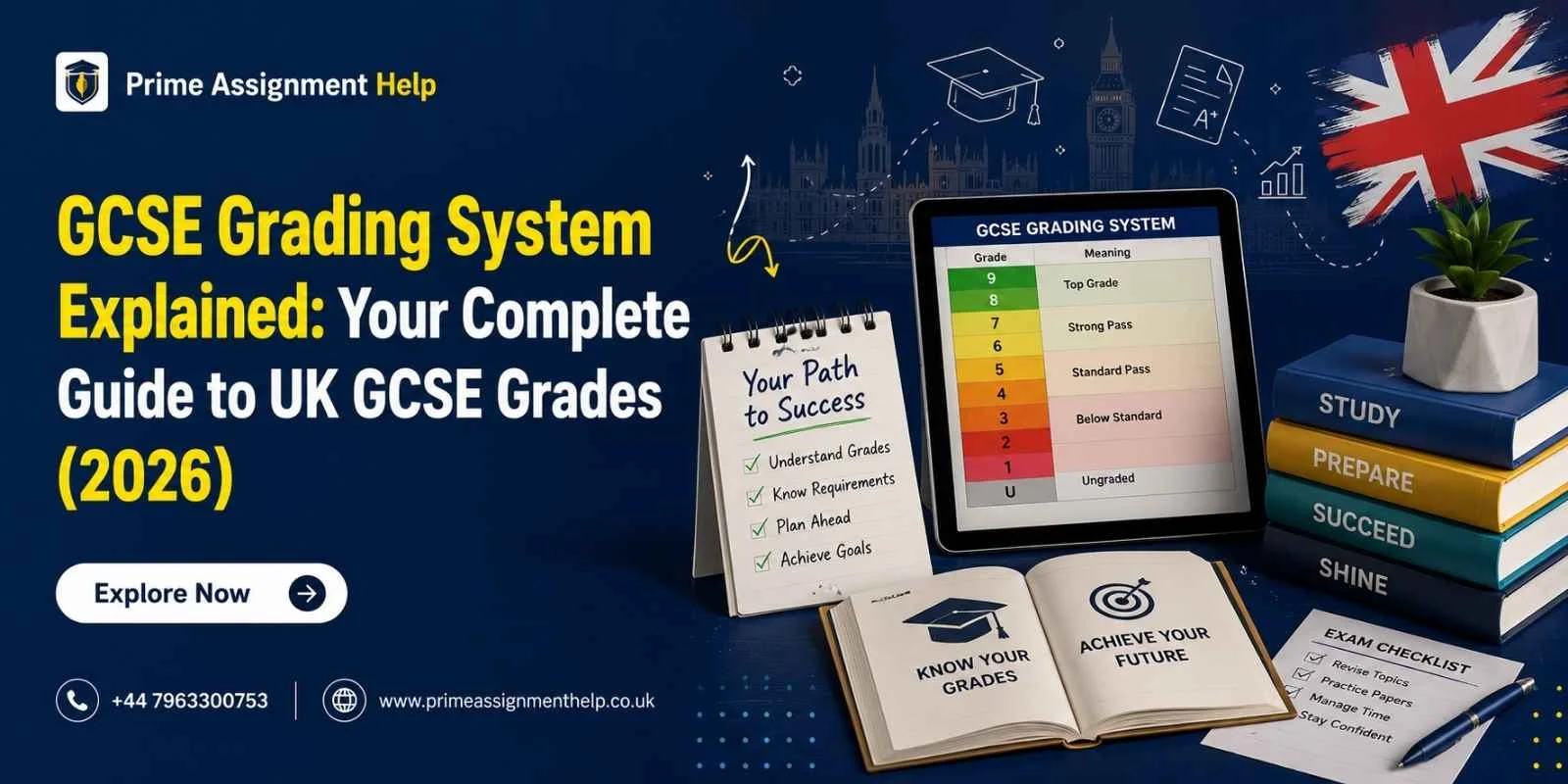
One of the most common questions around this topic is simply: what do GCSE grades mean? The table below gives you a clear, at-a-glance GCSE grading chart comparing the new numerical grades with the old letter system, along with what each grade represents in practice.
GCSE Grading Chart 2026 New vs Old System
| New Grade (9–1) | Old Letter Grade | What It Means | Pass Status |
| 9 | Above A* | Outstanding – top performers nationally only | ✔ Strong Pass |
| 8 | A* | Excellent near the very top of the cohort | ✔ Strong Pass |
| 7 | A | Very good performance | ✔ Strong Pass |
| 6 | B | Good, above the national strong pass benchmark | ✔ Strong Pass |
| 5 | B / C | Strong pass above the national minimum expectation | ✔ Strong Pass |
| 4 | C | Standard pass meets the national minimum expectation | ✔ Standard Pass |
| 3 | D | Below standard pass threshold | ✗ Below Pass |
| 2 | E | Below standard pass threshold | ✗ Below Pass |
| 1 | F / G | Lowest recorded grade | ✗ Below Pass |
| U | U | Ungraded, no mark awarded | ✗ Fail |
Grade 1 is not a fail. It is a low grade, but it is a recorded result. Only a U (ungraded) is a true fail, meaning a student did not score enough marks to receive any grade at all. This is a point that often gets misrepresented, so it is worth being clear about.
One more important distinction: Grade 9 does not simply replace the old A*. Under the old system, a large proportion of the highest-performing students received A* grades. Grade 9 is awarded to only the top few per cent nationally, typically around 3–4% of all entries in any given subject. It was specifically designed to identify truly exceptional performance that the old system could not differentiate.
What Is a Pass in GCSE? Standard Pass vs Strong Pass
There are two official pass thresholds in the current GCSE grading system and understanding both matters enormously when planning next steps.
Grade 4 – Standard Pass Grade 4 is the national benchmark and is roughly equivalent to the old grade C. The majority of Sixth Forms, colleges and employers will accept a Grade 4 as a satisfactory result. In England, students who do not achieve a Grade 4 in GCSE English Language or GCSE Maths are required to continue studying those subjects post-16 – this is a legal government requirement.
Grade 5 – Strong Pass Grade 5 sits above the standard pass and is considered the “strong pass” threshold. Competitive Sixth Forms, Russell Group universities and many professional employers specifically ask for Grade 5 or above in English Language and Maths. If a student is aiming for a selective university or a highly competitive A-level course, Grade 5 is the minimum worth targeting.
Grade U – Ungraded A U grade means the student did not meet the minimum raw mark threshold to be awarded any grade. It is the only outcome that is technically a fail under the current system.
What Do GCSE Grades Mean for Your Future?
GCSE grades play an important role in shaping your future opportunities. They can affect your options for Sixth Form, university admissions, apprenticeships, and employment.
Sixth Form and College Entry
Most Sixth Forms and colleges across the UK require a minimum of five GCSEs at Grade 4 or above, including Grade 4 in both English Language and Maths. For specific A-level subjects, schools will typically ask for a Grade 6 or Grade 7 at GCSE in that particular subject for example, a Grade 6 in Biology to study A-level Biology.
University Admissions
Universities do consider GCSE results, though A-levels and equivalent qualifications carry more weight. For highly competitive courses, such as Medicine, Dentistry, Law at leading universities and certain Engineering programmes, admissions teams may look closely at GCSE profiles, particularly for evidence of consistent academic performance. A strong set of results, with several Grade 7s and above, genuinely strengthens a UCAS application.
Employer Requirements
For school leaver apprenticeships, trainee roles and most entry-level positions, employers across the UK typically require at least Grade 4 in both GCSE English Language and GCSE Maths. For higher-level apprenticeships and professional roles, GCSE grades carry less weight once a student has progressed to A-levels or degree qualifications.
Read More: 100+ Best GCSE Speech Topics for 2026 Grade 9 Ideas for UK Students
GCSE Marks to Grades: How Are Grade Boundaries Set in 2026?
This is the section most GCSE guides do not explain properly and it is genuinely important to understand, particularly around results day.
When a student receives their GCSE result, the grade is not based on a fixed percentage. There is no rule that says “60% always equals a Grade 6.” Instead, grade boundaries are set after each exam series by the awarding bodies (AQA, Edexcel, OCR and WJEC), under the oversight of Ofqual, through a process called comparable outcomes.
Here is how GCSE marks to grades actually work:
- Papers are marked by examiners across the country
- Statistical analysis is carried out to determine how this year’s cohort performed compared to previous years.
- Awarding meetings take place, where senior examiners review sample scripts and agree on the minimum mark required for each grade
- Ofqual reviews and approves the proposed boundaries
- Grade boundaries are published at 8:00 am on GCSE results day for 2026, which is Thursday, 20 August 2026
Because boundaries shift each year based on paper difficulty and national performance, a student cannot look at last year’s boundaries and assume they will be identical. A Grade 7 boundary in Maths might be 110 marks one year and 104 the next because the paper was slightly harder.
2026 Update: Formula Sheets Confirmed
One notable update for 2026 GCSE exams is that formula sheets and equation sheets are confirmed for GCSE Maths, Physics and Combined Science, continuing the provision introduced during the pandemic years. Ofqual published these support materials by September 2025, giving schools and students time to integrate them into revision. This means students are expected to demonstrate understanding and application of formulas, not just recall them from memory.
Foundation Tier vs Higher Tier: How the GCSE Grading Scale Differs
This is one of the most overlooked aspects of the GCSE grading system, yet it has a direct impact on what grades a student can actually achieve. Most science subjects, Maths and several other GCSEs are offered across two exam tiers:
| Tier | Grade Range Available | Maximum Grade Possible |
| Foundation Tier | Grades 1 to 5 | Grade 5 |
| Higher Tier | Grades 4 to 9 | Grade 9 |
A student who entered the Foundation Tier cannot achieve above a Grade 5, regardless of how well they perform on the day. A student sitting Higher Tier has the full range up to Grade 9, but if their performance is weak, they may receive a Grade 3 or even a U because the Higher Tier papers are designed with the assumption that students are working at a Grade 4 level and above.
The tier decision is made by the subject teacher, based on a student’s predicted performance and class work. It is worth discussing this decision openly with the school if a student is borderline, particularly in Maths, where Higher Tier entry opens the door to a Grade 7, 8, or 9 that is simply not available on the Foundation paper.
For students working with a tutor or seeking assignment writing support to boost their predicted grade, knowing which tier they are entered for is essential to setting realistic targets.
GCSE Resits in 2026: Your Options If Results Day Does Not Go to Plan
If a student does not achieve the grades they need, there are clear pathways forward and resitting is far more common than many people realise.
| Resit Window | Subjects Available | Who It Is For |
| November 2026 sitting | GCSE English Language and Maths only | School leavers are required to continue studying these subjects |
| June 2027 sitting | All GCSE subjects | Any student wishing to improve their grade |
For adult learners who left school without the qualifications they need, Functional Skills Level 2 in English and Maths is widely accepted as equivalent to GCSE Grade 4 by colleges, many employers and some universities. It is a practical, flexible alternative that can be studied online and sits at the same level on the Regulated Qualifications Framework (RQF).
If a student believes their result does not reflect their performance, there is also the option to request a review of marking through their school or exam centre. This must be done within a specific window after results day. As a last resort, a formal appeal to Ofqual is also possible, though it is rarely needed.
Conclusion
The UK GCSE grading system is more layered than a single number suggests. From understanding the difference between a standard and a strong pass, to knowing how tier entry affects your ceiling grade and how Ofqual sets grade boundaries after each exam series, having a full picture puts students, parents and adult learners in a much stronger position to plan ahead confidently.
The key points to remember for 2026: Grade 4 is the standard pass, Grade 5 is the strong pass, Grade 9 is awarded to only the very top performers and U is the only true fail. Grade boundaries are published on results day, Thursday, 20 August 2026 and they change every year, so last year’s figures are a guide only.
Whatever stage of your academic journey you are at, whether you are preparing for exams, navigating results day, or looking to improve your qualifications through resits, the right support makes a genuine difference. From essay writing help and coursework help to dissertation help UK and exam preparation guidance, Assignment Help in UK is here to help you reach the grade you are working towards.
Read More: Which Is the Hardest GCSE Exam Board in 2026? A Complete UK Student Guide
Frequently Asked Questions
1. Is a Grade 4 the same as a C in GCSE?
Yes, Grade 4 is broadly equivalent to the old Grade C under the previous A*–G system. It is the standard pass under the current UK GCSE grading system.
2. What is the highest GCSE grade in 2026?
Grade 9 is the highest grade. It sits above the old A* and is awarded to only the very top-performing students nationally, typically around 3–4% of entries per subject.
3. Is a Grade 3 a pass in GCSE?
No. Grade 3 falls below the standard pass threshold. Students in England who receive below a Grade 4 in English Language or Maths must continue studying those subjects post-16.
4. What is the difference between Grade 4 and Grade 5?
Grade 4 is the standard pass and the national minimum benchmark. Grade 5 is a strong pass above the minimum and is often required by competitive Sixth Forms and selective universities.
5. Are old GCSE letter grades still valid?
Yes. If you sat your GCSEs before 2017 and received A*–G grades, those results remain fully recognised and accepted by employers and educational institutions across the UK.
6. What is a good set of GCSE results?
A solid set of results would typically include five or more GCSEs at Grade 5 and above, including English Language and Maths. Achieving several Grade 7s and above is considered an excellent set of results.
7. When are GCSE grade boundaries published in 2026?
Grade boundaries for all subjects and all awarding bodies are published at 8:00 am on GCSE results day, Thursday, 20 August 2026.

