
Schon’s Reflective Model: A Complete 2026 Guide for UK Students and Professionals
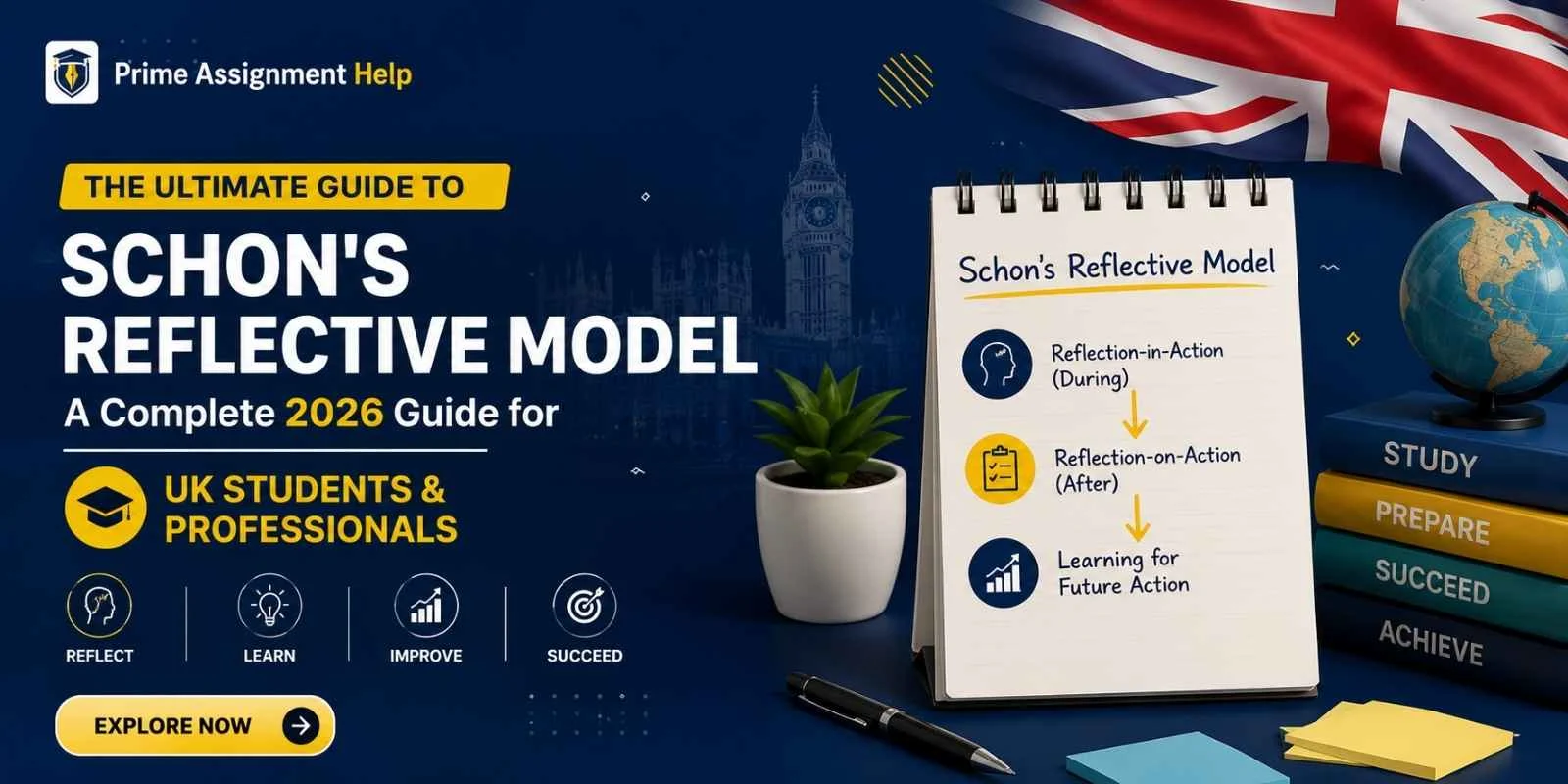
Have you ever adjusted your approach mid-task without consciously thinking about it? You noticed something was not working, shifted strategy on the spot and moved forward all within seconds. That instinctive ability to think and adapt during an experience is precisely what Donald Schön spent his career trying to explain. His framework, widely known as Schön’s Reflective Model, challenged the long-held assumption that professionals simply apply textbook theory to real-world situations. Instead, Schön argued that genuine expertise lives in the messy, unpredictable moments that no textbook can fully prepare you for.
First introduced through his landmark 1983 publication The Reflective Practitioner: How Professionals Think in Action, Donald Schön’s reflective practice has since become one of the most cited frameworks in professional education across the UK. Whether you are studying nursing, completing a CIPD qualification, training as a teacher, or writing a reflective assignment at university, understanding Schön’s model is no longer optional it is expected. This guide breaks down every component of the model, covers real-world applications, compares it to other leading frameworks and gives you practical guidance on applying it to your own writing and practice.
Who Was Donald Schön and Why Does His Model Still Matter in 2026?
Donald Schön (1930–1997) was an American philosopher and professor at MIT. He was deeply critical of what he called “technical rationality,” the idea that professionals solve problems by selecting from a library of established theories and techniques. His argument was simple but radical: real professional practice is far too complex, uncertain and unique for that approach to work on its own.
As of 2026, Schön’s 1983 publication remains one of the most cited works in professional education literature and his concepts continue to underpin frameworks used by the Nursing and Midwifery Council (NMC), CIPD qualifications and UK teacher training programmes. A 2026 study published in the Journal of Research in Nursing (Oxford Brookes University) confirmed that reflective practice rooted in Schön’s original thinking remains central to how nursing knowledge is generated and passed on through clinical experience.

The Three Core Components of Schön’s Reflective Model
Most resources only cover two stages of this model. However, Donald Schön’s reflective practice actually rests on three interconnected concepts. Understanding all three is what separates a surface-level reflection from one that earns distinction marks.
| Component | When It Occurs | What It Involves |
| Knowing-in-Action | Before and during an experience | Automatic, intuitive knowledge applied without conscious thought |
| Reflection-in-Action | During the experience | Real-time thinking, noticing and adjusting mid-task |
| Reflection-on-Action | After the experience | Deliberate analysis of what happened and what can be improved |
These three components are not separate stages that follow one another in a linear sequence. They interact throughout a professional experience, which is what makes Schön’s model so different from circular models like Gibbs.
Reflection-in-Action: Thinking on Your Feet
Reflection-in-action is the ability to think critically while something is happening and make adjustments in real time. Schön described the practitioner engaged in this process as “a researcher in the practice context,” someone who does not pause the situation but experiments within it.
This is not guesswork. Reflection-in-action draws on a practitioner’s existing expertise and immediately tests new responses against what they are observing. The key distinction is timing: it happens during the event, not before or after.
Example Schön’s Reflective Model in nursing: A ward nurse notices mid-consultation that a patient is becoming increasingly withdrawn and non-communicative. Rather than continuing with the standard assessment protocol, she pauses, adjusts her tone and shifts to open-ended questions. She is not stopping to write notes or review guidelines; she is reflecting and responding simultaneously. That is reflection-in-action at its most practical.
Reflection-on-Action: Learning After the Event
Reflection-on-action occurs after the experience has concluded. This is the more familiar form of reflection, sitting down after a shift, a lesson, or a meeting and asking yourself what happened, why it happened and what you would do differently.
Unlike reflection-in-action, this stage allows for more structured and critical thinking because there is distance from the event. It is the component most commonly required in UK university assignments and CPD portfolios.
Useful questions to guide reflection-on-action:
- What was I trying to achieve in that situation?
- What actually happened and why did it unfold that way?
- What knowledge or assumptions was I drawing on?
- What would I change if I faced the same situation again?
- What does this experience tell me about my professional development?
Example Schön’s Reflective Model in teaching: After delivering a lesson on persuasive writing, a secondary school teacher reflects that three students in the back row disengaged within the first ten minutes. During the lesson, she noticed but could not fully address it. After class, she considers whether the task was pitched at the right level, whether the seating arrangement played a role and how she might redesign the opening activity. That post-lesson analysis is reflection-on-action.
Knowing-in-Action: The Hidden Foundation
Knowing-in-action is the tacit knowledge professionals carry, skills and judgements so deeply embedded that they are performed automatically, without conscious deliberation. An experienced GP who quickly identifies that a patient’s symptoms do not quite match a common diagnosis is drawing on knowing-in-action. The concern with this component, which Schön was careful to highlight, is that relying entirely on automatic knowledge can lead professionals to miss unexpected outcomes. Reflection-in-action exists precisely to interrupt and question knowing-in-action when something does not feel right.
Read More: What Is a Level 3 Qualification in the UK? Types, Equivalents & Entry Requirements (2026)
Schön vs Gibbs: Which Reflective Model Should You Use?
This is one of the most searched questions among UK students and the answer is not straightforward. Both frameworks have genuine merit; the right choice depends on your assignment brief and your professional context.
| Feature | Schön’s Reflective Model | Gibbs’ Reflective Cycle |
| Structure | Flexible, non-linear | Six structured stages |
| Focus | Real-time and post-event reflection | Post-event systematic analysis |
| Best suited for | CIPD Level 5 & 7, nursing, fast-paced professional settings | Education, healthcare and social work assignments |
| Ease of use for beginners | Moderate requires self-directed critical thinking | Highly guided step-by-step prompts |
| Academic depth | Strong for advanced reflective writing | Strong for structured reflective essays |
| Timing of reflection | During and after an experience | After an experience only |
The core distinction when considering Schön vs Gibbs reflective cycle is this: if your assignment requires you to demonstrate how you think and adapt during practice, particularly in HR, management, or advanced nursing, Schön is the stronger choice. If you need to walk through an experience methodically from start to action plan, Gibbs provides the scaffolding to do so.
Schön’s Reflective Model in Nursing: A UK-Specific Guide
Schön’s Reflective Model in nursing is particularly well-established in the UK context. The NMC Code (updated 2024) requires registered nurses to maintain reflective accounts as part of the revalidation process every three years. Schön’s framework supports this requirement directly, as it encourages nurses to document both their in-the-moment decision-making and their post-event learning.
A 2026 paper from Oxford Brookes University’s School of Nursing and Midwifery confirmed that reflection remains a core mechanism through which nursing knowledge is generated through practice, not just in training, but across the entire career span. What makes Schön particularly valuable in clinical settings is that nursing decisions are rarely made in calm, controlled environments. Reflection-in-action captures the thinking that happens under pressure, in the middle of a patient interaction, when there is no time to consult a textbook.
Applying Schön’s model for NMC revalidation: Your reflective account should demonstrate both components describe a clinical situation where you made real-time adjustments (reflection-in-action) and then analyze what that experience taught you about your practice and how it informed your subsequent approach (reflection-on-action).
How to Apply Schön’s Reflective Model: A Step-by-Step Approach
Whether you are completing a CIPD assignment, a nursing portfolio, seeking essay help UK, or writing a university reflective essay, the following framework will help you apply Schön’s Reflective Model effectively and demonstrate deeper critical reflection.
Step 1 – Identify the experience. Choose a specific, real situation from your practice. Avoid vague generalizations. The more concrete the scenario, the stronger your reflection will be.
Step 2 – Describe your knowing-in-action. What prior knowledge, skills, or habits were you relying on going into the situation? What did you assume would work?
Step 3 – Document your reflection-in-action. At what point did something unexpected occur? How did you notice it? What adjustments did you make and why did you make them in that moment?
Step 4 – Conduct structured reflection-on-action. Using the guiding questions from the earlier section, analyze the experience with critical distance. What went well? What did not? What assumptions were challenged?
Step 5 – Identify learning and next steps. What will you do differently in future? How has this experience changed your professional understanding? This is the section most directly linked to CPD frameworks.

Advantages and Limitations of Schön’s Reflective Model
No reflective framework is without weaknesses and being aware of them strengthens your academic writing rather than undermining it.
Strengths:
- Captures real-time professional thinking that other models miss entirely
- Highly relevant to fast-paced UK professional environments (NHS, schools, HR)
- Underpins CIPD, NMC and teacher training CPD requirements
- Encourages genuine critical thinking rather than formulaic stage-completion
Limitations:
- The absence of structured steps makes it harder to apply in early-stage academic writing compared to Gibbs
- Relies heavily on honest and accurate self-recall, which can be affected by memory and bias
- Provides limited guidance for practitioners who are new to reflective writing
- Some recent academic debates, including a 2022 paper in Studies in Higher Education, have questioned whether Schön’s model alone is sufficient in rapidly changing professional environments, suggesting it works best when used alongside other frameworks
Conclusion:
Schön’s Reflective Model endures because it reflects how professionals actually think — not how theory suggests they should. In a landscape where UK employers, professional bodies and academic institutions place increasing weight on continuous professional development, the ability to reflect both during and after an experience is no longer a soft skill. It is a core professional competency.
Whether you are a nursing student preparing your NMC revalidation portfolio, an HR professional completing a CIPD Level 7 assignment, or an undergraduate writing your first reflective essay, applying this framework with genuine critical depth will set your work apart.
If you need support in structuring your reflective writing, our experts at Prime Assignment Help are here to guide you. From reflective essay help UK to CIPD assignment help UK, nursing assignment help UK, dissertation help UK and coursework help UK, we support students across every stage of their academic journey with work that is tailored, thorough and delivered on time.
Frequently Asked Questions :
1. What are the two main types of reflection in Schön’s Reflective Model?
Schön’s model focuses on reflection-in-action and reflection-on-action. Reflection-in-action occurs while performing a task and helps professionals adapt to situations in real time. Reflection-on-action happens after the event and involves reviewing experiences to identify lessons and areas for improvement. These processes are supported by knowing-in-action, which refers to the skills and knowledge developed through experience.
2. When was Schön’s Reflective Model introduced?
Donald Schön introduced the model in 1983 through his book The Reflective Practitioner: How Professionals Think in Action. The framework has since become one of the most widely used approaches to reflective practice in fields such as nursing, education and social work.
3. Is Schön’s Reflective Model suitable for nursing assignments?
Yes. Schön’s Reflective Model is commonly used in nursing assignments because it helps students analyze clinical experiences, evaluate decision-making and demonstrate professional development. It is particularly useful for reflective essays, placement reports and NMC-related reflective accounts.
4. How do I cite Schön in Harvard referencing?
The standard Harvard reference is: Schön, D.A. (1983) The Reflective Practitioner: How Professionals Think in Action. New York: Basic Books. For in-text citations, use (Schön, 1983) unless your institution requires a different format.
5. What are the main benefits of Schön’s Reflective Model?
The model encourages critical thinking, continuous learning and professional growth. By reflecting on experiences during and after an event, individuals can improve their decision-making, problem-solving abilities and overall professional practice.

