


Summative vs Formative Assessment: Key Differences, Examples & Methods Explained (2026)
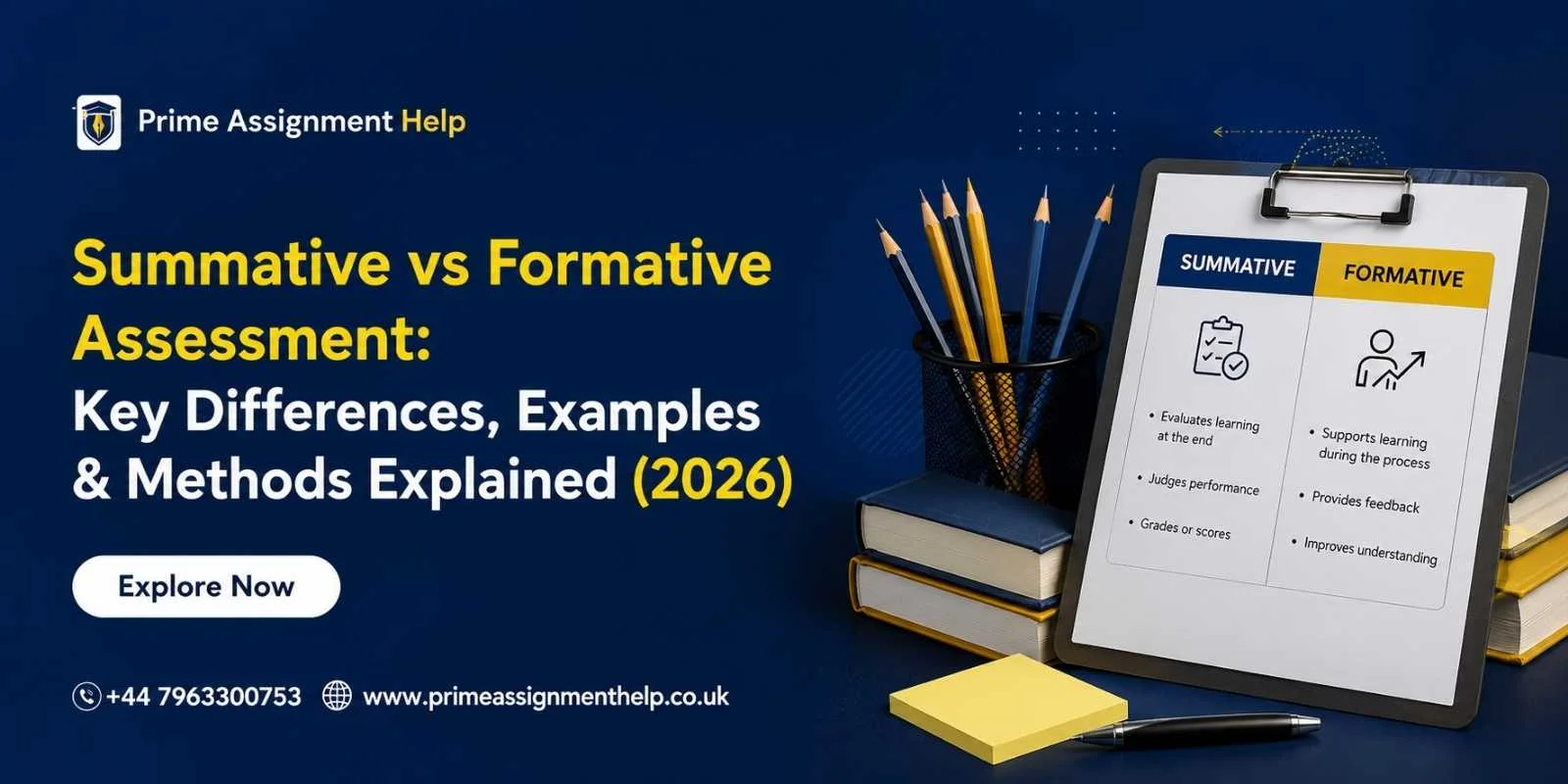
If you have ever sat through a class wondering whether the quiz you just took actually counted toward your grade or why your teacher keeps asking questions mid-lesson, you have already experienced the difference between summative vs formative assessment firsthand. These two assessment types in education sit at the heart of how teachers measure learning, plan lessons and decide whether students are genuinely progressing or just going through the motions. Understanding both is not just useful for teachers; it matters for students, parents and anyone involved in education.
At Assignment Help in UK, we work closely with students across all academic levels, from school coursework to university-level dissertation help UK. Through our coursework writing service and essay help online, we see firsthand how students struggle when they do not understand how their work is being assessed. That is exactly why we have put together this complete guide to break down what formative and summative assessment really mean, how they differ and how you can use both to your advantage.
What is Formative Assessment?
Formative assessment is the ongoing process of gathering feedback during the learning journey, not at the end of it. Think of it as the teacher checking the temperature of the room while the lesson is still happening. It is low-stakes, meaning it usually does not directly impact a final grade, but it has a huge influence on how teaching and learning move forward.
The primary purpose of formative assessment is to identify gaps in understanding while there is still time to do something about them. A student who is confused about a concept on Tuesday can receive support and be back on track by Friday; that is the power of this approach.
Common characteristics of formative assessment:
- Continuous and embedded in day-to-day teaching
- Low-stakes or completely ungraded
- Focused on feedback rather than final scores
- Encourages self-reflection and peer learning
- Immediately informs the teacher of the next steps
Formative Assessment Examples
Formative assessment examples vary widely depending on the subject and age group, but the common thread is always the same: they happen during learning and exist to improve it.
| Formative Assessment Method | How It Works |
| Exit tickets | Students write one thing they learned and one question they still have at the end of a lesson |
| Hinge questions | A single multiple-choice question mid-lesson that reveals whether students are ready to move on |
| Think-pair-share | Students think independently, discuss with a partner, then share with the class |
| Mini whiteboards | Students write answers simultaneously, allowing the teacher to instantly see who is struggling |
| Classroom polls | Quick digital or show-of-hands votes to gauge understanding |
| Diagnostic pre-tests | Short quizzes at the start of a topic to establish what students already know |
| Peer review | Students evaluate each other’s work against agreed criteria |
| Teacher observation | Teachers circulate during tasks, noting misconceptions and adjusting support in real time |
The key point with all formative assessment examples is that the activity itself is not what makes it formative; it is how the teacher uses the information gathered. A quiz can be formative if the results are used to reshape the next lesson.

What is Summative Assessment?
Summative assessment measures what a student has learned at the end of a defined period a unit, a term, a year, or a key stage. Unlike formative approaches, summative assessment is high-stakes and results in a grade, score, or formal judgment of achievement. It is often compared against a standard benchmark or national curriculum expectation.
The purpose here shifts from improving learning to evaluating it. Summative data tells teachers, schools, parents and students how much has been retained and whether learning objectives have been met.
Common characteristics of summative assessment:
- Takes place at the end of a learning cycle
- High-stakes and formally graded
- Measured against a set standard or benchmark
- Provides data for tracking, reporting and accountability
- Results are shared with parents, the institution and sometimes external bodies
Summative Assessment Examples
Summative assessment examples are generally more formal and structured than their formative counterparts.
| Summative Assessment Type | Context |
| End-of-term exams | Used across primary, secondary and higher education to test retained knowledge |
| GCSE and A-Level exams | National qualifications measuring student achievement at key stages in the UK |
| SATs (Key Stage 1 & 2) | Standardised tests used in primary schools to assess core subject achievement |
| End-of-unit tests | Classroom-based assessments marking the close of a specific topic |
| Final year dissertations | Used in higher education as the ultimate measure of independent academic ability |
| Coursework portfolios | Collected work assessed at the end of a module or year |
| Standardised aptitude tests | Externally set assessments used for comparison across schools or regions |
| Graded presentations | Formal spoken assessments scored against a rubric at the end of a project |
It is worth noting that the same piece of work, such as an essay, can function as either a formative or summative assessment depending on whether it is graded for a final mark or reviewed purely to guide future improvement. This is why many students seek essay help online to better understand assessment criteria, improve their writing skills, and ensure their work meets academic expectations before final submission.
Summative vs Formative Assessment: The Key Differences
This is where most people want clarity and rightly so. The difference between formative and summative assessment goes beyond just timing. They serve entirely different purposes and should be treated as complementary tools rather than alternatives.
| Feature | Formative Assessment | Summative Assessment |
| Purpose | Improve learning in progress | Evaluate learning after the fact |
| Timing | During the learning process | At the end of a unit, term, or year |
| Stakes | Low usually ungraded | Highly graded |
| Feedback type | Immediate, specific and actionable | Final judgment or overall score |
| Who benefits most | Teachers (to adjust instruction) | Schools, parents, institutions |
| Frequency | Frequent daily or weekly | Infrequent per term or per unit |
| Examples | Exit tickets, observations, polls | Exams, SATs, dissertations |
| Also known as | Assessment for learning | Assessment of learning |
A useful way to remember the distinction: formative assessment tells you how the journey is going, while summative assessment tells you where you ended up.
Read More: Schon’s Reflective Model: A Complete 2026 Guide for UK Students and Professionals
Assessment Methods in Education: Using Both Together
One of the biggest misconceptions in education is treating summative vs formative assessment as an either/or decision. In practice, the most effective assessment methods in education are used in a deliberate cycle.
Here is how a well-structured assessment cycle typically looks:
- Diagnose – Before starting a new unit, use a short diagnostic task to understand what students already know.
- Teach and check – During teaching, embed regular formative assessment to catch misconceptions early and adjust your approach.
- Review and feedback – Use the data from formative checks to give targeted feedback, encouraging students to self-correct before any final evaluation.
- Evaluate – At the end of the unit, apply a summative assessment to measure what has been achieved against the intended learning outcomes.
- Reflect – Use summative results to inform the planning of the next unit, essentially feeding back into step one.
This cycle recognises that neither type of assessment works well in isolation. Schools that rely exclusively on summative exams often find that students cram rather than genuinely understand. Schools that use only formative methods can lose sight of whether students are meeting expected standards.

Conclusion
Understanding the difference between summative vs formative assessment is essential for both students and educators. While formative assessment focuses on improving learning through ongoing feedback and regular progress checks, summative assessment evaluates what has been achieved at the end of a learning period. Rather than competing approaches, they work best when used together, creating a balanced system that supports learning while also measuring achievement.
Whether you are preparing for classroom tests, coursework, exams, or university projects, knowing how these assessment methods in education are used can help you perform more effectively and make better use of feedback. If you need additional academic support, Prime Assignment Help UK offers expert assistance with essays, coursework, reports, dissertations and research projects across a wide range of subjects. With professional guidance tailored to UK academic standards, students can confidently meet assessment requirements and improve their overall academic performance.
Frequently Asked Questions
1. Can formative assessment become summative?
Yes. The same activity, a written task, a quiz, or even a presentation, can serve as either type depending on how the results are used. If a teacher uses a quiz to adapt the next lesson, it is formative. If the same quiz contributes to a final grade, it becomes summative.
2. Which assessment type is better for learning?
Research consistently shows that frequent formative assessment has a greater direct impact on student learning outcomes than summative assessment alone. However, summative assessment is essential for accountability, qualification and measuring progress against national standards. The most effective approach is always a combination of both.
3. How often should formative assessment happen?
Ideally, some form of formative assessment should happen in every lesson, even something as simple as targeted questioning or an observation. The frequency is what makes it powerful.
4. What are the disadvantages of summative assessment?
The main criticism is that summative assessments capture a single snapshot in time, which may not reflect a student’s full ability. They can also create significant exam pressure and encourage surface-level memorisation rather than deep understanding.

