30+ GCSE Creative Writing Examples Every UK Student Should Read Before Exams
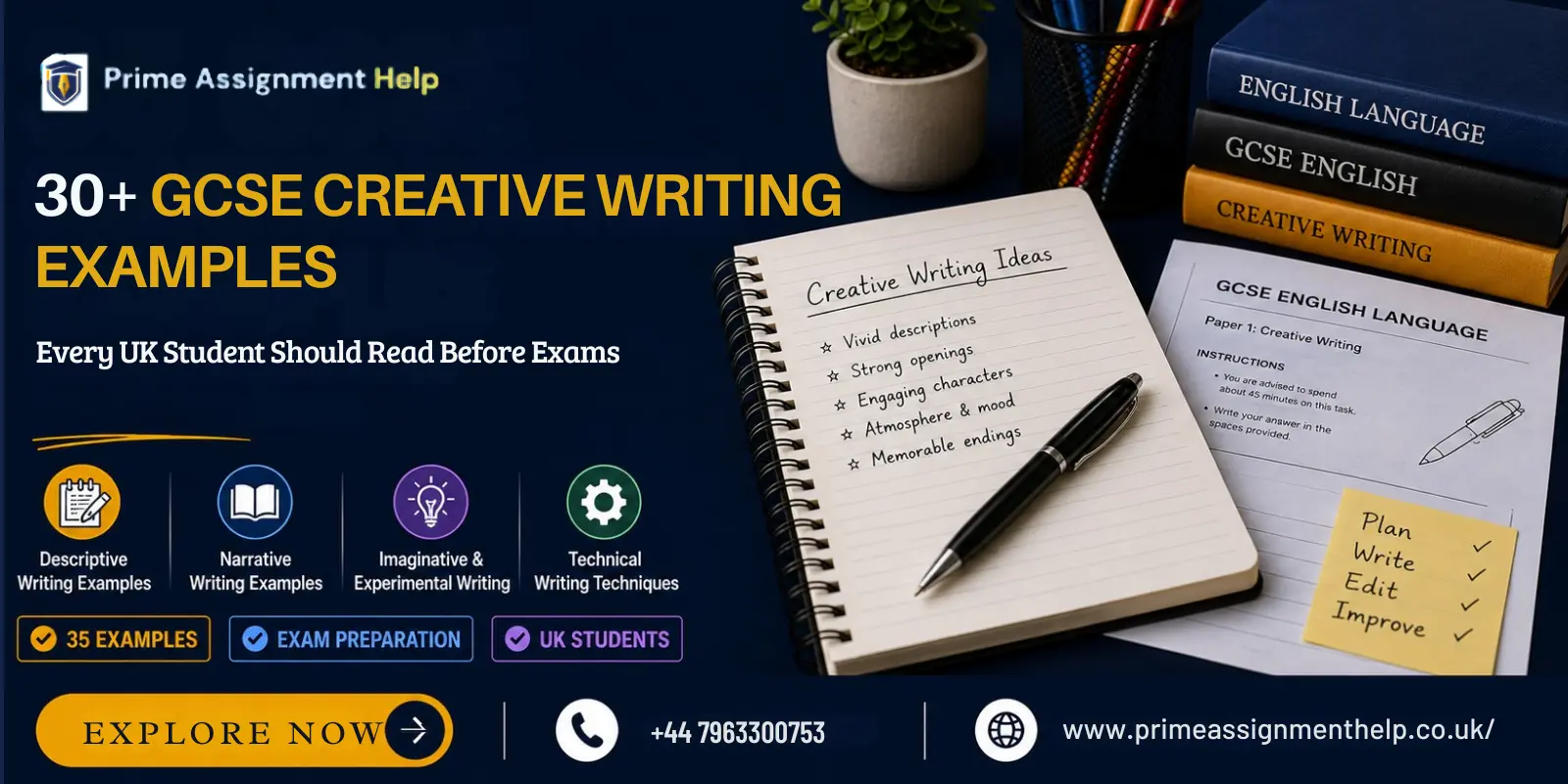
GCSE English Language exams test far more than spelling and grammar, they test a student’s ability to write with purpose, creativity and control. The gap between an average response and a top-band one is rarely about effort; it is about exposure. Students who read widely, study how skilled writers construct sentences, build atmosphere and shape meaning, naturally develop stronger instincts when they sit down to write under timed conditions. Yet most revision guides focus on rules and mark schemes rather than showing students what genuinely impressive writing looks like in practice. Reading real examples and understanding the choices behind them is what truly prepares a student for exam day. This guide brings together 35 essential GCSE creative writing examples covering descriptive, narrative, imaginative and technical writing so that every UK student can walk into their exam with a clear understanding of what outstanding writing actually looks like.
What Is GCSE Creative Writing?
GCSE Creative Writing is a section of the GCSE English Language exam that tests a student’s ability to write imaginatively and engage the reader. Students are usually asked to create a descriptive or narrative piece in response to a prompt or image.
Examiners assess how effectively students use language, structure, vocabulary, and punctuation to communicate ideas. High-scoring responses often include vivid descriptions, varied sentence structures and creative techniques such as similes, metaphors and sensory imagery.
Studying GCSE creative writing examples can help students understand what examiners expect and improve their own writing skills before the exam. Regular practice and reading model answers can also help students build confidence, develop creativity and achieve higher marks in GCSE English Language assessments.
30+ GCSE Creative Writing Examples You Must Explore
From descriptive pieces that paint vivid scenes to experimental narratives that break conventional structure, these 35 examples cover every style and technique a GCSE student needs to study before exam day.
1. Descriptive Writing Examples
- A Rainy London Street
- An Abandoned Fairground
- The First Day of Winter
- A Crowded Market in Birmingham
- A Coastal Cliff at Sunrise
- An Empty School at Night
- The Inside of a Hospital Waiting Room
- A Forest in Autumn
- A Traffic Jam on the M6
- A Childhood Bedroom Revisited
2. Narrative Writing Examples
- The Interview
- The Letter She Never Sent
- Last Train Home
- The Neighbour
- New Kid
- The Prize
- Midnight Call
- The Apology
- The Runner
- The Visitor
- The Garden
- Birthday Candles
Must Read: University of York Harvard Referencing - A Complete Guide with Examples in 2026
3. Imaginative and Experimental Examples
- Second Person Narrative
- A Story Told in Text Messages
- Flash Fiction Under 300 Words
- The Unreliable Narrator
- Circular Narrative
- In Medias Res Opening
- Stream of Consciousness
- Multiple Perspectives on One Event
4. Technical Examples to Study for Craft
- Sentence Length Variation in Action Scenes
- Dialogue That Reveals Character Without Stage Directions
- The Extended Metaphor Across a Full Piece
- Opening Lines That Hook
- Endings That Resonate
Each of these 35 examples represents a different skill, structure, or stylistic choice and together they form a complete picture of what examiners look for in outstanding GCSE creative writing.
GCSE Creative Writing Sample Answers You Can Learn From
The following samples show four key styles you may be asked to write in the exam. Each one reflects a high Grade 8 to 9 standard, with a focus on strong language, structure and clear engagement with the reader.
1. Narrative GCSE Creative Writing Example
The letter arrived on a Tuesday, which was strange because Tuesday was the day my mother always said nothing good ever happened. She repeated it so often that it felt like a rule in our house. Yet there it was, thick cream paper, my name written in ink so precise it looked carved into the surface. I turned it over twice before opening it, half expecting it to vanish.
Why it works: The opening creates immediate curiosity and establishes a strong narrative voice. The superstition adds character depth, while the slow reveal builds tension effectively.
2. Descriptive GCSE Creative Writing Example
The market breathed. Stalls released steam into the cold morning air, while vendors called out in overlapping rhythms like a restless choir. The cobblestones beneath her feet were dark and slick. The smell of roasted chestnuts drifted through everything, warm, sweet, slightly burnt, a scent that stayed with her long after she left.
Why it works: The use of sensory language makes the setting vivid and immersive. Personification and metaphor create atmosphere, while emotional connection adds depth.
3. Suspense GCSE Creative Writing Example
The handle did not move. He tried again, slower this time, as though the door might respond. The corridor light flickered behind him and then steadied. He pressed his ear against the wood. Silence. Then, from inside, came the slow sound of a chair scraping across the floor.
Why it works: Short sentences build tension, while sound-based imagery increases suspense. The door feels almost alive, adding to the unease.
4. Character-Based GCSE Creative Writing Example
Mrs Okafor had been waiting for forty-seven years. Not all at once, but in fragments. Waiting for kettles to boil, for letters that never came, for calls that never rang. Today she sat by the window, watching the street without truly seeing it. Her tea had gone cold again.
Why it works: The contrast between a long lifetime and small moments of waiting creates emotional impact. Subtle detail conveys sadness and patience without directly stating it.
These samples highlight how strong writing uses clear structure, precise language and engaging openings.
What Makes a GCSE Creative Writing Example Effective?
Across all four samples, a few key features appear consistently:
- Strong opening line: Each piece immediately grabs the reader’s attention instead of starting slowly.
- Precise vocabulary: Careful word choices like ‘deliberate’, ‘slick’ and ‘exhaled’ create stronger impact than simple words.
- Structural control: Short sentences build tension, while longer ones create atmosphere or reflection.
- Show, don’t tell: Emotions are shown through actions and details rather than directly explained.
These techniques are what make creative writing clear, engaging and high-scoring.
Why Reading Examples Is the Most Underrated Revision Strategy
Grammar revision and mark scheme memorisation have their place, but neither teaches you how to write well. Examiners reward originality, deliberate technique and a strong sense of voice qualities that come from reading, not rote learning. When you study a well-crafted piece and ask yourself why it works, you begin to internalise the decisions behind it. That instinct is what produces confident, controlled writing under pressure.
Think of it this way: a student who has read twenty strong opening lines will instinctively write a better opening than one who has simply memorised the definition of a hook. Exposure builds pattern recognition and pattern recognition under exam pressure is invaluable. The more examples you study actively annotating technique, noticing structure, questioning word choices, the more naturally those same skills appear in your own writing when time is limited and the pressure is real.
How to Use These Examples Effectively
Reading alone will not raise your grade; active engagement will. For each example you study, identify the key technique being used, annotate what makes it effective, and then write your own version using a completely different setting. Timed practice matters too; knowing a technique and executing it under exam pressure are very different skills.
Study examples in small groups, read three descriptive pieces together, spot what they share, then spend fifteen minutes writing your own response to a similar prompt. This builds a personal toolkit of techniques you can reach for naturally when the exam clock is running. Also notice what strong writing avoids: over-explanation, filler phrases and unnecessary drama. The best GCSE responses find something small and make it feel significant.
GCSE Creative Writing Exam Requirements
Requirements vary by exam board, so always check your own specification. For AQA, creative writing is Section B of Paper 1, with one writing question worth 40 marks and 45 minutes recommended.
Across all boards, marks are awarded for communication and organisation, vocabulary and structural choices, and technical accuracy including spelling, punctuation and grammar.
Tips to Improve Your GCSE Creative Writing
These practical tips can help you improve your writing style and achieve higher marks in the exam with more confidence and control.
- Plan before you write: Spend five minutes mapping your structure. A clear arc, even in a short piece, makes a big difference.
- Vary your sentence length: Mix short punchy sentences with longer, flowing ones to control the reader’s pace.
- Use all five senses: Most students default to sight. Smell, sound and touch often make descriptions more memorable.
- Read your work aloud: If it sounds clunky when spoken, it reads clunky on the page. Trust your ear.
- End with intention: A strong final line is as important as a strong opening. Aim for something that lingers.
Consistent practice with these tips can quickly improve both confidence and exam performance.
Common Mistakes to Avoid in GCSE Creative Writing
Many students lose easy marks by repeating simple writing mistakes that can be avoided with awareness.
- Overusing adjectives: ‘A dark, stormy, ominous night’ is weaker than ‘the night smelled like rain and old iron.’
- Starting with waking up: It is one of the most common openings examiners see. Start in the middle of action instead.
- Ignoring punctuation for effect: Dashes, ellipses and colons are powerful tools. Use them deliberately, not randomly.
- Writing too much: A tightly written 450 words outscores a rambling 700. Quality matters more than quantity.
Avoiding these common mistakes helps your writing feel sharper, more focused and more examiner-friendly.
Conclusion
Developing strong GCSE creative writing skills takes time, practice and deliberate study of what excellent writing looks like in action. The 35 examples covered in this guide from atmospheric description and short narrative to experimental form and technical craft, give you the full picture of what examiners reward and why. Use them as models to learn from, not templates to copy. Read actively, write regularly and approach your exam with a clear understanding of the choices great writers make.
For students who need additional structured support with their GCSE preparation or wider academic writing, Prime Assignment Help is a trusted source of assignment help in uk, providing expert guidance tailored to UK students and helping you build the skills and confidence to perform at your best when it counts.
Read More: Vancouver Referencing - A Quick Guide with Examples for Students
Read More: 70+ GCSE English Speech Topics for 2026 That Will Actually Get You Top Marks
Written by Prime Team
Practical resources to help you plan your studies, develop your writing and approach coursework with confidence.