

Offer Ticker Bar
OFFER
Special Offer For You - 40% OFF On Every Order Special Offer For You - 40% OFF On Every Order Special Offer For You - 40% OFF On Every Order Special Offer For You - 40% OFF On Every Order Special Offer For You - 40% OFF On Every Order Special Offer For You - 40% OFF On Every Order Special Offer For You - 40% OFF On Every Order Special Offer For You - 40% OFF On Every Order
UK Education Grading System
Blog

UK Education Grading System Explained: Grades, Classifications & Percentages

UK Education Grading System Explained: Grades, Classifications & Percentages

UK Education Grading System

Understanding the UK education grading system can often be confusing, particularly for international students unfamiliar with how universities in Britain assess academic performance. Unlike many other countries where scoring above 90% is common, the grading system in UK universities follows a stricter academic framework focused on critical thinking, originality and analytical depth.

Whether you are applying to a British university or are currently studying there, understanding the university grading system UK uses is essential for interpreting your academic performance correctly. This guide explains the UK grading scale, degree classifications and percentage ranges to help students better understand how marks are awarded.

What Is the UK Education Grading System?

The UK education grading system is a structured method used by universities to assess students’ academic performance through percentages and degree classifications.

Unlike straightforward percentage systems used elsewhere, the UK grading system explained here reflects not only your numerical score but also the quality of your analysis, argument development, research depth and academic writing standards.

Most universities assess students through:

UK Undergraduate Degree Classifications

The undergraduate grading system UK follows a classification-based approach. Final marks are converted into degree classes, which indicate your academic achievement.

UK Undergraduate Grading Scale

Percentage Range Degree Classification Performance Level
70% and above First-Class Honours (1st) Excellent
60% – 69% Upper Second-Class Honours (2:1) Very Good
50% – 59% Lower Second-Class Honours (2:2) Good
40% – 49% Third-Class Honours Satisfactory
Below 40% Fail Unsatisfactory

This UK grading scale is widely recognised across British universities.

What Each Classification Means

First-Class Honours (70%+)

This is the highest academic classification and reflects exceptional understanding, critical analysis and originality.

Upper Second-Class Honours (2:1)

A 2:1 is considered a strong degree and is often required by employers and postgraduate programmes.

Lower Second-Class Honours (2:2)

This indicates competent academic performance and acceptable understanding of the subject.

Third-Class Honours

This is the minimum honours classification awarded.

Masters Grading System UK

The masters grading system UK differs slightly from undergraduate marking criteria.

UK Postgraduate Grading Table

Percentage Range Classification
70% and above Distinction
60% – 69% Merit
50% – 59% Pass
Below 50% Fail

Postgraduate marking focuses heavily on:

  • Independent research
  • Advanced analysis
  • Academic argumentation
  • Critical evaluation

Achieving distinction demonstrates outstanding academic performance at master’s level.
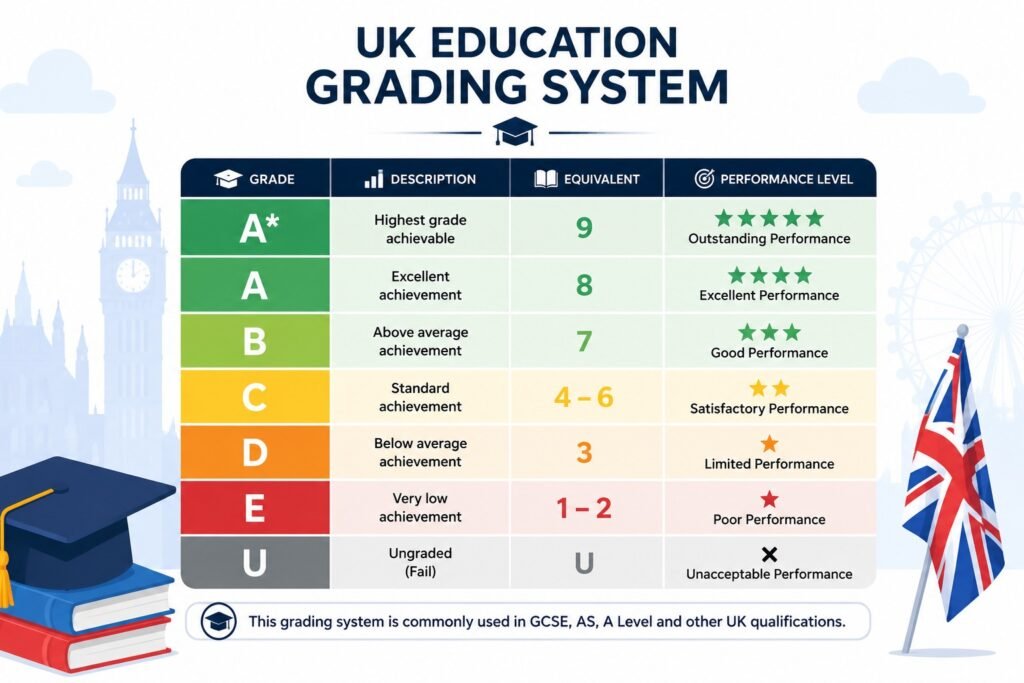
uk grading system
Why Is 70% Considered Excellent in the UK?

Many international students are surprised to learn that 70% is considered outstanding in the grading system in UK universities.

This is because UK institutions apply strict marking criteria. Marks are awarded based on:

  • Depth of critical analysis
  • Quality of evidence
  • Academic structure
  • Independent thinking
  • Original contribution

In the UK education grading system, scoring above 80% is relatively rare and usually reflects exceptional academic work.

UK Grades Percentage Explained

Understanding UK grades percentage helps students interpret their academic results accurately.

Percentage Performance Guide

Percentage Academic Interpretation
80%+ Exceptional / Rare
70–79% Outstanding
60–69% Strong Performance
50–59% Competent
40–49% Basic Pass
Below 40% Fail

This system demonstrates why achieving even 65% is often considered a very good result in British universities.

What Does 2:1 Mean in the UK?

One of the most common terms in the UK grading system explained is “2:1”.

A 2:1 degree refers to an Upper Second-Class Honours classification, awarded for marks between 60% and 69%.

It is highly valued because:

  • Many graduate employers require it
  • It is often needed for postgraduate admission
  • It reflects strong academic competence

For most students, achieving a 2:1 is considered a significant academic success.

How UK Universities Calculate Final Grades

The university grading system UK universities use typically calculates final grades based on weighted assessments.

These may include:

  • Coursework assignments (30–50%)
  • Examinations (30–50%)
  • Dissertation/project work (20–40%)

Some universities place greater emphasis on final-year modules, which can significantly affect overall UK degree classifications.

UK Grading System Compared to Other Countries

International students often compare the UK education grading system to systems used in other countries.

UK vs GPA Comparison

UK Classification Approximate GPA Equivalent
First-Class 3.7 – 4.0
2:1 3.3 – 3.6
2:2 2.7 – 3.2
Third-Class 2.0 – 2.6

This comparison provides a clearer understanding of where UK grades stand globally.

Tips to Perform Better in the UK Grading System

Success in the undergraduate grading system UK requires more than memorising facts.

To improve your grades:

Focus on Critical Analysis

Universities reward evaluation and discussion over simple description.

Improve Academic Referencing

Proper referencing strengthens academic credibility.

Follow Assessment Guidelines

Always match your work to the marking rubric.

Plan Your Assignments Early

Good time management improves overall quality.

Seek Academic Guidance

Professional support can help clarify complex requirements.

Conclusion

The UK education grading system is designed to measure analytical ability, originality and academic depth rather than simply rewarding high percentages. Understanding the UK grading scale, percentage ranges and UK degree classifications helps students set realistic academic expectations and work towards stronger results.

For students who need expert academic guidance to meet British university standards, seeking reliable assignment help in UK can improve research quality, structure, referencing and overall academic performance. At Prime Assignment Help, students can access professional support tailored to UK university marking criteria.


Sociology Dissertation Topics & Research Ideas
Blog

100+ Sociology Dissertation Topics & Research Ideas for UK Students in 2026

100+ Sociology Dissertation Topics & Research Ideas for UK Students in 2026

Sociology Dissertation Topics & Research Ideas

Sociology remains one of the most engaging and influential academic disciplines, helping researchers understand how societies develop, interact and respond to change. In 2026, sociology research is becoming increasingly important as modern societies continue to experience rapid social, cultural, economic and technological transformations. Issues such as digital communication, social inequality, changing family structures, global migration, cultural diversity, mental health awareness and evolving lifestyles are shaping how people live and connect in contemporary society. These ongoing changes provide sociology students with a wide range of relevant and meaningful areas to explore through academic research.

A sociology dissertation in the UK is more than just a university assignment; it is an opportunity for students to investigate real-world social issues, analyse human behaviour, and contribute valuable insights to academic discussions. It also helps students strengthen their research, analytical, and critical thinking abilities while applying sociological theories to modern social challenges. Selecting the right dissertation topic is one of the most important stages of the research process because it influences the direction, quality and overall success of the dissertation. With the right sociology dissertation topic, students can produce research that is academically strong, socially relevant and intellectually engaging.

What is a Sociology Dissertation?

A sociology dissertation is a detailed academic research project that allows students to study social issues, human behaviour and modern societal changes in depth. It is usually completed during undergraduate or postgraduate studies and requires students to investigate a specific sociology topic using proper research methods, theories and academic analysis.

A sociology dissertation typically includes:

  • Introduction and research objectives
  • Literature review and sociological theories
  • Research methodology and data collection
  • Analysis and discussion of findings
  • Conclusion and recommendations

In 2026, sociology dissertations often focus on modern issues such as social media influence, mental health awareness, digital society, cultural diversity, workplace changes and globalisation.

List of 100+ Sociology Dissertation Topics for 2026

Choosing the right sociology dissertation topic is important for students. In 2026, sociology research focuses on modern issues such as mental health, social media, gender equality, education and cultural change. 

Sociology Research Ideas for Master’s Students

Master’s students are usually expected to conduct more advanced sociology research with stronger theoretical analysis and critical evaluation.

  • Social media algorithms and public opinion formation
  • Workplace discrimination and organisational culture in British companies
  • Digital activism and political participation among youth
  • Mental health stigma in modern British communities
  • Feminism and changing gender roles in urban  society
  • Immigration and multicultural identity formation in Britain
  • Crime perception through British digital news platforms
  • Social isolation in remote working environments
  • Artificial intelligence and employment insecurity in the labour market
  • Consumer culture and social identity construction among British young adults

Easy Sociology Dissertation Topics for Beginners

Many students prefer sociology dissertation topics that are simple to research, easy to structure, and supported by accessible academic sources.

  • Peer pressure among teenagers in schools
  • The effects of smartphones on social interaction among British students
  • Changing family roles in modern society
  • Social impacts of reality television in Britain
  • Friendship and social networking platforms among youth
  • Bullying in schools and colleges
  • Public attitudes towards mental health in Britain
  • The role of sports in social development within communities
  • Social behaviour during online education in universities
  • Effects of social media influencers on British lifestyle choices

Unique Sociology Thesis Topics for Academic Research

Students searching for original sociology dissertation topics can explore emerging social issues connected to technology, online culture and modern British society.

  • The sociology of virtual reality communities
  • Cancel culture and online public shaming in British social media
  • AI-generated content and social trust among audiences
  • Digital dating culture among Generation Z in Britain
  • Meme culture as a form of social communication
  • The sociology of online gaming communities among British youth
  • Climate anxiety among young adults
  • Social behaviour in remote workplaces across Britain
  • Influencer culture and consumer identity in society
  • Ethical concerns surrounding artificial intelligence in Britain

Sociology Topics Related to Education and Learning

Education sociology remains one of the most researched academic areas in the field because it explores how social background, culture and inequality affect learning experiences.

Popular Research Topics

  • Educational inequality among social classes
  • Online learning and student engagement in British universities
  • Teacher-student relationships in digital classrooms
  • The impact of social background on academic success in Britain
  • Gender differences in educational achievement
  • The influence of parental support on learning outcomes in British schools
  • Social media use among university students
  • Bullying and academic performance in educational institutions
  • Educational reforms and student well-being in Britain
  • Cultural diversity in modern classrooms

Sociology Dissertation Ideas on Gender and Equality

Gender sociology remains highly important due to ongoing discussions about workplace equality, representation and social inclusion.

  • Gender pay gap in workplaces
  • Representation of women in British media industries
  • Masculinity and social expectations in British society
  • Feminism and social change in 2026
  • LGBTQ+ inclusion in educational institutions
  • Gender stereotypes in British social media content
  • Workplace equality and leadership opportunities in Britain
  • Domestic labour division in households
  • Online harassment and gender discrimination in Britain
  • Gender identity and digital communities

Crime and Society Research Topics in Sociology

Crime sociology examines how social inequality, media, poverty and community environments influence crime and public safety.

Research Ideas

  • Cybercrime and digital society
  • Social causes of juvenile delinquency in Britain
  • Media influence on crime perception
  • Poverty and criminal behaviour in British communities
  • Drug abuse and community violence in urban Britain
  • The sociology of prison systems
  • Gang culture among urban youth in Britain
  • Social inequality and crime rates.
  • Rehabilitation and criminal reform policies in Britain
  • Fear of crime in modern cities

Must Read: 130+ Best Accounting Dissertation Topics for UK Students in 2026

Family, Relationships and Social Behaviour Topics

Family sociology explores changing relationships, communication patterns and social expectations within modern British society

  • Divorce rates and changing family values.
  • Parenting styles and child development in British families
  • Social media effects on romantic relationships among youth
  • Marriage attitudes among young adults in Britain
  • Long-distance relationships in the digital age
  • Work-life balance and family wellbeing in Britain
  • Single-parent households and social challenges.
  • The impact of technology on family communication in Britain
  • Domestic violence and social awareness in society
  • Cultural expectations in British family systems

Social Media and Digital Society Dissertation Ideas

Digital sociology has become increasingly important in academic research because social media now influences communication, politics, identity and behaviour.

Trending Topics

  • TikTok culture and youth identity in Britain
  • Instagram and body image issues among students
  • Social media addiction among British teenagers
  • Online communities and social belonging.
  • Digital communication and loneliness among young adults
  • Fake news and public trust in the British media
  • Influencer marketing and consumer behaviour in Britain
  • Political debates on social media platforms
  • Privacy concerns in British digital society
  • Social media activism and social change.

Mental Health and Society Research Topics

Mental health sociology continues to grow in importance across the globe due to increasing awareness surrounding wellbeing and psychological support.

  • Social anxiety among university students
  • Mental health effects of social media use in Britain
  • Workplace stress and employee wellbeing in organisations
  • Depression and social isolation in British communities
  • Cultural attitudes towards therapy
  • Mental health stigma in conservative British communities
  • Student burnout in higher education
  • Online counselling and psychological support in Britain
  • Economic pressure and mental well-being among adults
  • Community support systems for mental health

Sociology Research Topics on Culture and Identity

Culture and identity remain central areas in sociology because they shape social values, traditions, and belonging within British society.

  • Cultural identity in multicultural communities
  • Language and social belonging in Britain
  • Globalisation and local traditions
  • Fashion trends and identity expression among British youth
  • Music culture among Generation Z in Britain
  • Cultural appropriation debates in the media
  • Religion and cultural identity in British society
  • Ethnic diversity in urban communities
  • National identity in modern Britain
  • Social traditions in the digital age

These sociology dissertation topics help students analyse how globalisation continues to reshape British society, workplaces and cultural experiences in 2026.

Pro Tip: Get expert Dissertation Writing Help in the UK from qualified academic professionals. 

Why Choosing the Right Sociology Topic Matters

Selecting a strong dissertation topic can define the success of your entire research. A well-chosen topic helps you stay motivated throughout the research process, as it aligns with your personal interests and academic curiosity.

Key reasons why topic selection matters:

  • Helps you stay motivated and focused throughout the research journey
  • Makes it easier to access relevant and reliable data for analysis
  • Allows you to build a clear, structured and focused argument
  • Improves the quality and depth of your research findings
  • Enables you to contribute meaningfully to existing sociological studies
  • Helps identify research gaps and new perspectives in society
  • Saves time by avoiding confusion and unnecessary topic changes

A weak or overly broad topic, on the other hand, can make research confusing, unstructured and time-consuming. It often leads to a lack of clarity and direction in your dissertation. That’s why careful and thoughtful topic selection is essential for producing high-quality academic work.

Categories of Sociology Dissertation Topics

Sociology offers a wide range of research areas that help students explore different dimensions of society and human behaviour in a structured and meaningful way. 

  1. Education and Society: Education plays a major role in shaping society. Topics include inequality in education, digital learning systems and student behaviour.
  2. Crime and Deviance: This includes studies on criminal behaviour, cybercrime, youth crime trends and rehabilitation systems.
  3. Gender and Identity Studies: Research in this area explores gender roles, LGBTQ+ rights, feminism and identity formation in modern society.
  4. Family and Social Relationships: Topics focus on changing family structures, divorce rates, parenting styles and intergenerational relationships.
  5. Digital Society and Social Media Impact: This category explores how platforms like Instagram, TikTok and online communities influence human behaviour.

Common Challenges in Sociology Dissertation Writing

Students often face challenges such as:

  • Difficulty in narrowing down topics
  • Lack of reliable data sources
  • Time management issues
  • Complex data analysis
  • Structuring academic arguments

Proper planning can help overcome these obstacles.

Tips to Write a High-Quality Sociology Dissertation

Writing a strong sociology dissertation requires proper planning, detailed research and good academic writing skills. Following the right approach can help students produce well-structured and high-quality research work.

  • Start your dissertation early and follow a proper timeline
  • Choose a topic that is focused, relevant and researchable
  • Use reliable academic journals, books and credible sources
  • Maintain a clear structure throughout the dissertation
  • Keep your research objectives clear and consistent
  • Include recent sociological trends and real-world examples
  • Avoid plagiarism by using proper referencing and citations
  • Analyse theories critically instead of only describing them

Consistency, critical thinking and organised research are the key factors that contribute to a successful sociology dissertation in 2026.

Conclusion

Sociology dissertation topics in 2026 reflect a rapidly changing world. Digital Sociology dissertation topics in 2026 reflect the changing realities of modern British society, including digital transformation, social inequality, cultural diversity, mental health awareness and evolving social relationships. Selecting a focused and researchable topic can help students produce a well-structured and academically valuable dissertation that contributes to both theoretical understanding and real-world social issues.

By using reliable sources, strong research methods and proper planning, students can improve the quality of their academic work and achieve better results in UK universities. If you need professional guidance with topic selection, research structure or dissertation writing, Prime Assignment Help offers trusted academic support and expert assistance for students looking for reliable assignment help in uk universities.

Read more: Interesting Nursing Dissertation Topics & Ideas in 2026

Frequently Asked Questions

Q1. What are the trending sociology research areas in the UK?

Trending sociology research areas in the UK include digital sociology, mental health studies, migration and multiculturalism, gender studies, environmental sociology and social inequality.

Q2. How long should a sociology dissertation be in UK universities?

The length of a sociology dissertation depends on the university and academic level. Undergraduate dissertations are usually between 8,000 and 12,000 words, while master’s dissertations may range from 12,000 to 20,000 words.

Q3. What research methods are commonly used in sociology dissertations?

Common sociology research methods include surveys, interviews, questionnaires, case studies, observations and qualitative or quantitative data analysis.

Q4. Why is sociological research important in modern society?

Sociology research helps understand social behaviour, inequality, cultural change, education systems, mental health and modern social challenges. It also supports policy development and social improvement in the UK.

Q5. What research methods are commonly used in sociology dissertations?

Common sociology research methods include surveys, interviews, questionnaires, case studies, observations and qualitative or quantitative data analysis.

Nursing Dissertation Topics & Ideas
Blog

80+ Nursing Dissertation Topics & Ideas for UK Students in 2026

80+ Nursing Dissertation Topics & Ideas for UK Students in 2026

Nursing Dissertation Topics & Ideas

Nursing is one of the fastest-growing and most respected professions in the UK healthcare industry. In 2026, the nursing field continues to evolve with new healthcare technologies, mental health awareness, patient care innovations, and digital healthcare systems. As a result, nursing students in UK universities are expected to conduct high-quality academic research that contributes to the improvement of modern healthcare.

A nursing dissertation is an important part of academic success because it allows students to explore real healthcare challenges, analyse patient care systems, and provide evidence-based solutions. However, choosing the right dissertation topic is often one of the biggest challenges for students in the UK.

The ideal nursing dissertation topic should be relevant, researchable, practical, and aligned with current healthcare trends. Whether you are interested in mental health nursing, critical care, public health, or healthcare technology, selecting the right topic can make your research process easier and more rewarding.

What is a Nursing Dissertation?

A nursing dissertation is an academic research project completed by nursing students in UK universities. It allows students to explore healthcare issues, analyse nursing practices, and provide evidence-based solutions for improving patient care.

Key features of a nursing dissertation include:

  • Researching real healthcare challenges and nursing practices
  • Analysing patient care systems using academic evidence
  • Developing critical thinking and research skills
  • Exploring modern healthcare topics like mental health, elderly care, and digital healthcare
  • Preparing students for professional careers in the healthcare industry

In 2026, nursing dissertations are becoming more important as healthcare systems continue to evolve with new technologies, patient care methods, and public health challenges.

List of 80+ Nursing Dissertation Topics & Ideas in 2026

Choosing the right nursing dissertation topic is essential for students aiming to conduct meaningful healthcare research and achieve academic success in 2026. From mental health to digital healthcare, nursing research offers many valuable and career-focused dissertation opportunities. 

Mental Health Nursing Dissertation Topics

Mental health nursing has become one of the most important areas of healthcare in recent years.

  • The impact of social media on teenage mental health
  • The role of nurses in suicide prevention
  • Anxiety management techniques in healthcare settings
  • Depression among university students
  • The effectiveness of cognitive behavioural therapy
  • Stress management strategies for nurses
  • Mental health support in rural communities
  • Sleep disorders and mental health conditions

Adult Nursing Dissertation Topics

Adult nursing focuses on caring for adult patients with different healthcare needs.

  • Improving patient communication in adult nursing
  • Chronic disease management strategies
  • The impact of nurse shortages on patient care
  • Diabetes management in adult healthcare
  • Pain management techniques in hospitals
  • Preventing hospital-acquired infections
  • Patient satisfaction in adult healthcare services
  • Post-operative nursing care effectiveness

Pediatric Nursing Dissertation Topics

Pediatric nursing research focuses on improving healthcare services for children and adolescents.

  • Childhood obesity prevention programs
  • The importance of family-centred pediatric care
  • Pain management for children in hospitals
  • Vaccination awareness among parents
  • Autism care support strategies
  • Communication barriers in pediatric nursing
  • Anxiety management among hospitalised children
  • Neonatal intensive care nursing practices

Critical Care Nursing Topics

Critical care nurses work in high-pressure healthcare environments that require quick decision-making and advanced clinical skills.

  • Stress management among ICU nurses
  • Infection control in intensive care units
  • Burnout among critical care nurses
  • Ethical challenges in critical care settings
  • End-of-life care in ICU environments
  • Family involvement in critical patient care
  • Ventilator-associated pneumonia prevention
  • Emergency response strategies in intensive care

Community Health Nursing Ideas

Community nursing focuses on preventive healthcare and improving public health services.

  • Healthcare access in rural communities
  • Community vaccination campaigns
  • Public awareness of infectious diseases
  • Nutrition education programs
  • Maternal healthcare support in communities
  • Community mental health awareness programs
  • Preventing lifestyle-related diseases
  • Health education for low-income families

Public Health Nursing Dissertation Topics

Public health nursing aims to improve healthcare outcomes for large populations.

  • Smoking cessation public health campaigns
  • Public health strategies during disease outbreaks
  • Obesity prevention programs in schools
  • Public awareness of mental health services
  • Nurses’ role in disease prevention
  • Healthcare accessibility challenges
  • Sexual health education effectiveness
  • Public healthcare policies and patient outcomes

Nursing Leadership and Management Topics

Leadership and management play a major role in healthcare quality and organisational success.

  • Leadership styles and nurse performance
  • Reducing nurse burnout in hospitals
  • Communication in nursing leadership
  • Nurse retention strategies
  • Conflict management in healthcare teams
  • The impact of workplace culture on healthcare quality
  • Staff motivation strategies in hospitals
  • Leadership challenges during healthcare emergencies

Evidence-Based Nursing Research Topics

Evidence-based practice helps improve patient care through scientific research.

  • Evidence-based approaches to patient safety
  • Medication administration safety improvement
  • Hand hygiene effectiveness in hospitals
  • Reducing patient readmission rates
  • Barriers to evidence-based nursing practice
  • Scientific research in modern nursing care
  • Evidence-based pain management strategies
  • Improving clinical nursing procedures

Must Read: 50+ Politics Dissertation Topics for Students in 2026

Nursing Education Dissertation Ideas

Nursing education research focuses on preparing future healthcare professionals.

  • Online learning in nursing education
  • Clinical placement challenges for nursing students
  • Academic stress among nursing students
  • Simulation-based nursing training
  • Technology integration in nursing classrooms
  • Communication skills in nursing education
  • Student experiences during clinical training
  • Virtual learning in healthcare education

Digital Healthcare and Nursing Technology Topics

Technology continues to transform modern healthcare systems.

  • Artificial intelligence in nursing care
  • Telehealth effectiveness in patient care
  • Electronic health records and patient safety
  • Mobile healthcare applications in nursing
  • Cybersecurity challenges in digital healthcare
  • Wearable patient monitoring devices
  • Technology adoption in hospitals
  • Healthcare automation and nursing practice

Elderly Care and Geriatric Nursing Topics

The ageing population has increased the demand for elderly healthcare services.

  • Dementia care strategies in nursing homes
  • Fall prevention methods for elderly patients
  • Loneliness and mental health in older adults
  • Medication management in elderly care
  • Palliative care for older patients
  • Alzheimer’s patient support strategies
  • Family involvement in geriatric care
  • Improving quality of life in nursing homes

Midwifery and Maternal Healthcare Topics

Maternal healthcare remains an important research area in nursing.

  • Prenatal care provided by midwives
  • Maternal mental health after childbirth
  • Breastfeeding support strategies
  • Pregnancy complications and nursing care
  • Antenatal education programs
  • Postnatal depression management
  • Cultural influences on maternal healthcare
  • Reducing maternal mortality through education

Emergency and Trauma Nursing Research Topics

Emergency nursing focuses on rapid patient assessment and trauma care.

  • Emergency room overcrowding challenges
  • Trauma care management techniques
  • Stress management for emergency nurses
  • Patient triage systems in hospitals
  • Communication during trauma care
  • Emergency healthcare during natural disasters
  • Critical injury management strategies
  • Nurses’ role during pandemics

Oncology Nursing Dissertation Topics

Oncology nursing focuses on supporting cancer patients during treatment and recovery.

  • Emotional support for cancer patients
  • Pain management in oncology nursing
  • The role of nurses in chemotherapy care
  • Palliative care approaches for cancer patients
  • Psychological effects of cancer diagnosis
  • Family support during cancer treatment
  • Improving the quality of life for cancer patients
  • Managing chemotherapy side effects

These nursing dissertation topics in 2026 help students explore healthcare challenges, improve research quality, and create strong academic dissertations for modern nursing practice. 

Why Choosing the Right Nursing Dissertation Topic Matters

Your dissertation topic plays a major role in determining the quality of your research and overall academic performance. A strong topic helps you stay motivated throughout the writing process and allows you to conduct meaningful research.

Choosing the right nursing dissertation topic is important because it:

  • Helps maintain interest during long research periods
  • Improves the quality of analysis and discussion
  • Provides practical value to healthcare professionals
  • Increases the chances of scoring better grades
  • Builds specialised knowledge in a nursing field
  • Supports future career opportunities in healthcare

A weak or overly broad topic can make research difficult, time-consuming, and stressful. Therefore, students should spend enough time carefully selecting their dissertation subject.

How to Select a Strong Nursing Dissertation Topic in 2026

Selecting a nursing dissertation topic may seem difficult at first, but following a few simple steps can make the process easier.

Choose an Area That Interests You

Start by identifying the nursing field you enjoy the most. This could include:

  • Mental health nursing
  • Pediatric nursing
  • Adult healthcare
  • Emergency care
  • Public health
  • Elderly care
  • Critical care nursing

Research becomes much easier when you are genuinely interested in the subject.

Focus on Current Healthcare Issues

Modern healthcare challenges provide excellent dissertation opportunities. Topics related to telemedicine, nurse burnout, artificial intelligence, patient safety, and healthcare accessibility are highly relevant in 2026.

Keep the Topic Specific

Avoid selecting topics that are too broad. For example, instead of researching mental health, focus on a narrower subject like “The impact of social media on adolescent mental health.

Check Research Availability

Before finalising your topic, ensure that enough academic journals, healthcare reports, and research materials are available.

Consider Time and Resources

Choose a realistic topic that matches your available time, research skills, and access to participants or healthcare data.

Latest Trends in Nursing Research for 2026

Healthcare is continuously changing, and nursing research trends reflect these developments. Understanding current healthcare trends can help students choose modern and valuable dissertation topics.

Some major nursing research trends in 2026 include:

  • Artificial intelligence in healthcare
  • Telehealth and virtual patient care
  • Mental health support systems
  • Patient-centred healthcare models
  • Elderly and dementia care
  • Infection prevention strategies
  • Healthcare inequality research
  • Digital patient monitoring
  • Nursing staff burnout management
  • Community healthcare improvement

These areas provide excellent opportunities for nursing students to conduct meaningful and innovative research.

Pro Tip: Professional dissertation writing help saves time, improves research quality, and reduces stress. 

Common Mistakes Students Make When Choosing Nursing Dissertation Topics

Many nursing students make avoidable mistakes while choosing dissertation topics. These mistakes can affect research quality, increase stress, and make dissertation writing more difficult. Understanding these common issues helps students select better topics and complete their research more successfully. 

Choosing Topics That Are Too Broad

Broad or general topics make research difficult because students must cover too much information within a limited time and word count. Choosing a focused healthcare issue helps improve research quality and analysis.

Ignoring Existing Research

Some students select topics without checking available academic sources. Limited journals, books, or healthcare reports can create research difficulties later. Reviewing existing literature helps ensure enough reliable information is available.

Selecting Overly Difficult Topics

Highly technical or complicated topics can make dissertation research stressful and time-consuming. Students should choose manageable topics that match their academic skills, knowledge, and available research resources.

Poor Time Management

Delaying topic selection, research, or writing often leads to rushed work and weak academic performance. Starting early and following a proper schedule helps students complete dissertations more effectively.

Choosing a Topic Without Interest

Selecting a topic without personal interest can reduce motivation and make research stressful. Choosing a healthcare subject you genuinely enjoy often improves research quality and dissertation performance.

Avoiding these common mistakes can help students choose stronger nursing dissertation topics and complete high-quality research successfully. 

Tips for Writing a High-Quality Nursing Dissertation

Writing a high-quality nursing dissertation requires proper planning, research accuracy, and strong academic writing skills.

  1. Create a Clear Research Plan: Divide your dissertation into smaller tasks and set realistic deadlines for each research stage. Proper planning helps students manage time effectively and reduce unnecessary academic pressure during writing.
  2. Use Credible Academic Sources: Use peer-reviewed journals, healthcare databases, and reliable medical reports for accurate dissertation research. Strong academic sources improve research credibility and help support arguments with reliable healthcare evidence.
  3. Follow Proper Referencing: Always use the required referencing style, such as APA, Harvard, or MLA, correctly throughout. Proper referencing avoids plagiarism issues and improves the professional quality of academic dissertations significantly.
  4. Proofread Carefully: Check grammar, structure, formatting, and spelling carefully before submitting your nursing dissertation. Careful proofreading helps remove writing mistakes and improves the overall readability and presentation quality.
  5. Seek Regular Feedback: Supervisor feedback can improve research quality and help identify mistakes during dissertation writing early. Regular academic guidance helps students strengthen arguments and improve overall dissertation performance successfully.

Following these dissertation writing tips can improve research quality and academic performance.

Final Thoughts

Choosing the right nursing dissertation topic in 2026 can strongly impact your academic success and future healthcare career. Modern nursing research includes important areas such as mental health, digital healthcare, public health, elderly care, and evidence-based nursing practice. Selecting a focused and meaningful topic helps students conduct valuable research that improves patient care and healthcare services.

Whether you are interested in community nursing, healthcare leadership, or modern medical technology, these dissertation ideas can help you start your research journey with confidence. If you need professional academic guidance, Prime Assignment Help offers reliable assignment help in uk for students seeking expert support with nursing dissertations, research writing, and academic projects.

Read more: 200+ Business Management Dissertation Topics (2026)

Frequently Asked Questions 

Q1. What is the best nursing dissertation topic in 2026?

Popular nursing dissertation topics in 2026 include mental health nursing, digital healthcare technology, patient safety, telemedicine, and elderly care.

Q2. How do I choose a nursing dissertation topic?

Choose a topic that is specific, researchable, relevant to current healthcare trends, and aligned with your personal interests.

Q3. Are nursing dissertations difficult?

Nursing dissertations can be challenging, but selecting a focused topic and following a clear research plan can make the process much easier.

Q.4. Which nursing field offers the most research opportunities?

Mental health nursing, critical care, healthcare technology, and public health currently offer strong research opportunities.

Q5. Can I use modern healthcare issues in my dissertation?

Yes, using current healthcare challenges can strengthen the relevance and academic value of your nursing dissertation.

business management dissertation topics
Blog

200+ Business Management Dissertation Topics in the UK (2026)

200+ Business Management Dissertation Topics in the UK (2026)

business management dissertation topics

Business management is a dynamic academic field that covers key areas such as leadership, strategy, finance, marketing and innovation. As businesses continue to evolve in response to digital transformation and global market changes, selecting the right business management dissertation topics has become essential for producing high-quality academic research.

Choosing a strong dissertation topic allows students to explore current business challenges, apply relevant theories and present practical solutions through detailed analysis. A well-structured dissertation in business management demonstrates critical thinking, research skills and subject knowledge that can support both academic success and future career opportunities.

This guide presents 200+ business management dissertation topics for 2026 to help students find relevant and research-focused ideas for their thesis business management project. For expert academic assistance, Prime Assignment UK offers reliable dissertation writing services in the UK to support students with topic selection, research and complete dissertation writing.

What is a Business Management Dissertation?

A business management dissertation is an independent research project that explores a specific management issue, theory, or challenge within an organisation or industry.

It allows students to:

  • Demonstrate analytical and critical thinking skills
  • Apply theoretical concepts to real-world business problems
  • Conduct independent research
  • Present evidence-based recommendations


A dissertation in business management differs from essays and reports because it requires original analysis, detailed research methodology and in-depth findings. For students who need academic assistance, professional
essay help in the UK from Prime Assignment UK can provide expert guidance for essays, reports and dissertations to support better academic performance.

Explore 200+ Trending Business Management Dissertation Topics

Discover the latest business management dissertation ideas across leadership, marketing, human resources, strategy, and operations to help you choose the perfect research topic for academic success.

Artificial Intelligence in Decision-Making

  1. The role of AI in strategic business decisions
  2. AI-driven forecasting in retail management
  3. Predictive analytics in corporate planning
  4. AI and risk assessment in organisations
  5. Machine learning in operational efficiency
  6. AI adoption barriers in SMEs
  7. AI-based performance evaluation systems
  8. Ethical challenges of AI in management
  9. AI in customer relationship management
  10. AI’s impact on executive leadership

Automation and Workforce Transformation

  1. Robotic process automation in business efficiency
  2. Automation and employee productivity
  3. Workforce displacement due to automation
  4. Automation in HR recruitment processes
  5. Digital transformation in manufacturing firms
  6. Automation and organisational restructuring
  7. Automation in service-based industries
  8. Employee adaptation to digital transformation
  9. Automation’s impact on management roles
  10. Smart business systems and operational control

Cybersecurity and Data Governance

  1. Cybersecurity strategy in modern businesses
  2. Data governance frameworks for organisations
  3. GDPR compliance and business management
  4. Cyber risk management strategies
  5. Data privacy and customer trust
  6. Blockchain for business security
  7. Cybersecurity challenges for SMEs
  8. Digital ethics in business operations
  9. Managing cyber threats in e-commerce
  10. Strategic information security management

International & Global Business Dissertation Topics

Globalisation continues to influence business expansion.

  1. Global trade strategies post-Brexit
  2. Foreign direct investment in emerging markets
  3. Cross-cultural management challenges
  4. Global supply chain resilience
  5. International expansion strategies for SMEs
  6. Managing multinational teams
  7. Exchange rate fluctuations and business performance
  8. International market entry strategies
  9. Global branding strategies
  10. Cross-border e-commerce growth
  11. International HRM practices
  12. Political risks in global business
  13. Globalisation and competitive advantage
  14. Export strategies for UK businesses
  15. Managing international partnerships
  16. International crisis management
  17. Global logistics challenges
  18. Cultural intelligence in leadership
  19. Global market diversification strategies
  20. International business sustainability practices

Sustainability & Green Management Dissertation Topics

Sustainability has become central to modern organisations.

  1. ESG strategies in UK businesses
  2. Circular economy implementation
  3. Green supply chain management
  4. Sustainable procurement practices
  5. Net-zero business strategies
  6. Corporate sustainability reporting
  7. Green innovation and profitability
  8. Sustainable HRM practices
  9. Environmental responsibility and brand image
  10. Renewable energy management strategies
  11. Consumer response to green branding
  12. Sustainability in retail management
  13. Green business transformation
  14. Carbon reduction initiatives
  15. Sustainable leadership models
  16. CSR and business reputation
  17. Eco-friendly product development
  18. Waste reduction in manufacturing
  19. Sustainability and investor confidence
  20. Ethical sourcing practices

Human Resource Management Dissertation Topics

Human resource management remains a vital research area.

  1. Hybrid work and employee performance
  2. Remote team engagement strategies
  3. Employee retention among Gen Z
  4. Flexible working policies and productivity
  5. Diversity and inclusion in organisations
  6. Gender equality in leadership
  7. HR analytics in recruitment
  8. Talent management in competitive industries
  9. Employee wellbeing strategies
  10. Organisational culture and staff retention
  11. Leadership development programmes
  12. HR digital transformation
  13. Employee motivation strategies
  14. Performance appraisal systems
  15. Workplace conflict management
  16. Employee training effectiveness
  17. Employer branding and recruitment
  18. Work-life balance policies
  19. Psychological safety at work
  20. Employee satisfaction and performance

Business Strategy & Innovation Dissertation Topics

Innovation drives competitive advantage.

  1. Disruptive innovation in start-ups
  2. Strategic agility in modern organisations
  3. Competitive strategy in digital markets
  4. Innovation management frameworks
  5. Business model transformation
  6. Strategic planning effectiveness
  7. Mergers and acquisitions strategies
  8. Growth strategies for SMEs
  9. Corporate innovation culture
  10. Strategic alliances and partnerships
  11. Blue ocean strategy applications
  12. Innovation in family businesses
  13. Strategic risk management
  14. Digital innovation in retail
  15. Market disruption analysis
  16. Strategic resilience after crises
  17. Innovation and business scalability
  18. Competitive advantage through technology
  19. Strategic change management
  20. Innovation investment outcomes

Marketing & Consumer Behaviour Dissertation Topics

Marketing trends continue to evolve rapidly.

  1. Social media marketing effectiveness
  2. Influencer marketing and consumer trust
  3. Consumer behaviour in online shopping
  4. Personalisation in e-commerce
  5. Digital advertising performance
  6. Ethical consumer purchasing decisions
  7. Green consumer behaviour
  8. Brand loyalty in competitive markets
  9. Customer experience management
  10. Consumer psychology in pricing strategies
  11. Viral marketing campaigns
  12. Mobile marketing effectiveness
  13. Consumer trust in online reviews
  14. Digital branding strategies
  15. Customer retention strategies
  16. Emotional branding impact
  17. Neuromarketing applications
  18. Consumer behaviour after economic crises
  19. Luxury brand marketing
  20. Social commerce growth trends

Leadership & Organisational Behaviour Dissertation Topics

Leadership influences organisational performance.

  1. Transformational leadership effectiveness
  2. Transactional leadership outcomes
  3. Leadership styles and employee engagement
  4. Organisational culture and productivity
  5. Change management strategies
  6. Crisis leadership effectiveness
  7. Leadership communication styles
  8. Ethical leadership practices
  9. Emotional intelligence in leadership
  10. Decision-making in management
  11. Leadership during digital transformation
  12. Team dynamics and organisational success
  13. Conflict resolution leadership approaches
  14. Organisational resistance to change
  15. Employee empowerment strategies
  16. Leadership in remote work environments
  17. Organisational commitment drivers
  18. Leadership development frameworks
  19. Innovation-oriented leadership
  20. Collaborative leadership models


Read more:
50+ Politics Dissertation Topics for Students in 2026

Accounting, Finance & Corporate Governance Dissertation Topics

Financial management is essential in business success.

  1. Fintech innovation and financial management
  2. Blockchain in corporate finance
  3. Financial risk management strategies
  4. Corporate governance effectiveness
  5. Ethical financial decision-making
  6. Board diversity and business performance
  7. Financial planning in SMEs
  8. Corporate fraud prevention
  9. Cryptocurrency adoption in business
  10. ESG and investment performance
  11. Capital structure decisions
  12. Financial crisis management
  13. Audit quality and governance
  14. Dividend policy analysis
  15. Financial sustainability models
  16. Digital banking transformation
  17. Financial transparency practices
  18. Investor confidence factors
  19. Governance and organisational ethics
  20. Financial forecasting strategies

Entrepreneurship & Start-up Dissertation Topics

Entrepreneurship remains highly relevant for 2026.

  1. Social entrepreneurship models
  2. Women-led start-up challenges
  3. Venture capital funding strategies
  4. Bootstrapping versus external investment
  5. Start-up scaling challenges
  6. Entrepreneurial leadership styles
  7. Innovation in start-ups
  8. Digital entrepreneurship opportunities
  9. Entrepreneurial resilience
  10. Business incubation effectiveness
  11. Start-up failure analysis
  12. Entrepreneurial ecosystems
  13. Funding gaps in start-ups
  14. SME innovation strategies
  15. Entrepreneurial networking
  16. Lean start-up methodology
  17. Start-up market entry strategies
  18. Investor decision-making
  19. Sustainable entrepreneurship
  20. Technology-driven entrepreneurship

Industry-Specific Dissertation Topics

Healthcare and Pharmaceutical Management

  1. Healthcare operational efficiency
  2. Pharmaceutical supply chain management
  3. Digital health transformation
  4. Leadership in healthcare organisations

Retail and E-commerce

  1. Omnichannel retail strategies
  2. Inventory optimisation in retail
  3. Consumer behaviour in e-commerce

FinTech and EdTech

  1. FinTech disruption in traditional banking
  2. EdTech innovation management

Hospitality and Tourism

  1. Crisis management in hospitality
  2. Customer experience in tourism businesses
  3. Sustainability in hotel management
  4. Digital transformation in hospitality

Operations & Project Management Dissertation Topics

  1. Agile project management effectiveness
  2. Lean management in business operations
  3. Six Sigma implementation outcomes
  4. Supply chain optimisation strategies
  5. Risk management in projects
  6. Crisis response planning
  7. Logistics performance improvement

How to Write Your Dissertation

A successful thesis business management project typically includes:

Structure

  • Introduction
  • Literature Review
  • Research Methodology
  • Data Analysis
  • Findings
  • Discussion
  • Conclusion and Recommendations

Research Methodology

Choose between:

  • Qualitative research
  • Quantitative research
  • Mixed methods

Literature Review Tips

  • Use current academic journals
  • Compare multiple viewpoints
  • Identify research gaps
  • Build strong theoretical foundations

Conclusion

Choosing the right business management dissertation topics is a crucial step towards academic success and achieving higher grades. A well-selected topic helps you build a strong, research-focused dissertation in business management that reflects current industry trends and demonstrates critical analytical skills. The dissertation topics in business management listed above are designed to help students explore relevant and engaging research areas for 2026.

If you need expert guidance with topic selection, research, writing, or editing, professional business management assignment help in the UK can make the process easier and more effective. At Prime Assignment UK, students can access reliable academic support for every stage of their thesis business management project. With expert assistance, you can confidently create a well-structured dissertation that meets university standards and helps you achieve academic excellence.

Frequently Asked Questions

How long should a business management dissertation be?

The length of a business management dissertation usually depends on your academic level and university requirements. Most UK universities require between 8,000 and 15,000 words. At Prime Assignment, we help students structure their dissertations according to university guidelines.

Can I change my business management dissertation topic after approval?

Yes, in many cases you can change your topic after approval, but this normally requires permission from your supervisor. It is always best to discuss any changes early to avoid delays in completing your dissertation.

How do I choose the best business management dissertation topic?

Choose a topic that matches your academic interests, aligns with current industry trends and offers enough reliable research material. Selecting relevant business management dissertation topics can improve the quality of your research and final grade.

Can I get help with urgent business management dissertation deadlines?

Yes, Prime Assignment offers timely academic assistance for urgent dissertation submissions while maintaining high-quality academic standards.

google scholar research topics
Blog

100+ Trending Google Scholar Research Topics for Students in 2026

100+ Trending Google Scholar Research Topics for Students in 2026

google scholar research topics

Google scholar research topics are a great starting point when UK students need fresh, credible and academically suitable ideas for essays, reports, dissertations or research papers.
Choosing the right google scholar research topics can save hours of confusion and help students build stronger arguments from reliable sources.

For many students in the UK, the hardest part is not always writing the assignment. It is deciding what to write about. Google Scholar helps because it gives access to academic books, journal papers, conference papers, case studies and google scholar research articles from different subject areas. It is especially useful when students want current debates, recent evidence and topic ideas that feel suitable for university-level work.

Why Choosing the Right Research Topic Matters

A good topic makes the whole research process easier. A weak topic usually creates problems later, such as limited sources, unclear arguments, poor structure and repetitive writing.

UK universities expect students to show independent thinking, academic reading and clear analysis. That is why topic selection matters so much. A strong topic should be specific, researchable and connected to current academic discussion.

For example, “marketing” is too broad. “The impact of AI chatbots on customer trust in UK online retail” is much better. It gives the student a clear focus, a target audience and a modern issue to explore.

How Students Use Google Scholar for Academic Research

Students use Google Scholar to find reliable sources for coursework, dissertations, essays and reports. It helps students discover google scholar research articles, identify key authors, check citation counts and understand how academic debates are developing.

Students can also use it to find a google scholar research paper related to their subject before finalising their own topic. This helps them avoid choosing an idea that is too vague or already overused.

For students who struggle with research writing, Google Scholar can also show how academic arguments are structured. Reading abstracts, introductions and literature reviews can make it easier to understand academic tone and evidence-based writing.

research topics

How to Find Trending Research Topics on Google Scholar

To find trending google scholar research topics, students should search using specific terms instead of broad phrases. For example, instead of typing “business research”, search “AI in UK small business management 2026” or “sustainable finance in UK universities”.

A simple method is:

  • Search your subject area
  • Add a current issue such as AI, sustainability, mental health, remote work or digital learning
  • Check recent papers from 2022–2026
  • Read abstracts and keywords
  • Note repeated themes
  • Turn those themes into your own research question

This method works well for dissertation ideas, essays and google scholar research proposal topics.

Tips for Selecting a Strong Research Topic

A strong topic should not only sound impressive. It should be practical enough to complete within your deadline.

  • Before choosing, ask yourself:
  • Can I find enough academic sources?
  • Is the topic relevant to my course?
  • Can I narrow it down to one clear question?
  • Does it connect to UK examples or data?
  • Can I explain why the topic matters?

Students looking for dissertation writing help, essay writing assistance, thesis writing help or research paper writing help should still understand their topic properly. Support can guide the structure, but the topic must match the student’s module and university brief.

100+ Fresh Google Scholar Research Topics for UK Students in 2026

Below are subject-wise google scholar research topics designed for UK students. These topics are suitable for essays, reports, dissertations, proposals and academic projects.

Business and Management Research Topics

These google scholar research topics in business focus on modern workplace issues, leadership, technology and UK business growth.

  1. How is generative AI changing the future of marketing?
  2. Remote work and employee productivity in UK organisations
  3. Central bank digital currencies, opportunity or threat?
  4. The role of emotional intelligence in modern management
  5. Sustainable supply chains, can fashion ever be truly ethical?
  6. Employee motivation in post-pandemic workplaces
  7. The impact of digital transformation on small businesses
  8. Crisis management strategies in UK retail businesses
  9. The role of data analytics in business decision-making
  10. Diversity and inclusion in UK corporate leadership
  11. The impact of automation on human resource management
  12. Consumer trust in ethically managed businesses
  13. ESG investing genuine commitment or corporate greenwashing?
  14. The role of innovation in business competitiveness
  15. Employee retention strategies in the UK service sector

Nursing and Healthcare Research Topics

These google scholar nursing research topics are useful for nursing students, healthcare management students and public health learners.

  1. The impact of nurse burnout on patient care quality
  2. Mental health support for NHS nurses
  3. The role of technology in improving patient safety
  4. Patient communication challenges in UK hospitals
  5. The impact of staff shortages on NHS service delivery
  6. Impact of telemedicine on patient outcomes in rural areas
  7. The role of telemedicine in rural healthcare access
  8. Infection control practices in UK healthcare settings
  9. The impact of long waiting times on patient satisfaction
  10. Health inequalities among ethnic minority communities in the UK
  11. The role of gut microbiome in managing chronic illness
  12. How mRNA vaccine technology is being applied beyond COVID-19
  13. The impact of artificial intelligence in healthcare diagnosis
  14. Workplace stress among nursing students
  15. Antimicrobial resistance are we heading towards a post-antibiotic era?

Psychology Research Topics

  1. Social media use and anxiety among UK university students
  2. The impact of academic stress on student wellbeing
  3. Sleep quality and concentration among undergraduate students
  4. The psychology of online shopping behaviour
  5. Loneliness among international students in the UK
  6. The impact of childhood trauma on adult relationships
  7. Emotional resilience among university students
  8. The role of mindfulness in reducing stress
  9. Body image concerns among young adults
  10. The impact of part-time work on student mental health

Education Research Topics

  1. The impact of online learning on UK university students
  2. AI tools and academic performance in higher education
  3. The role of feedback in student improvement
  4. Digital learning challenges in UK universities
  5. Inclusive education for students with learning difficulties
  6. The effect of tuition fees on student motivation
  7. Student engagement in blended learning environments
  8. The impact of teacher support on academic confidence
  9. Assessment methods and student stress
  10. The role of technology in classroom learning

Law Research Topics

  1. AI liability when algorithms cause damage, who pays?
  2. Data protection challenges under UK GDPR
  3. Human rights and digital surveillance in the UK
  4. Domestic abuse laws and victim protection
  5. The role of employment law in remote working
  6. Online Safety legislation can governments regulate the internet?
  7. The impact of Brexit on UK commercial law
  8. Legal issues in online consumer protection
  9. Gig economy workers employees or self-employed and does it matter?
  10. Child poverty how effective are welfare systems at protecting families?

Computer Science and AI Research Topics

  1. How AI chatbots are transforming mental health support
  2. Post-quantum cryptography and the future of data security
  3. AI-powered chatbots in customer service
  4. Deepfake technology and its threat to digital democracy
  5. Blockchain applications in data security
  6. Cloud computing adoption in UK businesses
  7. Cybersecurity risks in remote work systems
  8. The role of AI in healthcare systems
  9. Natural language processing in academic research
  10. Bias in artificial intelligence algorithms

Engineering Research Topics

  1. How smart traffic management systems are reducing congestion and carbon emissions in UK cities
  2. Renewable energy solutions in civil engineering
  3. Autonomous traffic signal control can AI outperform traditional timer-based systems?
  4. Smart home automation and its impact on quality of life for elderly residents
  5. Wireless EV charging technology feasibility, efficiency and road-embedded systems
  6. Waste reduction strategies in large-scale construction projects what actually works?
  7. Human-robot collaboration on the factory floor safety, efficiency and worker acceptance
  8. Risk management in engineering projects
  9. Smart sensors in public transport systems
  10. Energy-efficient building design

Environmental Science Research Topics

  1. Can carbon capture technology make a real dent in emissions?
  2. Offshore wind energy benefits, barriers and breakthroughs
  3. Microplastic pollution in rivers tracking the source
  4. Green hydrogen as a fuel of the future fact or fiction?
  5. Urban heat islands how cities trap heat and what can be done
  6. Air pollution and public health in urban areas
  7. Sustainable food consumption among students
  8. The role of universities in carbon reduction
  9. Water conservation strategies in the UK
  10. Biodiversity loss what are the tipping points and when do they hit?
  11. Green transport and urban sustainability

Marketing and Media Research Topics

These google scholar research topics in marketing are ideal for students studying digital marketing, media, branding and consumer behaviour.

  1. Influencer marketing and consumer trust in the UK
  2. TikTok marketing and Gen Z buying behaviour
  3. The role of AI in personalised advertising
  4. Green marketing and consumer scepticism
  5. Brand loyalty in online fashion retail
  6. Social media marketing for small UK businesses
  7. The impact of user-generated content on brand image
  8. Ethical concerns in digital advertising
  9. Customer reviews and online purchase decisions
  10. The role of storytelling in brand communication

Finance and Accounting Research Topics

These google scholar research topics in finance focus on fintech, investment, risk and UK financial behaviour.

  1. The impact of fintech on UK banking services
  2. Cryptocurrency awareness among UK students
  3. ESG investing and financial performance
  4. The role of AI in fraud detection
  5. Personal budgeting habits among university students
  6. Digital banking and customer satisfaction
  7. Risk management in UK financial institutions
  8. The impact of inflation on student spending
  9. Financial literacy among young adults
  10. Green finance and sustainable investment

Sociology Research Topics

  1. The impact of social media on youth identity
  2. Housing affordability and student life in the UK
  3. Gender equality in modern workplaces
  4. The role of culture in student integration
  5. Food poverty among university students
  6. Social class and access to higher education
  7. The impact of migration on UK communities
  8. Youth unemployment and social wellbeing
  9. Online communities and social belonging
  10. The impact of part-time work on student lifestyle

Politics and International Relations Research Topics

  1. How Brexit changed study, travel and career opportunities for students
  2. Why young people are becoming more active in politics
  3. Climate policy and the growing trust gap between people and government
  4. How news media shapes public opinion during political debates
  5. Foreign policy challenges in a post-Brexit world
  6. Human rights protection in modern international relations
  7. How misinformation influences election results and voter behaviour
  8. Public trust in political institutions during times of crisis
  9. Global conflict and its impact on national security decisions
  10. How international organisations support peace, diplomacy and global stability

Cyber Security Research Topics

  1. Phishing attacks and student awareness
  2. Cybersecurity risks in online banking
  3. Data privacy in UK universities
  4. Ransomware attacks on public organisations
  5. Password security habits among students
  6. Social engineering and online fraud
  7. Cybersecurity challenges in remote working
  8. AI in cyber threat detection
  9. Mobile app security risks
  10. Cloud security in higher education

Data Science Research Topics

  1. Predictive analytics in student performance
  2. Big data in healthcare decision-making
  3. Data visualisation in business reporting
  4. Machine learning in customer behaviour analysis
  5. Data privacy in academic research
  6. Sentiment analysis of social media content
  7. Data-driven decision-making in UK SMEs
  8. Predicting housing prices using data science
  9. AI models in financial forecasting
  10. Data ethics in modern research

English Literature Research Topics

  1. Feminism in contemporary British literature
  2. Identity and belonging in postcolonial fiction
  3. Mental health themes in modern novels
  4. Gender roles in Victorian literature
  5. The use of symbolism in poetry
  6. Class conflict in British drama
  7. Narrative voice in modern fiction
  8. Gothic elements in English literature
  9. Trauma and memory in contemporary writing
  10. Race and representation in UK literature

Best Research Topics for Undergraduate Students

Undergraduate students should choose topics that are clear, manageable and easy to support with sources. Good examples include student mental health, social media behaviour, AI in education, online shopping habits and sustainability in daily life.

These topics work well because students can find enough google scholar research articles and connect the discussion to real UK student experiences.

Best Research Topics for Postgraduate Students

Postgraduate students need deeper, more analytical topics. Strong options include AI ethics, ESG finance, NHS workforce challenges, digital transformation, climate policy and advanced consumer behaviour.

At this level, students may also need google scholar research proposal topics that include aims, objectives, methodology and expected contribution. A postgraduate topic should not just describe an issue. It should investigate a gap, compare evidence or test a clear argument.

Common Mistakes Students Make When Choosing a Topic

One common mistake is choosing a topic that is too broad. Another is picking something just because it sounds trendy. A topic must match the assignment brief and available evidence.

Students also make the mistake of ignoring academic sources until the last minute. This creates weak arguments and poor referencing. Reading a google scholar research paper early can help students understand whether the topic is actually suitable.

Another issue is choosing a topic without checking UK relevance. For UK assignments, it is often better to include UK examples, UK policies, UK companies or UK student experiences where possible.

Free Tools UK Students Can Use Alongside Google Scholar

Google Scholar is useful, but it works even better with other tools. UK students can also use:

  • Google Books for academic book previews
  • University library databases
  • Zotero for reference management
  • Mendeley for saving sources
  • Grammarly for basic grammar checks
  • Cite This For Me for referencing support
  • Office 365 or Google Docs for drafting
  • ONS data for UK statistics
  • NHS Digital for healthcare data
  • UK Parliament research briefings for policy topics

These tools can make research writing more organised and less stressful.

Final Tips for Writing a Strong Research Paper

Once the topic is selected, students should create a clear plan. Start with the research question, then collect sources, group ideas, build an outline and write one section at a time.

A good research paper usually includes an introduction, background, literature review, analysis, discussion and conclusion. For dissertations and theses, students may also need methodology, findings and recommendations.

Students who need help with writing assignments should focus on improving structure, referencing and argument quality. Reliable academic support should guide learning, not replace student effort.

Conclusion

Choosing the right google scholar research topics can make academic work much easier for UK students in 2026. Whether the subject is business, nursing, finance, marketing, law, psychology, AI or literature, the best topic is always clear, current and supported by strong academic sources.

Students can use Google Scholar to explore fresh ideas, read credible sources and shape better research questions. For those who need extra academic guidance, Prime Assignment Help provides student-focused support, including assignment help in uk, writing services, dissertation guidance and research support tailored to UK university expectations.

Frequently Asked Questions

What are the best Google Scholar research topics in 2026?

The best topics in 2026 include AI in education, student mental health, sustainable business, NHS workforce challenges, fintech, ESG investing, cyber security, digital marketing and climate change.

How do students choose a research topic?

Students should choose a topic that is specific, researchable, relevant to their course and supported by enough academic sources.

Is Google Scholar reliable for university research?

Yes, Google Scholar is useful for finding academic books, journal papers, conference papers and research articles. Students should still check source quality before using them.

Which research topics are currently trending in the UK?

Trending UK topics include AI ethics, sustainability, NHS staffing, student wellbeing, digital learning, fintech, cyber security, housing affordability and green marketing.

How many sources should students use in academic research?

It depends on the assignment level. A short essay may need 8–15 sources, while a dissertation may need 40–100+ sources depending on university guidelines.

Disadvantages of Primary Research
Blog

A Simple Explanation of the Disadvantages of Primary Research for UK Learners

A Simple Explanation of the Disadvantages of Primary Research for UK Learners

Disadvantages of Primary Research

In simple words, primary research means collecting information directly from people or real-life situations instead of relying on already published data. Rather than reading reports or analysing existing statistics, you gather fresh data yourself. This can include conducting surveys, arranging interviews, organising focus groups, or carrying out observations.

Many learners in the UK prefer primary research because it allows them to explore a topic in depth and gather specific, up-to-date information. It gives you control over the type of questions you ask and the kind of data you collect. This makes the research more personalised and relevant to your chosen topic.

Primary research is often seen as more reliable because the data comes straight from the source. You are not depending on someone else’s interpretation or findings. It can also help develop useful skills such as communication, critical thinking, planning, and data analysis.

What Are the Disadvantages of Primary Research?

Primary research helps collect original and current information, but it also comes with several disadvantages that can make the process difficult for students and researchers.

Main Disadvantages of Primary Research

  • High Costs: Surveys, interviews, and experiments often require money for travel, software, equipment, or participant rewards.
  • Time-Consuming: Collecting and organising data can take a long time, especially for large projects.
  • Skill Requirements: Good research needs proper planning, data collection, and analysis skills.
  • Limited Reach: Small sample sizes may not represent the whole population accurately.
  • Risk of Bias: Personal opinions or poor questions can affect the accuracy of results.
  • Participant Recruitment Issues: Finding people willing to take part in research is not always easy.
  • Ethical Challenges: UK research rules and data protection laws must be followed carefully.
  • Data Can Become Outdated: Information may lose relevance by the time the study is completed.
  • Difficult Data Analysis: Understanding and interpreting collected data can be challenging for beginners.

Knowing these disadvantages helps learners decide whether primary research is the right choice or if secondary research may be a better option for their project.

Why Primary Research Can Be Expensive for Learners

One of the biggest hurdles UK learners face with primary research is the cost involved. Unlike secondary research, which uses existing data available online or in libraries, primary research requires you to invest money up front.

Why is it expensive?

  • Participant incentives: You often need to offer vouchers, gift cards, or cash to encourage people to participate in surveys or interviews
  • Equipment costs: Recording devices, cameras, software subscriptions, or laboratory equipment can add up quickly
  • Travel expenses: If you’re conducting face-to-face interviews or observations, you’ll need to budget for transport
  • Printing and materials: Physical questionnaires, consent forms, and information sheets all require printing

For students and independent learners in the UK, these costs can be prohibitive, especially when working on limited budgets.

Why Primary Research Takes a Significant Amount of Time 

Time is another major disadvantage of primary research. From planning to execution to analysis, every step demands significant time investment.

Time-consuming stages include:

  • Designing research tools: Creating questionnaires, interview guides, or observation checklists takes careful thought and multiple drafts
  • Recruitment: Finding and convincing participants to take part can take weeks or even months
  • Data collection: Conducting interviews, distributing surveys, or observing behaviours requires a substantial time commitment
  • Data processing: Once collected, data needs to be organised, cleaned, and prepared for analysis

For UK learners juggling studies, work, or other responsibilities, finding enough time for thorough primary research can be extremely challenging.

Why Primary Research Requires Skilled Researchers and Proper Research Knowledge 

Primary research isn’t just about asking questions-it requires specific skills and knowledge to do it properly.

Essential skills include:

  • Research design: Understanding how to structure your research to answer your questions effectively
  • Questionnaire development: Knowing how to write clear, unbiased questions that gather useful data
  • Interview techniques: Being able to ask follow-up questions and make participants feel comfortable
  • Statistical knowledge: Understanding how to analyse numerical data correctly
  • Ethical awareness: Knowing UK research ethics guidelines and data protection laws

For beginners or those without formal research training, these skills can be difficult to develop quickly. Poor research skills can lead to unreliable results or wasted effort.

Small Sample Sizes Can Affect Results

Due to budget and time constraints, many UK learners end up working with small sample sizes in their primary research. This can seriously impact the reliability and generalisability of findings.

Problems with small samples:

  • Limited representation: A small group might not accurately represent the larger population you’re interested in
  • Statistical limitations: Many statistical tests require minimum sample sizes to produce meaningful results
  • Higher margin of error: Smaller samples increase the chance that your findings are due to chance rather than revealing true patterns
  • Difficulty concluding: It’s harder to make confident claims based on limited data

While small-scale research can still provide valuable insights, it’s important to acknowledge these limitations when interpreting results.

Risk of Bias in Data Collection

Bias can creep into primary research in many subtle ways, affecting the quality and trustworthiness of your findings.

Common types of bias:

  • Researcher bias: Your own beliefs and expectations might unconsciously influence how you ask questions or interpret responses
  • Selection bias: Choosing participants who are easy to reach rather than those who truly represent your target population
  • Response bias: Participants might give answers they think you want to hear rather than their honest opinions
  • Leading questions: Poorly worded questions can push participants toward certain answers
  • Confirmation bias: Focusing on data that supports your existing beliefs while overlooking contradictory information

UK learners need to be particularly aware of these biases and take active steps to minimise them, which requires experience and careful planning.

Why is Difficulty in Reaching Research Participants Common 

Finding and recruiting participants for primary research can be surprisingly difficult, especially in the UK’s busy, privacy-conscious society.

Common challenges:

  • Low response rates: Many people ignore survey invitations or interview requests, particularly online
  • Specific populations: If you need to research a particular demographic (like new parents, business owners, or specific age groups), finding them can be like searching for a needle in a haystack
  • Geographic limitations: Reaching participants across different UK regions can be logistically complex
  • Time constraints: People are busy and may not have time to participate, even if they’re willing
  • Privacy concerns: With growing awareness about data protection, many people are hesitant to share personal information

These difficulties can delay your research or force you to compromise on your ideal participant profile.

Must Read: Master Language Techniques: The Smart Student Guide to Powerful Writing

Ethical and Privacy Concerns in the UK

The UK has strict regulations around research ethics and data protection, particularly the General Data Protection Regulation and the Data Protection Act 2018.

Key ethical considerations:

  • Informed consent: You must clearly explain your research purpose and get explicit permission from participants
  • Data protection: Personal information must be stored securely and used only for stated purposes
  • Right to withdraw: Participants can leave the study at any time without explanation
  • Anonymity and confidentiality: You must protect participants’ identities unless they explicitly agree otherwise
  • Vulnerable groups: Extra protections apply when researching children, elderly people, or those with disabilities
  • Ethical approval: Many institutions require formal ethics approval before you can begin research

Navigating these requirements can be complex and time-consuming, but failing to do so properly can have serious legal and ethical consequences.

Why Primary Research Data Quickly Becomes Outdated 

By the time you’ve designed your research, collected data, and analysed results, the information might already be outdated-especially in fast-moving fields.

Why does data become outdated?

  • Changing trends: Consumer preferences, technology, and social attitudes shift rapidly
  • Economic fluctuations: The UK economy experiences regular changes that affect behaviours and opinions
  • Seasonal variations: Data collected in January might look very different from data collected in July
  • Current events: Major news stories, political changes, or public health situations (like the COVID-19 pandemic) can quickly make data irrelevant

This is particularly frustrating when you’ve invested significant time and money into your research, only to find the landscape has changed by the time you’re ready to use your findings.

Challenges in Analysing Research Data

Collecting data is only half the battle; analysing it properly presents its own set of challenges for UK learners.

Analysis difficulties include:

  • Quantitative analysis: Understanding statistical software like SPSS, Microsoft Excel, or R requires technical knowledge
  • Qualitative analysis: Identifying themes and patterns in interview transcripts or open-ended responses is subjective and time-intensive
  • Data cleaning: Raw data often contains errors, incomplete responses, or inconsistencies that must be addressed
  • Interpretation: Knowing what your results actually mean and what conclusions you can reasonably draw requires experience
  • Visualisation: Presenting findings in clear, meaningful charts and graphs is a skill in itself

Without proper analytical skills, even well-collected data can lead to incorrect or meaningless conclusions.

Comparison Between Primary and Secondary Research

Understanding how primary research compares to secondary research helps clarify when each approach is most appropriate.

Aspect Primary Research Secondary Research
Cost High (participant incentives, materials, travel) Low (mostly free or subscription costs)
Time Very time-consuming Relatively quick
Data relevance Highly specific to your needs May not perfectly match your requirements
Data originality Completely original Already published elsewhere
Control Full control over methods and questions Limited to what others have researched
Reliability Depends on your research skills Depends on the quality of original sources
Sample size Often smaller due to resource constraints Usually larger (from existing studies)
Flexibility Can adjust approach during research Fixed-you work with what’s available

When to choose primary research

  • You need very specific information that is not available elsewhere
  • You’re exploring new or under-researched topics
  • You need current data reflecting the latest situation
  • You want complete control over methodology

When to choose secondary research

  • You have limited time or budget
  • Extensive existing research is available on your topic
  • You need historical data or broad overviews
  • You’re in the early exploratory stage of a project

For many UK learners, a combination of both approaches often works best, using secondary research to understand the broader context, then conducting targeted primary research to fill specific gaps.

Tips for UK Learners to Overcome These Challenges

While primary research has clear disadvantages, there are practical strategies to minimise these challenges:

1. Start with a clear plan

Define exactly what you need to know and why. A focused research question prevents wasted effort and keeps costs down.

2. Use free or low-cost tools

  • Google Forms or Microsoft Forms for surveys
  • Zoom or Microsoft Teams for online interviews
  • Free statistical software like JASP or R instead of expensive SPSS
  • University libraries for research design books and guides

3. Leverage online platforms

Reach participants through social media, online communities, or platforms like Prolific Academic, which connects researchers with participants affordably.

4. Keep your sample realistic

Don’t overstretch your resources trying to reach hundreds of people. A well-designed small study can provide valuable insights.

5. Learn basic research skills

Invest time in understanding research fundamentals through free online courses on platforms like FutureLearn and Coursera, or through YouTube tutorials.

6. Design clear, simple questions

Avoid jargon and complicated wording. Test your questions on friends or family before using them with real participants.

7. Understand GDPR basics

Familiarise yourself with UK data protection requirements. The Information Commissioner’s Office website offers helpful guidance.

8. Combine methods efficiently

Mix online and offline approaches, or combine quick surveys with a few in-depth interviews to balance breadth and depth.

9. Build in flexibility

Expect some recruitment challenges and have backup plans for reaching participants.

10. Seek guidance early

Don’t wait until problems arise. Ask for advice from tutors, mentors, or experienced researchers at the beginning of your project.

11. Pilot your research

Test your approach with a small group first to identify problems before investing in full-scale data collection.

12. Document everything

Keep detailed records of your decisions, methods, and challenges. This transparency strengthens the credibility of your findings.

By following these practical tips, UK learners can reduce the common disadvantages of primary research and complete their projects more confidently, efficiently and successfully.

Conclusion

Primary research offers original data, specific insights, and greater control over the research process, making it highly valuable for UK learners. However, it also comes with several disadvantages, including high costs, time-consuming processes, small sample sizes, risk of bias and the need for strong research skills.

Understanding these challenges helps learners make better decisions about when and how to use primary research effectively. With proper planning, realistic goals and the use of free or low-cost tools, many of these difficulties can be reduced. Combining primary and secondary research is often the most practical approach, as it saves time while still providing useful and reliable information.

Although primary research can feel challenging, it is also a valuable learning experience that helps students develop critical thinking, analytical and problem-solving skills useful in both academic and professional settings.

If you need expert guidance with research projects, dissertations or academic writing, Prime Assignment Help provides reliable assignment help in uk for learners across different subjects and academic levels.

Read more: Advantages and Disadvantages of Secondary Research: Complete Student Guide

Frequently Asked Questions

Q1. What are the main disadvantages of primary research?

The main disadvantages of primary research include high costs, time consumption, small sample sizes, risk of bias, and difficulties in finding participants. It also requires strong research and data analysis skills.

Q2. Why is primary research expensive for UK learners?

Primary research can be expensive because learners may need to pay for travel, printing, survey tools, participant incentives, and research materials. These costs can quickly increase, especially for large projects.

Q3. Is primary research more reliable than secondary research?

Primary research can be more reliable when conducted correctly because it provides original and specific data. However, poor research design or biased questions can reduce reliability.

Q4. Can primary research be done online?

Yes, many UK learners now conduct primary research online using tools like Google Forms, Zoom, and social media platforms. Online research helps save time and reduce costs.

Q5. How can students reduce the challenges of primary research?

Students can reduce challenges by planning carefully, using free research tools, keeping sample sizes realistic, testing questions before data collection, and learning basic research skills before starting their project.

Language Techniques
Blog

Master Language Techniques: The Smart Student Guide to Powerful Writing

Master Language Techniques: The Smart Student Guide to Powerful Writing

Language Techniques

Language techniques can turn a plain sentence into something clear, memorable and convincing. For UK students, learning language techniques is not just useful for English class; it can also improve essays, speeches, reports, creative writing and university assignments.

Think about the difference between “The room was quiet” and “The room fell into a silence so sharp it felt like glass.” Both sentences say something similar, but the second one creates mood, imagery and feeling. That is the power of well-chosen wording.

Many students hear terms like metaphor, repetition, rhetorical question and emotive language, then feel they need to memorise a huge list. The truth is simpler. You do not need to use every technique in every piece of writing. You only need to understand what each one does and when it makes your writing stronger.

This guide explains the most useful language techniques, with examples, student-friendly explanations and practical tips for better grades.

What Are Language Techniques?

Language techniques are writing methods used to create meaning, emotion, emphasis or impact. Writers use them to guide the reader’s thoughts, build interest and make ideas easier to understand.

For example, a writer may use a rhetorical question to make the reader think, or a metaphor to explain a complex idea in a more visual way. These techniques are common in essays, speeches, novels, poems, advertisements, articles and exam texts.

In simple words, they are tools that help writing do more than just share information. They help writing persuade, describe, entertain, explain and argue.

Why Students Use Language Techniques in Writing

Students use language techniques because they make writing more effective. A good essay is not only about having the right information. It also needs clear expression, strong structure and convincing wording.

For example, in an English essay, a student may analyse how a writer uses emotive language to create sympathy. In a history essay, a student may use careful phrasing to build a balanced argument. In a speech, persuasive wording can make the message more powerful.

Students also use these techniques to show stronger understanding. Teachers and examiners want to see that students can identify language choices and explain their effect. This is especially important in language techniques GCSE study, where analysis is a key skill.

Difference Between Language Techniques and Literary Devices

Many students mix up language devices and literary devices. They are closely connected, but there is a slight difference.

Language techniques usually refer to methods used in all types of writing, such as repetition, rhetorical questions, emotive language and statistics. Literary devices are more often linked with creative texts, poetry and fiction, such as symbolism, foreshadowing, irony and personification.

For example, metaphor can be both a language technique and a literary device. It depends on the context. In an advert, it may be used to persuade. In a poem, it may be used to create deeper meaning.

So, the difference is not always strict. The main point is to understand how the technique works and what effect it creates.

Why Language Techniques Matter for UK Students

UK students write many types of work, from GCSE English answers and A-Level essays to university reports, coursework and reflective writing. Strong english language techniques help them write with more confidence, clarity and impact.

Language techniques make essays and assignments more engaging by improving explanations, supporting arguments and making ideas easier to understand. For example, repetition can highlight a key point, statistics can support a claim, and imagery can make writing more vivid.

They are also important for exams. In language techniques GCSE tasks, students often need to identify techniques and explain their effect on the reader. At A-Level and university, students need deeper analysis, stronger arguments and more polished writing.

A common mistake is naming a technique without explaining its effect. Students should not just say, “The writer uses a metaphor.” They should explain what it suggests and why it matters. It is also better to use a few techniques well rather than forcing too many into one paragraph.

Most Common Language Techniques with Examples

The table below gives a clear overview of useful techniques, their definitions, effects and examples.

Technique Definition and Effect Example
Simile Compares two things using “like” or “as”. It helps the reader picture an idea more clearly. Her smile was like sunshine after rain.
Metaphor Says one thing is another thing. It creates a stronger image or deeper meaning. The classroom was a battlefield before the exam.
Alliteration Repetition of the same starting sound. It makes phrases memorable and rhythmic. The cold, cruel wind cut through the street.
Repetition Repeating words or phrases for emphasis. It helps reinforce an idea. We need change. We need action. We need it now.
Rhetorical Question A question that does not need an answer. It makes the reader think. How can we ignore this problem any longer?
Emotive Language Words used to create strong feelings. It can build sympathy, anger or excitement. Thousands of innocent families were left helpless.
Hyperbole Exaggeration used for effect. It makes an idea seem bigger or more dramatic. I have told you a million times.
Imagery Descriptive language that appeals to the senses. It helps create a vivid picture. The golden leaves danced across the pavement.
Anecdote A short personal story. It makes writing feel relatable and real. When I first moved to London, I realised how expensive student life could be.
Facts True information used to support a point. It adds credibility. The UK has a long history of public examination systems.
Statistics Numerical evidence used to strengthen an argument. It makes claims more convincing. 72% of students said feedback helped improve their writing.
Personification Gives human qualities to non-human things. It adds life and imagination. The wind whispered through the trees.
Rule of Three Uses three linked words or ideas. It creates rhythm and balance. Clear, simple and effective.
Direct Address Speaks directly to the reader using “you”. It creates a personal connection. You can improve your writing with small changes.
Contrast Shows differences between two ideas. It makes a point sharper. The city was rich in opportunity but poor in kindness.
Imperative A command or instruction. It creates urgency or direction. Start revising today.
Tone The writer’s attitude or mood. It shapes how the reader feels. A serious tone can make an argument feel more important.
Symbolism Uses an object or image to represent a bigger idea. It adds deeper meaning. A broken mirror may symbolise damaged identity.

These are not all language techniques, but they are some of the most common ones students are likely to meet in school, college and university writing.

Language Techniques for Different Types of Writing

Different writing tasks need different methods. The same technique can work in many forms, but the purpose changes.

Language Techniques for Essays

In essays, clarity is more important than drama. Students should use techniques to build a strong argument, not to make the essay sound overly decorative.

For example, rhetorical questions can be useful in introductions, but they should not appear in every paragraph. Facts, statistics and balanced phrasing are more useful for academic essays.

Students can also use contrast to compare viewpoints. For example, an essay might compare the benefits and problems of social media, or the strengths and weaknesses of a business strategy.

Language Techniques for Speeches

Speeches need rhythm, emotion and audience connection. This is where persuasive language techniques are especially useful.

A strong speech may use direct address, repetition, emotive language and the rule of three. For example, “We deserve safer streets, better schools and stronger communities” sounds memorable because it uses a three-part structure.

Speeches also benefit from rhetorical questions because they involve the audience. A question like “What kind of future do we want to build?” encourages listeners to think about the topic personally.

Language Techniques for Creative Writing

Creative writing gives students more freedom. Imagery, metaphor, simile, personification and symbolism are especially useful here.

For example, instead of writing “The town was old”, a student could write, “The town wore its age in cracked windows, tired roofs and streets that remembered too much.” This creates a stronger atmosphere.

Creative writing is also about control. Too many descriptions can slow the story down. A few powerful images are better than a paragraph full of forced comparisons.

Language Techniques for Articles and Advertisements

Articles and adverts often use persuasive language techniques to keep readers interested. They may include direct address, catchy headlines, emotive language, facts, statistics and short punchy sentences.

For example, an advert might say, “Tired of wasting time? Try a smarter way to study.” This uses direct address and a question to connect with the reader.

Articles may use anecdotes to make a topic feel more human. A student article about exam stress, for instance, could start with a short story about someone struggling to revise the night before a test.

Language Teaching Methods and Their Role in Better Writing

Learning writing skills is not only about memorising definitions. Good language teaching methods help students understand how techniques work in real examples.

What Are Language Teaching Methods?

Language teaching methods are approaches teachers use to help students learn reading, writing, speaking and analysis skills. These methods may include discussion, modelling, guided writing, peer review, grammar practice and close text analysis.

For example, a teacher might first show a model paragraph, then ask students to identify the techniques used, then guide them to write their own version.

This helps students move from recognising techniques to using them confidently.

How Teachers Use Language Teaching Methods in Classrooms

Teachers use different language teaching methods depending on the level and topic. In GCSE classes, a teacher may focus on identifying language devices in short extracts. At A-Level, students may analyse more complex texts and discuss how context affects meaning.

In university settings, tutors may focus more on academic tone, argument structure and evidence-based writing. The method changes, but the goal stays similar: helping students communicate ideas clearly.

Group activities can also help. Students may compare two texts and discuss which techniques are more effective. This builds critical thinking and gives students more confidence when writing their own analysis.

Best Language Teaching Methods for Improving Writing Skills

Some of the best language teaching methods for improving writing include modelling, feedback, reading practice and rewriting.

Modelling means showing students what a good answer looks like. Feedback helps students understand what they need to improve. Reading practice exposes students to different styles and techniques. Rewriting helps students polish weak sentences and improve structure.

For example, a teacher may ask students to rewrite a dull sentence using imagery or emotive language. This small task can help students understand how wording changes impact.

How Students Can Learn Language Techniques Faster

Students can learn faster by making a short list of the most useful techniques and practising them in real sentences. Instead of trying to remember all language techniques at once, it is better to start with the basics.

A simple revision method is to choose one technique each day, write its meaning, create two examples and find it in a real article, advert or story.

Students can also read opinion articles, speeches and short stories to see how professional writers use language in natural ways. This makes the learning process easier and less robotic.

How to Analyse Language Techniques in a Text

Analysing language techniques means doing more than spotting a method. Students need to explain what the writer has done, why it has been used and how it affects the reader.

Step-by-Step Method to Identify Techniques

A simple way to analyse a text is to:

  1. Read the sentence carefully.
  2. Notice any unusual, repeated or emotional words.
  3. Name the language technique.
  4. Think about the writer’s purpose.
  5. Explain the effect on the reader.
  6. Link it back to the question.

For example, if a storm is described as “angry”, this is personification. It makes the storm seem powerful, threatening and almost alive.

How to Explain the Effect on the Reader

The effect is the most important part of analysis. Students should avoid simple lines like “It makes the reader interested” unless they explain why.

A stronger explanation would be: “The word ‘helpless’ creates sympathy because it presents the character as vulnerable and unable to protect themselves.”

Example Analysis Paragraph for Students

The writer uses emotive language in the phrase “innocent families were left helpless” to create sympathy. The word “innocent” suggests they did not deserve their suffering, while “helpless” shows they had no control. This makes the reader feel concerned and supports the writer’s argument.

How to Use Language Techniques to Get Better Grades

Better grades often come from clear ideas, strong evidence and controlled writing. Language techniques can support all three when they are used for the right purpose.

Choosing the Right Technique for Your Argument

Students should choose techniques based on the task. For persuasive writing, direct address, repetition and rhetorical questions work well. For descriptive writing, imagery, simile and metaphor are useful. For academic writing, facts, statistics and balanced language are usually stronger.

The technique should always fit the writing style. A university report does not need dramatic metaphors, while a creative piece may not need too many statistics.

Making Writing More Clear, Powerful and Engaging

Strong writing should be clear before it tries to sound clever. Good english language techniques make meaning stronger, not more confusing.

For example, repetition can highlight an important point, but too much repetition can feel forced. Imagery can create atmosphere, but too much description can slow the writing down.

Practical Tips for Students Before Submission

Before submitting work, students should check that they have answered the question, used evidence properly and explained the effect of each technique. They should also remove repeated points, check grammar and spelling, use a suitable academic tone and cut unnecessary words.

Students who struggle with structure or analysis can also use english assignment help, history assignment help or online essay help to understand how stronger academic writing is developed.

Final Thoughts on Mastering Language Techniques

Mastering language techniques is not about memorising a huge list of terms. It is about understanding how writers create meaning and how students can use words more effectively in their own work.

For UK students, this skill is useful across GCSE, A-Level and university writing. It helps with English analysis, persuasive speeches, creative writing, reports and academic essays. Once students understand the purpose behind each technique, writing becomes less stressful and more controlled.

The smartest approach is to practise little by little. Learn the common techniques first, read examples, write your own sentences and focus on explaining the effect clearly.

For students who need extra academic support, Prime Assignment Help can support better writing, clearer structure and assignment help in UK for different subjects and study levels.

FAQs About Language Techniques

1 What are the main language techniques?

The main language techniques include simile, metaphor, alliteration, repetition, rhetorical questions, emotive language, hyperbole, imagery, facts, statistics, personification, direct address and the rule of three. These techniques help writers create meaning, emotion and impact.

2 What are persuasive language techniques?

Persuasive language techniques are methods used to influence the reader or listener. Common examples include rhetorical questions, repetition, emotive language, direct address, facts, statistics and the rule of three. They are often used in speeches, adverts, opinion articles and argumentative essays.

3 How do language techniques improve writing?

They improve writing by making ideas clearer, stronger and more engaging. They help students explain points, create emotion, support arguments and guide the reader’s response. Used well, they can make essays, speeches and creative writing more effective.

4 Are language techniques and literary devices the same?

They are similar, but not always the same. Language devices can appear in many types of writing, including essays, adverts and speeches. Literary devices are often linked more closely with poetry, drama and fiction. Some techniques, such as metaphor and imagery, can be both.

5 What language techniques should students use in essays?

For essays, students should use techniques that support clear argument and analysis. Useful choices include facts, statistics, contrast, rhetorical questions, repetition and careful word choice. In English essays, students should also identify techniques in quotations and explain their effect on the reader.

You May Also Like :

Advantages of Primary Research: Build Stronger Insights with First-Hand Data

How to Start a Conclusion in 2026 – UK Student Writing Guide

advantage and disadvantage of secondary research
Blog

Advantages and Disadvantages of Secondary Research: Complete Student Guide

Advantages and Disadvantages of Secondary Research: Complete Student Guide

advantage and disadvantage of secondary research

Understanding the advantage and disadvantage of secondary research is important for students who want to write better assignments, essays, reports, research papers and dissertations. Secondary research can save time, reduce stress and help students build strong arguments using already available information.

For UK students, secondary research is almost impossible to avoid. Whether you are writing a business report, nursing essay, marketing assignment, education project or dissertation chapter, you will usually need to use books, journal articles, government reports, company websites, statistics and published studies. The real skill is not just finding information. The skill is knowing which information is useful, which source is reliable and where the limitations of secondary research may affect your work.

What Is Secondary Research?

Secondary research means using information that already exists. Instead of collecting fresh data through surveys, interviews or experiments, you study data that has already been collected and published by someone else.

For example, a student writing about customer behaviour in the UK fashion industry may use journal articles, Statista reports, company websites, Mintel reports, government data and newspaper articles. This is secondary research because the student is not directly asking customers questions. They are reviewing existing material.

Common Sources of Secondary Research

Common sources include:

Source Type Examples
Academic sources Journal articles, textbooks, research papers
Official sources Government reports, ONS data, NHS reports
Business sources Company reports, annual reports, industry reports
Media sources Newspapers, magazines, credible news websites
Online sources Trusted websites, databases, digital libraries
Market sources Consumer reports, competitor websites, market analysis

The best assignments usually do not depend on one source only. They combine different sources to create a balanced view.

Why Is Secondary Research Important for Students?

Secondary research is especially useful for UK students because most academic assignments require evidence. You cannot simply write what you think. You need to support your ideas with credible sources.

Use of Secondary Research in Assignments

Students use secondary research to understand the topic, support arguments and build a literature review. For example, if you are writing about leadership styles in healthcare, you may use journal articles about transformational leadership, NHS reports and management theories.

This makes your assignment stronger because your points are based on evidence rather than personal opinion.

Secondary Research for Academic Writing

Academic writing is not just about collecting quotes. It is about reading, comparing, questioning and explaining information in your own words. Secondary research helps students compare different viewpoints and develop critical analysis.

For example, one author may say remote work improves productivity, while another may argue it reduces teamwork. A good student does not just copy both points. They explain why the authors disagree and which argument is stronger in the given context.

Role of Secondary Research in UK University Assignments

UK universities usually expect students to use credible sources, clear referencing and critical evaluation. This is where many students look for online assignment help, online essay help, research paper writing help or thesis writing assistance, especially when they struggle with source selection and structure.

Secondary research is useful, but it must be used properly. Poor sources, missing references and weak analysis can reduce marks.

Advantages of Secondary Research

There are many benefits of secondary research, especially for students with tight deadlines and limited budgets.

Secondary Research Saves Time

The biggest advantage is time saving. The data is already available, so students do not need to create surveys, find participants or conduct interviews. This is helpful when assignments are due quickly.

For example, if a student has only two weeks to complete a marketing report, secondary sources can provide fast access to industry trends, customer behaviour and competitor information.

Secondary Research Is Cost-Effective

Secondary research is usually cheaper than primary research. Many academic sources are available through university libraries. Government websites, official statistics and open-access journals can also be free.

This makes secondary research useful for students who cannot afford paid reports or large-scale data collection.

It Provides a Wider Range of Information

Secondary research gives students access to large amounts of information. You can study past research, compare countries, review historical trends and understand different industries.

This is one reason why the advantage and disadvantage of secondary research must be understood carefully. The wide range of information is useful, but too much information can also confuse students if they do not filter sources properly.

It Helps Build Strong Background Knowledge

Before writing any assignment, students need background understanding. Secondary research helps explain key theories, definitions, models and debates.

For example, a student writing about employee motivation may first read about Maslow, Herzberg and modern workplace motivation studies. This background helps them write with more confidence.

It Supports Better Decision-Making

Businesses use secondary research to make better decisions. They study market reports, customer reviews, competitor websites and industry data before launching products or changing strategies.

This is also why secondary research in marketing is so common. Marketers use existing data to understand customer needs, pricing trends, competitor activity and market opportunities.

It Helps Identify Research Gaps

Secondary research helps students find what has already been studied and what still needs more attention. This is useful for dissertations, research papers and thesis work.

Many students who need research paper writing help or thesis writing assistance struggle with identifying research gaps. Secondary research makes this easier because it shows where previous studies are limited.

Disadvantages of Secondary Research

Secondary research is useful, but it is not perfect. Students must understand the disadvantages of secondary research before depending on it completely.

Data May Be Outdated

One of the main disadvantages of secondary research is that data may be old. A report from 2016 may not explain customer behaviour in 2026. This is a major issue in fast-changing areas such as digital marketing, artificial intelligence, healthcare and online education.

Outdated data can weaken your argument and make your assignment less relevant.

Data May Not Match the Exact Research Question

Secondary data was collected for another purpose. This means it may not fully answer your assignment question.

For example, a report about UK online shopping may not specifically explain student buying behaviour in London. The information may be useful, but not completely suitable.

This is one of the common disadvantages of secondary data because students have limited control over what was originally collected.

Reliability Can Be a Problem

Not every source is trustworthy. Some websites are biased, some company reports highlight only positive results, and some online articles lack evidence.

These drawbacks of secondary data can create problems if students do not evaluate sources properly. A weak source can damage the quality of the whole assignment.

Limited Control Over Data Collection

With primary research, you decide the questions, sample and method. With secondary research, someone else already made those decisions.

This creates limitations of secondary research because you may not know how the original data was collected, who participated or whether the sample was suitable.

Lack of Specific Information

Secondary research may give general information, but it may not answer a very specific question. For example, a student researching customer satisfaction at one local restaurant may not find enough published data.

In this case, primary research may be needed.

Limitations of Secondary Research

The limitations of secondary research are important because they affect how much trust you can place in the findings.

Limited Relevance to the Research Aim

Secondary research may not directly answer your research aim. It may cover a similar topic, but not the exact issue. This is a common problem in assignments where the question is very specific.

Difficulty in Verifying Original Data

Students may not know how the original data was collected. The sample size, method, location and timing may not be fully explained.

This makes the limitations of secondary research more serious because you are depending on someone else’s method.

Risk of Over-Reliance on Existing Studies

If you only use secondary sources, your work may lack originality. This is especially important in dissertations and research projects. Students need to analyse the sources, not just repeat them.

Access Restrictions

Some journals and market reports require paid access. UK students can often access databases through university libraries, but not every useful source is free.

This can create problems when students need strong evidence but cannot access full reports.

Difference Between Primary and Secondary Research


Basis Primary Research Secondary Research
Data source Fresh data collected by the researcher Existing data collected by others
Examples Surveys, interviews, focus groups Books, journals, reports, websites
Cost Usually more expensive Usually cheaper
Time Takes more time Saves time
Control High control over questions and sample Limited control over original data
Best for Specific and fresh insights Background knowledge and wider context

Both methods are useful. The advantage and disadvantage of secondary research depends on the topic, deadline, available sources and assignment requirements.

How to Use Secondary Research Effectively in Assignments

Secondary research works best when it is planned properly.

Choose Recent and Credible Sources

Use academic journals, textbooks, government websites, official statistics and trusted databases. For UK students, sources such as university libraries, Google Scholar, ONS, NHS, GOV.UK and academic publishers can be useful.

Compare Different Sources

Do not depend on one source only. Compare different authors and viewpoints. This improves critical analysis and helps avoid bias.

Use Proper Referencing

Referencing is very important in UK universities. Whether your university asks for Harvard, APA, MLA or another style, you must cite sources correctly.

Students often ask for online assignment help, online essay help, research paper writing help or thesis writing assistance when they struggle with referencing and source formatting.

Avoid Copying Directly

Secondary research does not mean copy-paste. You need to read, understand and explain the information in your own words. Poor paraphrasing can lead to plagiarism issues.

Get Guidance When Needed

Some students understand the topic but struggle with structure, referencing or critical analysis. In such cases, online assignment help and online essay help can be useful for learning how to organise research properly.

Examples of Secondary Research for Students

Business Assignment Example

A business student may use market reports, annual reports and customer trend data to study buying behaviour in UK supermarkets.

Healthcare Assignment Example

A healthcare student may use NHS reports, academic journals and government statistics to study patient waiting times or staff shortages.

Education Assignment Example

An education student may use government data, Ofsted reports and academic studies to analyse student performance or online learning.

Marketing Assignment Example

A marketing student may use competitor websites, customer reviews and industry reports to study brand positioning. This is a clear example of secondary research in marketing.

Tips to Avoid Common Mistakes in Secondary Research

Do Not Use Outdated Sources

Recent sources are important, especially in business, marketing, healthcare and technology. Old data may not reflect current trends.

Do Not Rely on Blogs Only

Blogs can be useful for basic understanding, but academic work needs stronger evidence. Use journals, books and official reports wherever possible.

Do Not Ignore Source Bias

Always ask who created the source and why. A company report may highlight success but ignore weaknesses. These drawbacks of secondary data must be considered in your analysis.

Do Not Forget Referencing

Missing references can reduce marks and create plagiarism concerns. Always record source details while researching.

Do Not Overload the Assignment with Quotes

Too many quotes can make your work look weak. Use sources to support your own analysis, not replace it.

Conclusion

Secondary research is one of the most useful methods for students because it saves time, reduces cost and gives access to a wide range of information. It helps students build background knowledge, support arguments, compare theories and understand real-world issues. At the same time, students must be aware of the disadvantages of secondary research, limitations of secondary research and drawbacks of secondary data.

The advantage and disadvantage of secondary research should always be considered before writing an assignment, dissertation or research paper. Secondary research is helpful, but it should not be used blindly. Students need to check whether the data is recent, credible, relevant and suitable for academic use.

For UK students, secondary research can make academic writing much easier when used properly. Whether you need online assignment help, online essay help, research paper writing help or thesis writing assistance, understanding secondary research is a strong first step towards better academic work.

At Prime Assignment Help, students can get guidance with research planning, source selection, assignment structure and academic writing so they can produce clearer, stronger and better-referenced work.

Frequently Asked Questions

What is the main advantage and disadvantage of secondary research?

The main advantage is that secondary research saves time and money. The main disadvantage is that the data may be outdated, biased or not fully suitable for your research question. This is why students must understand the advantage and disadvantage of secondary research before using it.

What are the limitations of secondary research?

The limitations of secondary research include limited relevance, difficulty verifying original methods, access restrictions and risk of over-reliance on existing studies.

What is secondary research methodology?

Secondary research methodology is the process of collecting, reviewing, evaluating and analysing existing sources such as books, journals, reports, websites and official statistics.

How is secondary research used in marketing?

Secondary research in marketing is used to study customers, competitors, trends, pricing, reviews and market demand. It helps businesses make decisions before conducting expensive primary research.

Can secondary research be used in UK university assignments?

Yes, secondary research is widely used in UK university assignments. Students should use credible academic sources, apply proper referencing and explain the advantage and disadvantage of secondary research clearly where relevant.

How to Start a Conclusion
Blog

How to Start a Conclusion in 2026 – UK Student Writing Guide

How to Start a Conclusion in 2026 – UK Student Writing Guide

How to Start a Conclusion

Writing a strong conclusion is one of the most important parts of any essay, blog post, article, or report. Whether you are a student in the UK, a content writer, or someone improving their writing skills, a clear conclusion helps bring your ideas together and leaves your reader with a lasting impression. Many people know what they want to say in the main body, but struggle when it comes to ending their work properly.

A weak conclusion can make even well-written content feel incomplete, while a strong ending can make your writing more memorable, organised, and impactful. The way you start your conclusion also matters because it sets the tone for your final thoughts and helps your ideas flow naturally. Using the right conclusion starters can improve readability, strengthen your message, and make your writing sound more polished and professional.

In this guide, we will explain how to write a conclusion that is clear, effective, and suitable for UK academic and professional writing. You will also learn useful conclusion starters, common mistakes to avoid, and practical tips to help you create stronger endings for different types of content.

How to Start a Conclusion – The Fundamentals

Starting a conclusion the right way is just as important as writing the conclusion itself. The opening line sets the tone for your entire closing section and signals to the reader that your discussion is coming to a thoughtful end.

Element What It Means
Signal the Ending Your opening line should clearly indicate that the discussion is wrapping up, so the reader is prepared for your final thoughts
Connect to Your Main Argument Link back to your central point without copying it word for word — restate it in a fresh and natural way
Match Your Tone A formal essay needs a structured and precise opener, while a general article may allow a slightly more relaxed approach
Keep It Clear and Confident Your conclusion starter should feel purposeful and direct, leaving no doubt that you are bringing your work to a well-thought-out close
Ensure Smooth Transition The opener should flow naturally from your body paragraphs into the closing section, giving the whole piece a sense of completeness

These fundamentals form the foundation of every strong conclusion. Once you understand them, choosing the right conclusion starter becomes far more straightforward. The sections below will help you put them into practice.

Best Conclusion Starter Phrases for 2026

Using the right conclusion starters makes your ending clear, engaging, and easy to follow. A strong phrase signals that your writing is concluding while smoothly summarising your main message. 

Characteristics of Strong Conclusion Starters

  • Contain only a few words
  • Indicate clearly that you’re reaching the end
  • Connect preceding lines without breaking flow
  • Signal that a summary is coming
  • Appear catchy and memorable
  • Convey a positive or neutral tone

Formal Academic Conclusion Starters

  • In conclusion
  • To conclude
  • In summary
  • Ultimately, this analysis demonstrates
  • The evidence presented suggests
  • Drawing these points together

College-Level Alternatives

  • In the final analysis
  • After all
  • To wrap it all up
  • In a nutshell
  • All things considered

Research Paper Starters

  • As a result
  • The data seem to indicate
  • Based on the results of this study
  • The data clearly states
  • In light of these results

Must Read: 130+ Best Accounting Dissertation Topics for UK Students in 2026

Step-by-Step: Starting Your Conclusion

Follow these effective strategies to craft an excellent conclusion opening:

Step 1: Introduce the Topic Sentence Again

Instead of copying the topic sentence as it is, summarise it briefly to deliver the essence it holds. Avoid presenting new sub-themes or ideas in your concluding paragraphs.

Step 2: Choose Appropriate Transition Phrases

Select conclusion starters that match your subject area and essay tone. Formal essays require formal transitions.

Step 3: Restate Your Thesis Point

Remind readers about your main argument using different wording. This brings them back to focus on major points.

Step 4: Provide Closure

Readers must feel satisfied that they’ve invested time in your document. Your opening sentence should signal this closure effectively.

Step 5: Call for Action

For persuasive essays, your conclusion should prompt readers to think differently or take action.

Conclusion Starters by Subject

Different UK disciplines require tailored approaches:

Sciences and Medicine

  • The results indicate
  • This investigation has shown
  • Upon analysing the data
  • The main revelation of this study

Humanities (History, English, Philosophy)

  • In light of these facts
  • Given all these points
  • Looking back at the evidence
  • As expressed throughout this essay

Social Sciences

  • For these reasons, our results indicate
  • In general, the research suggests
  • Weighing up the facts, this essay
  • As per the data, it can be indicated

Business and Law

  • The logical conclusion seems to be
  • Based on this analysis
  • On the whole
  • All things considered

Examples of Strong Conclusion Openings

The following examples show how effective conclusion starters can be used across different academic subjects to create a clear, professional, and impactful ending. 

1. Social Sciences

 In light of these facts, the rampant increase in social media usage must be critically examined because it negatively influences individuals and communities.

2. Health Studies

 Given all these points, depression should be recognised as a grave societal problem because it affects both individuals and social groups significantly.

3. Environmental Science

 To sum up, addressing climate change requires immediate and sustained international efforts to mitigate its impacts and ensure a sustainable future for future generations.

4. Literature

Overall, through close analysis of symbolism and narrative structure, this essay has demonstrated Shakespeare’s complex portrayal of ambition.

5. Research Paper

For these reasons, our results indicate a substantial correlation between fast food consumption and increased risk of developing obesity.

Common Mistakes When Starting a Conclusion

The following mistakes are commonly seen in academic writing and can weaken the overall impact of your conclusion if not avoided properly. 

Avoid These Pitfalls

  • Using In conclusion repetitively across different essays
  • Introducing completely new information or arguments
  • Being too casual with phrases like So basically or Anyway
  • Apologising with phrases like This essay has tried to show
  • Copying your introduction word-for-word
  • Ending too abruptly without a proper closure
  • Using American spelling instead of British English

Tips for UK Students in 2026

To write a conclusion that stands out in 2026, UK students should focus on clarity, critical thinking, and proper academic style while avoiding repetitive or outdated writing patterns. 

Essential Considerations

  • Mind Your Spelling: Use British English consistently (analyse, behaviour, organise)
  • Follow Assessment Criteria: UK marking schemes reward synthesis and critical thinking
  • Check University Guidelines: Some institutions have specific conclusion requirements
  • Practice Variety: Don’t start every conclusion identically
  • Time Management: Reserve 10% of writing time for conclusions
  • Proofread Carefully: The conclusion is your final impression

In 2026, UK universities increasingly value clarity and precision over flowery language. Your conclusion starters should be professional yet accessible.

Quick Reference Guide

The table below provides a quick overview of effective conclusion starters that can be used in essays, assignments, speeches, and research papers across different writing styles.

Complete List of Effective Conclusion Starters:

Category Examples
Classic Thus, Ultimately, Clearly, Overall, Finally
Formal In conclusion, To conclude, In summary, Hence
Advanced In the final analysis, All things considered, in a nutshell
Speech In closing, my final point is, looking back, with all this in mind
Research The data indicate, upon analysis, that the results suggest

Final Thoughts

Mastering conclusion starters is crucial for academic success in UK institutions. Your opening sentence acts as a bridge between your arguments and your final summation, guiding readers smoothly toward closure. By selecting appropriate transitional phrases, avoiding common mistakes, and following subject-specific conventions, you can craft conclusions that strengthen your overall argument and impress your academic markers.

If you still struggle with structuring essays or writing impactful conclusions, getting professional assignment Help in uk can make the process easier and more effective. At Prime Assignment Help, students receive expert academic guidance tailored to UK university standards, helping them improve their writing quality, critical thinking, and overall grades.

Remember that practice makes perfect. Experiment with different starter phrases, seek feedback from tutors, and refine your approach with each assignment. The effort you invest in improving your conclusion writing skills today will benefit your entire academic journey in 2026 and beyond.

Read More: 200+ Geography Dissertation Topics for UK Students in 2026

Frequently Asked Questions

Q1. Is the conclusion too basic for university-level work?

While somewhat formulaic, it’s acceptable if used appropriately. Vary your approach across different assignments to demonstrate sophistication.

Q2.  How long should my conclusion be?

Typically, 10-15% of the total word count. For a 2,000-word essay, aim for 200-300 words.

Q3. Should I introduce new evidence in my conclusion?

No. Conclusions synthesise already-presented evidence rather than introducing new arguments or sources.

Q4. Can I use informal conclusion starters?

Avoid casual phrases in academic work. Maintain formality consistent with your essay tone.

Q5. What if my conclusion feels repetitive?

Use synonyms and restructure sentences. Your conclusion should echo arguments without copying them exactly.

Q6. Are conclusion starters necessary?

Yes, they signal closure and help structure your final paragraph professionally. They’re particularly important in UK academic writing.

politics dissertation topics
Blog

50+ Politics Dissertation Topics for Students in 2026

50+ Politics Dissertation Topics for Students in 2026

politics dissertation topics

Choosing the right politics dissertation topics can feel like a huge task, especially when you’re expected to pick something original, relevant and academically strong. For many UK students, the challenge isn’t just writing the dissertation itself, it’s deciding where to begin.

Politics is a broad subject. It covers everything from democracy and public policy to international relations, political theory, governance and global conflict. That means there’s plenty of scope to explore ideas that genuinely interest you while still meeting academic expectations.

The key is selecting a topic that is specific enough to research properly, relevant to current political discussions and practical within your university deadlines. Whether you’re looking for dissertation ideas, politics students can easily research, searching for politics research topics or browsing political science dissertation topics for inspiration, this guide has you covered.

In this blog, we’ve gathered the latest and most relevant politics thesis topics for UK students in 2026, along with expert advice to help you choose wisely.

List of 50+ Political Dissertation Topics

Now that you have a clearer understanding of how to choose a strong dissertation subject and the key areas within politics, it becomes much easier to narrow down your options. Selecting the right politics dissertation topics is all about finding something relevant, researchable and genuinely interesting to explore.

To make the process simpler, here are some carefully selected political science dissertation topics across different categories to help UK students find suitable ideas for academic research.

Best Politics Dissertation Topics in 2026

  1. Analyse the impact of China’s economic expansion on global political power.
  2. Evaluate political transformations of the late nineteenth century and their modern influence.
  3. Compare conservatism and social reform in modern democracies.
  4. Examine the role of political governance in rural development.
  5. Investigate the causes and consequences of civil wars in modern states.
  6. Analyse the impact of gender bias within political decision-making.
  7. Study political leadership and the influence of personal ambition.
  8. Assess the role of transparency in government accountability.
  9. Explore energy politics in international relations.
  10. Examine major global political developments over the last decade.

Unique Politics Dissertation Topics

  1. Examine the relationship between market forces and political authority.
  2. Analyse how game theory influences political decision-making.
  3. Assess the role of technology in reshaping global politics.
  4. Evaluate the impact of US foreign policy on developing nations.
  5. Explore strategies for increasing voter turnout in the UK.
  6. Investigate environmental degradation and political neglect in rural communities.
  7. Analyse public safety policies and political effectiveness.
  8. Explore how global politics is represented in modern cinema.
  9. Study international security networks and global cooperation.
  10. Examine social inequality through political frameworks.

Amazing Politics Dissertation Topics

  1. Examine government involvement in religious institutions.
  2. Analyse modern defence and national security approaches.
  3. Study Plato’s political philosophy and its relevance today.
  4. Compare cultural diplomacy between the United States and Japan.
  5. Analyse the political dimensions of resource curses.
  6. Compare political systems in two democratic nations.
  7. Investigate political solutions to global poverty.
  8. Study female representation in international politics.
  9. Analyse election processes and political participation.
  10. Examine the political controversies surrounding major corporate power projects.

Relevant Politics Dissertation Topics

  1. Analyse political rivalry between two neighbouring nations.
  2. Evaluate anti-corruption policies in government systems.
  3. Assess the impact of digital technology on international politics.
  4. Explore China’s influence on Western political strategies.
  5. Examine strategies for strengthening political institutions.
  6. Analyse the relationship between media and democracy.
  7. Investigate election campaign strategies in the UK.
  8. Study the role of culture in international political relations.
  9. Evaluate the importance of a national language in political identity.
  10. Examine lessons from the Asian financial crisis.

Politics Dissertation Topics for College Students

  1. Explore environmental politics in international policymaking.
  2. Analyse international political issues affecting the global economy.
  3. Compare political conflict with armed conflict.
  4. Investigate trade border challenges and political consequences.
  5. Examine the media’s role in shaping electoral outcomes.
  6. Compare presidential and parliamentary democracy.
  7. Analyse immigration regulation strategies.
  8. Examine government responses to unemployment.
  9. Evaluate how strong political institutions support economic development.
  10. Study the role of state intervention in national progress.

Best Politics Dissertation Ideas for Students

  1. Examine the role of technology in political campaigns.
  2. Analyse the political causes of the American Revolution.
  3. Explore key challenges in Australian foreign policy.
  4. Study media influence on political decision-making.
  5. Analyse human rights awareness and political activism.
  6. Examine political barriers to sustainable public transport.
  7. Compare political systems of two countries.
  8. Study post-war political and social movements.
  9. Explore the role of youth activism in modern politics.
  10. Analyse political responses to climate protests.

How to Choose the Best Politics Dissertation Topic

Choosing the right politics dissertation topic is one of the most important steps in your academic journey. A well-chosen topic makes research easier, keeps you motivated throughout the writing process and gives you a better chance of producing high-quality work. The key is to select a subject that is relevant, focused and backed by enough academic research.

Choose Something That Interests You

Your dissertation will require months of reading, analysing and writing, so it makes sense to choose a topic you genuinely enjoy. Picking a subject that matches your academic interests will help you stay engaged and make the research process feel less overwhelming.

Focus on Current Political Issues

Choosing a modern and relevant topic often gives your dissertation more academic value. Current political debates, policy changes and global developments usually provide fresh perspectives and access to recent studies, making your research stronger and more impactful.

Keep It Specific

One of the most common mistakes students make is selecting a topic that is too broad. Narrowing your focus to a specific issue, country, policy area or political event will make your research more manageable and allow for deeper analysis.

Check Research Availability

Before finalising your topic, make sure there are enough academic journals, books, reports and case studies available. A strong dissertation topic should provide plenty of reliable sources to support your arguments and help build a well-structured discussion.

Discuss It With Your Supervisor

Your supervisor can help refine your idea and ensure it meets academic standards.

Get expert Dissertation Writing Help in the UK from qualified academic writers delivering original, well-researched and high-quality dissertations. 


Political Theory Dissertation Topics

Political theory remains one of the most popular areas for students as it explores the key ideas, philosophies and principles that shape political systems. It allows researchers to critically analyse influential political thinkers and examine how their theories continue to impact modern governance and society.

Classical Political Theory Topics

  • The relevance of Plato’s political ideas in modern governance
  • Aristotle’s concept of justice in contemporary politics
  • The political philosophy of Thomas Hobbes
  • Locke’s social contract theory and modern democracy
  • Karl Marx and the evolution of socialist thought

Modern Political Theory Topics

  • Liberalism vs conservatism in modern British politics
  • Feminist political theory and public policy
  • Postmodern political thought and governance
  • Political legitimacy in democratic systems
  • The concept of freedom in political philosophy

International Politics Dissertation Topics

International relations continues to offer rich research opportunities for students interested in global affairs, diplomacy and political cooperation between nations. This area helps you explore modern international challenges such as conflict resolution, foreign policy, trade relations and global security issues.

Global Relations Topics

  • Brexit’s long-term impact on UK foreign policy
  • The role of NATO in global security
  • UK-China diplomatic relations in the 21st century
  • International sanctions as political tools
  • The role of diplomacy in conflict prevention

Conflict and Security Topics

  • Cybersecurity threats in international politics
  • Nuclear deterrence and global peace
  • The politics of refugee crises
  • The impact of global terrorism on policy-making
  • International peacekeeping effectiveness

Pro Tip: Get expert Dissertation Writing Help in the UK from qualified academic writers delivering original, well-researched and high-quality dissertations. 

Comparative Politics and Public Policy Dissertation Topics

Comparative politics helps students examine political systems across nations and understand how different governments respond to political, social and economic challenges. It provides valuable insight into political structures, policymaking processes and governance models, making it a strong area for detailed academic research.

Comparative Politics Topics

  • Comparing the UK and US electoral systems
  • Political participation in developed democracies
  • Comparing welfare policies in Europe
  • The role of coalition governments
  • Political polarisation across Western democracies

Public Policy Topics

  • Climate change policies in the UK
  • Public healthcare reforms and political challenges
  • Education policy and inequality
  • Housing policy in urban Britain
  • Social welfare policy after Brexit

UK Politics and Government Dissertation Topics

For students focused on British politics, these topics are highly relevant as they explore the structure, policies and challenges within the UK political system. They provide valuable opportunities to analyse current political debates, government reforms and the evolving role of British institutions in shaping national policy.

Government and Policy Topics

  • The future of devolution in the UK
  • Parliamentary sovereignty after Brexit
  • The role of the Prime Minister in modern Britain
  • House of Lords reform debates
  • Political accountability in UK governance

Political Change Topics

  • Youth political engagement in Britain
  • The rise of smaller political parties
  • The influence of media on UK elections
  • Public trust in British political institutions
  • Regional political divisions in the UK

Read More –  Dissertation vs Thesis: What’s the Key Difference?

Democracy, Elections and Human Rights Dissertation Topics

This area is especially relevant to current political discussions, as many modern debates are rooted in classical and contemporary political theories. It helps students connect historical political ideas with present-day issues such as democracy, justice, equality and governance.

Democracy and Elections

  • Social media’s influence on voting behaviour
  • Electoral reform in the UK
  • Voter turnout among young adults
  • Political campaigning in the digital age
  • Misinformation during elections

Human Rights Topics

  • Human rights law and immigration policy
  • Freedom of speech in democratic societies
  • Privacy rights in the digital era
  • Political protests and civil liberties
  • Human rights challenges in surveillance states

Contemporary and Trending Politics Dissertation Topics for 2026

Current political issues can make your dissertation more relevant, engaging and academically valuable. They provide opportunities to analyse real-world developments, recent policy changes and emerging political debates using up-to-date research and practical examples.

Trending Politics Research Topics

  • Artificial intelligence and political decision-making
  • The politics of climate migration
  • Populism in European politics
  • The future of democracy in the digital era
  • Political implications of misinformation

Emerging UK Topics

  • Net-zero politics in Britain
  • Cost-of-living crisis and public policy
  • Digital governance in the UK
  • Political trust after major national crises
  • Political participation among Gen Z voters

Common Mistakes to Avoid When Choosing a Politics Dissertation Topic

Many students make avoidable mistakes when selecting their dissertation topic, often choosing ideas that are too broad, lack sufficient research material or fail to match their academic interests. Taking the time to properly evaluate your options can save you from unnecessary stress later and help ensure a smoother research and writing process.

Common Mistakes to Avoid When Choosing a Politics Dissertation Topic

Choosing the wrong dissertation topic can make the entire research process far more difficult than it needs to be. Being aware of common mistakes early on can help you select a topic that is focused, practical and academically strong.

Choosing a Topic That’s Too Broad

A broad topic often makes it difficult to create clear arguments and maintain a strong structure throughout your dissertation. Narrowing your focus allows for deeper analysis and helps you produce more detailed, high-quality research.

Ignoring Available Research

Even the most interesting topic can become problematic if there is limited academic material available. Always check for enough journals, books, reports and case studies before finalising your dissertation idea.

Picking an Overused Topic

Popular topics may seem like a safe choice, but they can often lack originality. Try to approach common political themes from a fresh perspective or focus on recent developments to make your research stand out.

Not Thinking About Practicality

Your topic should be realistic to complete within the time and resources available. Consider whether you can gather enough evidence, manage the workload and stay within your academic deadlines.

Waiting Too Long

Delaying your topic selection can create unnecessary pressure and reduce the time available for research and writing. Starting early gives you more flexibility to refine your idea and build a stronger dissertation.

Conclusion

Finding the right politics dissertation topics doesn’t have to feel overwhelming. The strongest topics are usually the ones that combine your personal interests with current political relevance and clear research potential. Whether you are exploring politics thesis topics, searching for politics dissertation examples UK or narrowing down political science dissertation topics, the ideas above should help you move forward with confidence.

Take your time, refine your focus and choose a topic that gives you the chance to produce meaningful academic work. If you are still unsure where to begin, professional assignment help in UK can provide expert guidance with topic selection, research planning, dissertation structuring and academic writing support, making the entire process much more manageable.

Frequently Asked Questions 

What are the best politics dissertation topics for UK students?

Topics related to Brexit, UK governance, democracy, elections and public policy are highly relevant. These areas offer strong research opportunities and plenty of academic resources for detailed analysis.

How do I choose a politics dissertation topic?

Focus on your academic interests, available research materials and current political relevance. A good topic should be specific enough to manage while still offering enough depth for critical discussion.

Are current affairs good for politics dissertations?

Yes, current political events often provide fresh perspectives and contemporary relevance. They can help you produce original research that reflects modern political challenges and debates.

How long should a politics dissertation be?

Most UK universities typically require dissertations between 8,000 and 15,000 words, depending on the course level and institution. It is always best to check your university’s specific guidelines before starting.

Can I use case studies in my politics dissertation?

Yes, case studies are highly valuable in politics research as they provide practical examples and strengthen your analysis. They allow you to connect theoretical arguments with real-world political events and developments.