
Offer Ticker Bar
OFFER
Special Offer For You - 40% OFF On Every Order Special Offer For You - 40% OFF On Every Order Special Offer For You - 40% OFF On Every Order Special Offer For You - 40% OFF On Every Order Special Offer For You - 40% OFF On Every Order Special Offer For You - 40% OFF On Every Order Special Offer For You - 40% OFF On Every Order Special Offer For You - 40% OFF On Every Order
MLA Referencing Style
Blog

MLA Referencing Style for Assignments, Essays and Dissertations in the UK

MLA Referencing Style for Assignments, Essays and Dissertations in the UK

MLA Referencing Style

If you are a student in the UK working on an assignment, essay or dissertation, understanding the MLA Referencing Style is an essential academic skill. Whether your tutor has specified it or you are exploring citation options, the MLA referencing style provides a clear and widely respected framework for crediting your sources. Developed by the Modern Language Association, this style is commonly used in humanities subjects particularly literature, linguistics, cultural studies and media. This comprehensive mla referencing guide walks you through everything you need to know, from basic formatting rules to real-world examples.

What Is MLA Referencing Style?

The MLA referencing style is a system of citation developed by the Modern Language Association of America. It is designed to give researchers and students a consistent method for acknowledging the intellectual contributions of others in their written work. Unlike the Harvard referencing style, which is widely used across sciences and social sciences in the UK, MLA is more commonly applied in the humanities.

In the UK, MLA referencing is frequently required by English literature departments, film studies programmes and liberal arts courses. If you are unsure which style your institution uses, always check your assignment brief or ask your supervisor. Students seeking assignment help in UK universities often find that MLA and Harvard are the two most commonly encountered citation systems.

The MLA format guide is currently in its ninth edition, published in 2021, which brought several notable updates to the citation of digital and online sources.

Why Is MLA Referencing Important for UK Students?

Academic integrity is at the heart of higher education. Using a recognised citation style like MLA referencing demonstrates that you can:

  • Engage honestly with existing scholarship
  • Trace the origins of ideas and arguments
  • Allow readers to verify and locate your sources
  • Avoid plagiarism, which carries serious academic consequences in UK universities

Whether you are submitting a 2,000-word essay or a 15,000-word dissertation, accurate referencing signals academic rigour and respect for intellectual property. Many UK universities assess referencing as part of their marking criteria, so getting it right directly affects your grade.

Key Principles of the MLA Format Guide

Before diving into mla referencing examples, it helps to understand the foundational principles that govern the style.

The Works Cited Page

At the end of every piece of work using MLA referencing style, you must include a Works Cited page. This is a complete list of all the sources you have quoted, paraphrased or otherwise referenced in your work. It is alphabetically ordered by the author’s last name and formatted with a hanging indent (where the first line is flush with the margin and all subsequent lines are indented).

In-Text Citations

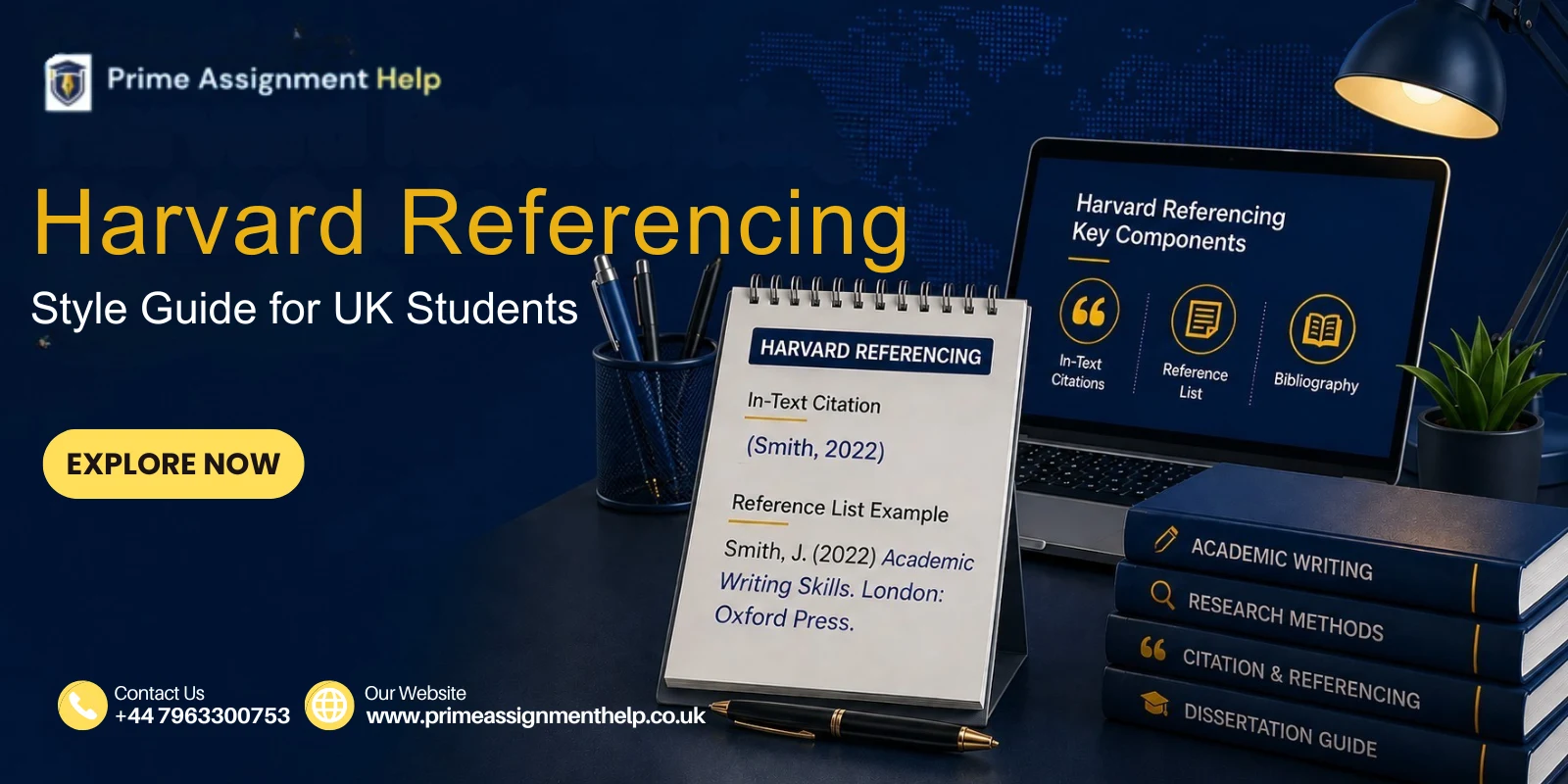
MLA uses parenthetical in-text citations. Whenever you quote or paraphrase a source, you insert the author’s last name and the relevant page number in parentheses at the end of the sentence, before the full stop. For example: (Smith 45).

If you have already mentioned the author’s name in your sentence, you only need to include the page number: (45).

The Container System

One of the most important concepts introduced in MLA 9 referencing is the “container” system. A container is the larger work that holds the source you are citing for instance, a journal that contains an article or a streaming platform that holds a film. Understanding containers helps you accurately describe where a source is found which is particularly useful for digital and online sources.

Read More:Complete Guide to University of Leeds Referencing Style in 2026

MLA Referencing Examples for Common Source Types

This section of the MLA referencing guide provides practical examples for MLA referencing of the types of sources most commonly used in UK academic work.

Books

Single Author: Last Name, First Name. Title of Book. Publisher, Year.

Example: Williams, Raymond. Culture and Society. Chatto and Windus, 1958.

Two Authors: Last Name, First Name and First Name Last Name. Title of Book. Publisher, Year.

Edited Collection: Last Name, First Name, editor. Title of Collection. Publisher, Year.

Journal Articles

In MLA referencing style, journal articles follow this structure:

Last Name, First Name. “Title of Article.” Journal Name, vol. number, no. number, Year, pp. page range.

Example: Hall, Stuart. “Encoding/Decoding.” Culture, Media, Language, vol. 2, no. 1, 1980, pp. 128–138.

Websites and Online Sources

With the rise of online research, MLA 9 referencing has expanded its guidance for digital sources significantly.

Last Name, First Name. “Title of Page.” Name of Website, Publisher or Sponsor, Date published or updated, URL.

Example: BBC Editorial. “How to Reference Academic Sources.” BBC Learning, BBC, 12 Mar. 2023, www.bbc.co.uk/learning/referencing.

If no author is listed, begin with the title of the page. Always include the URL but omit “https://” if it makes the citation cleaner.

Films and Documentaries

Title of Film. Directed by First Name Last Name, Production Company, Year.

Example: Atonement. Directed by Joe Wright, Working Title Films, 2007.

Book Chapters in an Edited Collection

Last Name, First Name. “Chapter Title.” Book Title, edited by First Name Last Name, Publisher, Year, pp. page range.

MLA 9 Referencing: What Changed in the Ninth Edition?

The ninth edition, often called MLA 9 referencing, was released in 2021 and introduced several important updates that UK students should be aware of.

Flexible Source Types

Previous editions of the MLA format guide provided rigid templates for different source types. The ninth edition moved towards a more flexible, universal template that works across source types, applying the container system as its organising framework. This makes mla referencing more adaptable to the ever-changing landscape of digital content.

URLs and Access Dates

MLA 9 referencing now recommends including URLs for online sources by default. Access dates are only required when the content of the source is likely to change over time such as wiki pages or frequently updated databases.

Inclusive Language

The ninth edition also updated its guidance on inclusive language, encouraging writers to use gender-neutral language where appropriate and to follow the preferences of individuals when referring to them in academic work.

Italics vs. Quotation Marks

The rule remains consistent across editions: use italics for titles of longer, standalone works (books, films, journals) and use “quotation marks” for shorter works contained within a larger source (articles, short stories, chapters, poems).

How to Format Your MLA Essay: A Practical Overview

Formatting is just as important as citation accuracy in the MLA referencing style. Here is how to set up your document correctly for a UK academic submission.

General Page Layout

  • Use a standard readable font such as Times New Roman, 12pt
  • Double-space the entire document, including the Works Cited page
  • Set one-inch margins on all sides
  • Include a header in the top right corner of each page with your last name and page number (e.g., Jones 3)

The Header Block

On the first page (top left), include the following in this order, each on its own line:

  • Your full name
  • Your tutor’s or supervisor’s name
  • Course name and number
  • Date of submission

Your essay title should be centred below this block, in standard title case not bolded or italicised unless it contains the title of another work.

Paragraphs and Indentation

Every paragraph should be indented by half an inch using the tab key. There is no extra space between paragraphs in MLA. The double spacing throughout the document provides sufficient visual separation.

MLA Referencing vs. Harvard and Open University Referencing

If you study at the Open University or are transitioning between institutions, you may encounter Open University referencing guidelines, which draw heavily from both Harvard and other styles depending on your faculty. The Harvard referencing style, meanwhile, differs from MLA primarily in its in-text citation format Harvard uses (Author, Year) rather than (Author Page Number).

Here is a quick comparison:

MLA: (Williams 45) – author and page number Harvard: (Williams, 1958) – author and year Open University: Varies by module; often follows Harvard conventions

For students seeking assignment help in UK institutions that use multiple styles across different modules, it is worth learning the core logic of each system rather than simply memorising templates.

Common MLA Referencing Mistakes to Avoid

Even experienced researchers make errors when formatting citations. Here are the most frequent mistakes students make when applying the MLA referencing style in their UK assignments and how to correct them.

Forgetting the Works Cited Page

Some students provide in-text citations but omit the Works Cited page entirely. This is a significant error. Every source cited in your text must have a corresponding full entry on your Works Cited page.

Incorrect Punctuation in In-Text Citations

The parenthetical citation comes before the full stop at the end of a sentence, not after. Incorrect: Williams argues that culture is ordinary. (45) – Correct: Williams argues that culture is ordinary (45).

Confusing Italics and Quotation Marks

Using quotation marks for a book title or italics for an article title is a common slip. Apply the rule consistently: italics for standalone works, quotation marks for works within containers.

Not Updating to MLA 9

Some students use outdated guides based on MLA 7 or MLA 8. Always use MLA 9 referencing unless your institution specifies otherwise.

Practical Tips for Using MLA Referencing in Dissertations

A dissertation requires a higher volume of sources and more complex citation scenarios than a standard essay. Here is how to manage MLA referencing effectively at dissertation level.

Keep a running Works Cited list from the very first source you consult. Trying to reconstruct your reference list at the end of a long project is time-consuming and error-prone. Use reference management software such as Zotero or Mendeley to organise your sources both support MLA formatting and can generate citations automatically, though you should always verify the output against the official MLA 9 referencing guidelines.

For primary sources such as manuscripts, archival materials, or interviews you have conducted yourself, the MLA format guide provides specific templates. Interviews, for instance, are cited with the interviewee’s name first, followed by the type of interview and the date.

Final Thoughts

Mastering the MLA referencing style takes practice, but once you understand its underlying logic  the container system, the author-page in-text citation and the structured Works Cited list, it becomes intuitive. Whether you are writing a short critical essay or a full dissertation, consistent and accurate MLA referencing demonstrates your commitment to academic integrity and helps your reader engage with your argument more confidently.

If you are unsure about specific citation scenarios not covered in this MLA referencing guide, the official MLA Handbook (9th edition) is the most authoritative resource available. Your university library will almost certainly have a copy and many institutions also provide digital access through their online portals.

For further support with academic writing and citation, students across the UK can explore tailored assignment help in UK platforms or cross-reference with guides on Harvard referencing style and Open University referencing to build a well-rounded understanding of academic citation.

Here is the shorter FAQ version:

Frequently Asked Questions 

1. What is MLA referencing style?

MLA referencing style is a citation format mainly used in humanities subjects such as English literature, linguistics, film studies and cultural studies.

2. What is the difference between MLA 8 and MLA 9?

MLA 9 is the updated version of MLA 8. It gives clearer rules for online sources, inclusive language, audiovisual content and social media citations.

3. How do I format MLA in-text citations?

Use the author’s last name and page number in brackets, such as (Williams 45). If the author is already named, use only the page number.

4. What goes on the Works Cited page?

The Works Cited page lists all sources used in the assignment. Entries are arranged alphabetically and formatted with a hanging indent.

5. Is MLA the same as Harvard?

No. MLA uses author and page number, such as (Williams 45), while Harvard uses author and year, such as (Williams, 1958).
open university referencing
Blog

Open University Referencing Guide for UK Students (2026)

Open University Referencing Guide for UK Students (2026)

open university referencing

Academic writing at university level is not only about presenting ideas and research. Students are also expected to acknowledge the sources they use in a professional and accurate way. This is where referencing becomes essential. If you are studying with The Open University, learning the correct referencing format can help you avoid plagiarism, improve academic credibility and achieve better assignment grades.

This open university referencing guide explains the complete process in a simple and student-friendly way. Instead of overwhelming students with complicated academic rules, this guide focuses on the practical information needed for essays, reports, dissertations and coursework. It also covers important topics such as harvard referencing examples, how to reference a website, bibliography vs reference list, journal referencing example and how to avoid plagiarism in university assignments. Students using essay service writing support can also use this guide to improve referencing accuracy and academic writing quality.

What Is Open University Referencing?

Open University referencing is the citation system used by The Open University to identify and credit information taken from books, websites, journals, reports and other academic sources. The university mainly follows the cite them right harvard referencing style, which is commonly used across UK universities.

When students include information from another author without referencing it correctly, it can lead to plagiarism issues and lower academic marks. Proper referencing shows lecturers that your work is based on reliable research and credible evidence. It also allows readers to locate the original source materials used within assignments and dissertations.

Students often search for terms such as open university harvard referencing, ou referencing and referencing guide for UK students because understanding referencing rules can initially feel confusing. However, once the structure is understood, referencing becomes much easier to manage throughout academic work.

Why Referencing Is Important in UK Assignments

Many students think referencing is simply an extra formatting requirement added by universities. In reality, referencing plays a major role in academic writing because it supports the quality, authenticity and professionalism of your work. Lecturers expect students to support their arguments with properly referenced academic sources.

Correct referencing in assignments helps students demonstrate independent research, critical thinking and academic honesty. It also protects students from plagiarism accusations while improving assignment structure and presentation.

Benefit of Referencing Why It Matters
Avoids plagiarism Shows that the original authors are properly acknowledged
Improves credibility Makes academic arguments more trustworthy
Supports higher grades Demonstrates strong research and writing skills
Helps readers verify sources Allows lecturers to review original evidence
Maintains academic integrity Follows university academic standards

Understanding how to avoid plagiarism through accurate citations is one of the most important academic skills university students can develop.

Which Referencing Style Does The Open University Use?

The Open University uses the cite them right harvard referencing system. This style is based on traditional Harvard referencing but follows specific formatting rules designed for university-level academic work.

Many students search online for harvard referencing examples because different universities often use slightly different versions of Harvard style. The main differences usually involve punctuation, formatting, structure and the order of information within references.

The referencing system mainly contains two important parts:

  • In-text citations
  • Full reference list

Students should always use one referencing style consistently throughout their assignments instead of mixing different citation formats together.

What Are the Two Main Parts of Referencing?

Understanding the two main sections of referencing is essential before learning individual citation formats. Every properly referenced assignment includes in-text citations within the main content and a complete reference list at the end of the document.

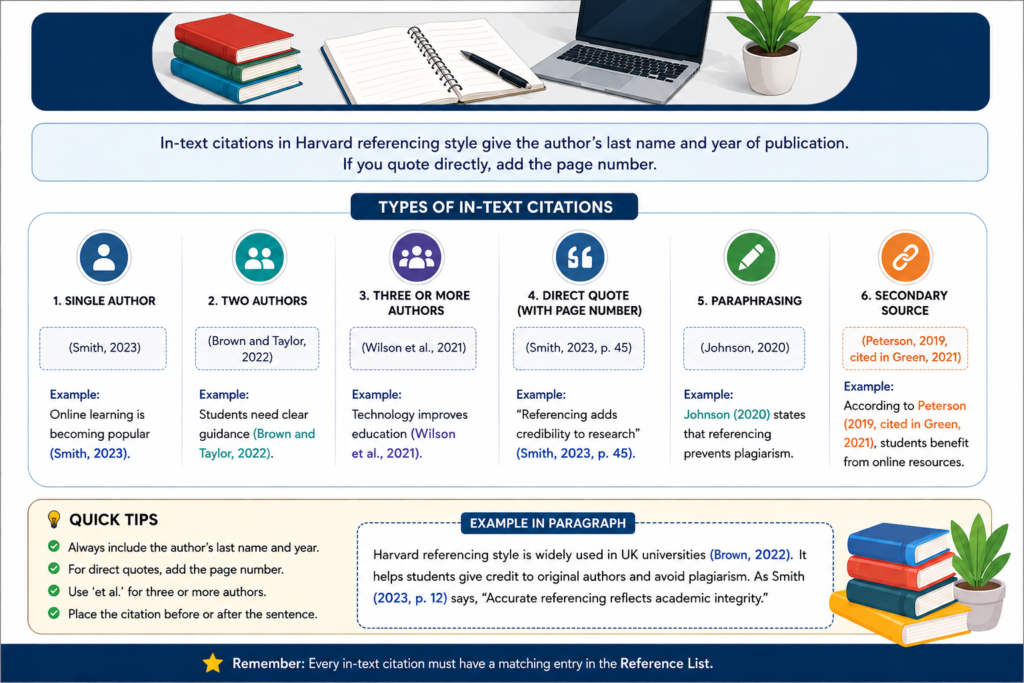
1. In-Text Citations

In-text citations are short references included within your writing whenever you use information from another source. These citations normally include the author’s surname and publication year.

Example: Online education continues to influence student learning experiences (Brown, 2025). If you directly quote an author, page numbers should also be included.

Direct Quote Example: Academic referencing supports research credibility” (Brown, 2025, p. 18).

2. Reference List

The reference list appears at the end of the assignment and includes complete details of every source mentioned in the text. Sources should always be organised alphabetically by author surname.

Referencing Part Purpose
In-text citation Shows where information was used within the assignment
Reference list Provides full publication details of sources

Many students also confuse bibliography vs reference list. A reference list only includes sources cited within the assignment, while a bibliography may include additional reading materials consulted during research.

How to Do In-Text Citations

Many students struggle with in-text citations because they are unsure when references are actually required. The simplest rule is that if the information is not your own original idea, it should usually be referenced.

In-text citations are commonly used when:

  • Quoting directly from a source
  • Paraphrasing academic information
  • Using statistics or research findings
  • Referring to theories or academic studies

Single Author Example

Referencing improves academic writing quality (Taylor, 2024).

Two Authors Example

Academic honesty is important within higher education (Taylor and Smith, 2024).

Direct Quote Example

“Good referencing strengthens assignment credibility” (Taylor, 2024, p. 12).

Paraphrasing Example

Paraphrasing means rewriting information in your own words while still acknowledging the original source.

Taylor (2024) explains that accurate referencing improves the reliability of academic work.

Students using an open university citation guide should focus on consistency and accuracy rather than trying to memorise every formatting rule perfectly.

How to Write a Reference List

A reference list provides full publication details for every source used in your assignment. This section allows lecturers and readers to locate the original materials if needed.

One of the most common mistakes students make is inconsistent formatting. Every reference should follow the same punctuation, spacing and structure throughout the assignment.

Common Harvard Referencing Examples

Source Type Example
Book Brown, T. (2024). Academic Writing Skills. Oxford: Oxford University Press.
Website The Open University (2026). Referencing and plagiarism. Available online (Accessed: 21 May 2026).
Journal Article Wilson, A. (2025) ‘Academic referencing practices’, Journal of Education, 15(2), pp. 20–35.
YouTube Video BBC Learning (2025). Academic writing tips [YouTube video]. Accessed online 21 May 2026.

Students looking for a journal referencing example should pay close attention to volume numbers, issue numbers and page ranges because these details are important in academic journal citations.

Open University Referencing Examples Students Actually Need

Most students do not need dozens of complicated reference formats. In reality, the majority of university assignments only require a few commonly used source types such as books, journal articles, websites and module materials.

This is why practical student-focused guidance is often more useful than long institutional referencing manuals. Learning the most frequently used formats first can make referencing much easier and less stressful for students.

How to Reference a Website

Many students ask how to reference a website correctly because online sources are commonly used in assignments.

Website Reference Example

BBC News (2026) UK university education trends. Available online (Accessed: 21 May 2026).

Journal Referencing Example

Journal Article Example

Green, P. (2025) ‘Digital learning and student performance’, Higher Education Review, 10(4), pp. 41–55.

AI Tool Reference Example

Example

OpenAI (2026) ChatGPT response on Harvard referencing, 21 May.

As AI tools become more widely used in education, many universities now expect students to reference AI-generated content correctly where permitted.

How to Reference OU Module Materials

One area that many students find confusing is referencing internal university materials. OU module content often includes online study resources, tutor guidance, lecture slides and video materials that still require proper citation.

When referencing module materials, students should normally include:

  • Module code
  • Publication year
  • Material title
  • University name

Example

The Open University (2026) DD102 Module Materials. Milton Keynes: The Open University.

If you are using online learning resources, it is also important to include access dates where required within the citation.

Common Referencing Mistakes Students Make

Referencing mistakes are extremely common, especially among first-year university students. Even well-written assignments can lose marks because of incorrect citation formatting or missing references.

Some of the most common referencing mistakes include:

  • Forgetting in-text citations
  • Missing page numbers for quotes
  • Incorrect author names
  • Broken website details
  • Mixing Harvard referencing styles
  • Incorrect reference order
Common Mistake Result
Missing citations Increased plagiarism risk
Incorrect formatting Lower academic marks
Mixing referencing styles Inconsistent presentation
Missing references Incomplete academic work

Carefully reviewing references before assignment submission can significantly improve overall academic quality.

Best Referencing Tools for Students

Referencing tools can help students save time and organise sources more efficiently. These tools are especially useful for dissertations, coursework projects, research-heavy assignments and dissertation help requiring multiple references.

Popular referencing tools include:

  • Zotero
  • Mendeley
  • Cite Them Right
  • Microsoft Word Referencing Tool

Although these tools can be helpful, students should still review references manually because automatic citation generators sometimes create formatting errors or incomplete references.

How to Avoid Plagiarism Using Correct Referencing

Plagiarism occurs when students present another person’s work or ideas as their own without proper acknowledgement. Universities take plagiarism seriously, which is why accurate referencing is essential in academic writing.

Students can learn how to avoid plagiarism by:

  • Referencing all borrowed information
  • Using quotation marks correctly
  • Paraphrasing properly
  • Keeping research notes organised
  • Double-checking citations before submission

Correctly referencing not only protects academic integrity but also demonstrates professionalism, research ability and strong academic writing skills.

Quick Referencing Checklist Before Submission

Before submitting your assignment, spend a few minutes reviewing your references carefully. A simple final check can help identify small mistakes that may affect your grades.

Checklist Question Completed
Have all sources been cited in the text?
Are all references included in the reference list?
Is the reference list in alphabetical order?
Are page numbers included for direct quotes?
Is one referencing style used consistently?

Students following a referencing guide for UK students should always review formatting, punctuation and consistency before final submission.

Final Thoughts

Learning open university referencing may seem difficult initially, but it becomes much easier with regular practice and careful formatting. Understanding how citations, reference lists and harvard referencing examples work will improve both academic writing quality and research skills throughout university studies.

By following this open university harvard referencing guide, students can avoid common mistakes, improve referencing in assignments and meet UK university academic standards more confidently. Students looking for assignment help in UK can also benefit from proper referencing knowledge to produce higher-quality academic work. The key to successful referencing is consistency, accuracy and using reliable academic sources throughout your work.

University of Leeds Referencing
Blog

Complete Guide to University of Leeds Referencing Style in 2026

Complete Guide to University of Leeds Referencing Style in 2026

University of Leeds Referencing

You are a student at the University of Leeds and referencing is one of the most important academic skills you need to develop. Whether you are writing your first essay or finishing a postgraduate dissertation, citing your sources correctly is not just a formatting rule; it is a key part of academic honesty. Many students leave it to the last minute. This is a mistake. Poor referencing costs marks and can raise questions about the integrity of your work. At Leeds, academic misconduct, including unintentional plagiarism from missing or incorrect references, is taken seriously and can affect your academic record.

Once you understand how referencing works, it becomes much simpler. It is just a way of being transparent: showing your reader where your ideas came from so they can follow your thinking and check your sources.

The University of Leeds uses the Harvard Referencing Style, one of the most widely used systems in academia. Known as the “author-date” system, it requires you to cite sources in two places: within your text (in-text citations) and at the end of your work (reference list). Understanding how these two elements work together is where referencing success at Leeds begins.

What Is the Leeds Referencing Style?

The University of Leeds does not have a completely separate referencing system of its own. Rather, it adopts and adapts the Harvard referencing style with specific guidelines tailored for its students and academic departments. This means the core structure of Harvard referencing applies, but the university provides detailed guidance through its library resources to help students apply it consistently and correctly.

The purpose of referencing is threefold:

  • To give credit to the original authors whose ideas, research, or data you have used
  • To allow your readers to locate and verify the sources you have consulted
  • To demonstrate the depth and breadth of your reading and research

Academic misconduct, including plagiarism, is taken very seriously at the University of Leeds. Proper referencing protects you from unintentional plagiarism and strengthens the credibility of your academic work.

How to Reference Different Sources at the University of Leeds 

One of the trickiest parts of referencing is that different types of sources require slightly different formats. Below is a breakdown of how to reference the most common source types you will encounter as a Leeds student.

Referencing Different Types

Different sources require different referencing formats. This section explains how to correctly cite common academic and online sources used at the University of Leeds.

1. Books

Books are the most straightforward source to reference.

Format: Author(s) Surname, Initial(s). (Year) Title of Book. Edition (if applicable). Place of Publication: Publisher.

Example: Harrison, M. (2018). Research Methods in Social Sciences. 2nd edn. Oxford: Oxford University Press.

For a book with an editor rather than an author, add “(ed.)” or “(eds.)” after the name: Clarke, P. (ed.) (2017). Contemporary Theories in Education. London: Sage.

2. Journal Articles

Journal articles are among the most frequently cited sources in academic work.

Format: Author(s) Surname, Initial(s). (Year) ‘Title of article’, Name of Journal, Volume(Issue), pp. page range.

Example: Patel, R. and Khan, S. (2022) ‘Digital learning in higher education’, Journal of Educational Technology, 15(3), pp. 112–128.

Note that the article title uses single quotation marks and is not italicised, while the journal name is italicised.

3. Websites

Websites are increasingly common sources, but must be referenced carefully to ensure the information is credible and traceable.

Format: Author(s) Surname, Initial(s), or Organisation Name. (Year) Title of Webpage. Available at: URL (Accessed: Day Month Year).

Example: NHS England (2023) Mental Health Services in the UK. Available at: https://www.nhs.uk/mental-health (Accessed: 14 March 2024).

Always include the date you accessed the webpage, as web content can change or be removed.

4. Newspapers

Both print and online newspaper articles can be cited in your work.

Format (Print): Author(s) Surname, Initial(s). (Year) ‘Title of article’, Newspaper Name, Day Month, p. page number.

Example: Ahmed, L. (2023) ‘University applications rise despite tuition fee increases’, The Guardian, 12 September, p. 6.

Format (Online): Author(s) Surname, Initial(s). (Year) ‘Title of article’, Newspaper Name, Day Month. Available at: URL (Accessed: Day Month Year).

5. E-books

E-books follow the same format as print books, with the addition of the URL or DOI and access date.

Format: Author(s) Surname, Initial(s). (Year) Title of Book. Edition (if applicable). Place of Publication: Publisher. Available at: URL or DOI (Accessed: Day Month Year).

Example: Thompson, G. (2021). Introduction to Psychology. 4th edn. Cambridge: Cambridge University Press. Available at: https://www.cambridge.org/ebook/psychology (Accessed: 5 January 2024).

6. PDFs and Reports

PDFs from organisations, government bodies, or research institutions are commonly used in academic work.

Format: Author(s) or Organisation. (Year) Title of Report. Place of Publication: Publisher. Available at: URL (Accessed: Day Month Year).

Example: Department for Education (2022) Education Statistics Annual Report 2022. London: HMSO. Available at: https://www.gov.uk/education-statistics (Accessed: 20 February 2024).

If a PDF has no named author, begin the reference with the name of the organisation or institution that produced it.

7. YouTube Videos

YouTube videos and other online video content are now widely accepted as academic sources in some disciplines.

Format: Author/Uploader Surname, Initial(s), or Username. (Year) Title of Video [Video]. Platform Name. Day Month. Available at: URL (Accessed: Day Month Year).

Example: TED Talks (2023) The Power of Vulnerability [Video]. YouTube. 15 April. Available at: https://www.youtube.com/watch?v=example (Accessed: 10 March 2024).

8. Lectures and Class Notes

If your lecturer has permitted you to cite lecture content, use the following format.

Format: Lecturer’s Surname, Initial(s). (Year) Title of Lecture. Module Code: Module Title. Institution. Date of lecture (Unpublished).

Example: Williams, J. (2024). Introduction to Quantitative Research Methods. SOCE1010: Research in Social Sciences. University of Leeds. 15 February (Unpublished).

Be cautious about citing lectures; always check with your module tutor whether this is acceptable for your assignment.

Must Read: Complete Harvard Referencing Style Guide for UK Students

Main Components of Referencing

Understanding referencing begins with understanding its two key components: in-text citations and the reference list. These two elements work together and must always correspond. Every source cited in your text must appear in your reference list, and every source in your reference list must be cited somewhere in your text.

1. In-Text Citations

An in-text citation appears within the body of your essay or assignment, directly after the point where you have used someone else’s idea, quote, or data. In the Harvard system used at Leeds, an in-text citation typically consists of:

  • The author’s surname
  • The year of publication
  • A page number (required for direct quotes; recommended for paraphrased ideas)

Example of a direct quote: Critical thinking is the foundation of academic writing” (Smith, 2021, p. 45).

Example of a paraphrase: Many academics argue that critical thinking underpins strong academic writing (Smith, 2021).

If you mention the author’s name naturally in your sentence, the format changes slightly: Smith (2021, p. 45) argues that “critical thinking is the foundation of academic writing.

When a source has two authors, include both surnames: (Johnson and Patel, 2020)

When a source has three or more authors, use the first author’s name followed by “et al.”: (Williams et al., 2019)

2. Reference List

The reference list appears at the very end of your work, on a new page, under the heading References or Reference List. It provides full bibliographic details for every source you cited in your text. Key rules for the reference list include:

  • Arrange entries in alphabetical order by the author’s surname
  • Do not number the entries
  • Use a hanging indent format, where the first line of each entry is flush with the left margin, and subsequent lines are indented
  • Include all authors (do not use “et al.” in the reference list)
  • Be consistent with punctuation, capitalisation, and formatting throughout

University of Leeds Harvard Referencing Format

The general format for a Harvard reference at the University of Leeds varies depending on the type of source, but all references follow a logical structure. The most common building blocks are: Author(s) Last Name, Initial(s). (Year of Publication) Title of Work. Edition (if not the first). Place of Publication: Publisher.

For example: Brown, T. (2020). Academic Writing for University Students. 3rd edn. London: Routledge.

Here are the core formatting rules you must keep in mind:

  • Author names: Write the surname first, followed by the initial(s). For multiple authors, list them all separated by commas, with “and” before the last author.
  • Year of publication: Always place it in brackets immediately after the author(s).
  • Title: The title of a book or report is written in italics. The title of an article or chapter is written in regular (roman) text, with only the first word and proper nouns capitalised.
  • Edition: Only include this if it is not the first edition.
  • Place of publication and publisher: Separate with a colon.

Examples of University of Leeds Referencing

To help consolidate your understanding, here is a comprehensive set of examples showing both in-text citations and their corresponding reference list entries side by side.

1. Book  Single Author

In-text: (Baker, 2019)

Reference list: Baker, S. (2019). Understanding Modern Politics. London: Palgrave Macmillan.

2. Book  Two Authors

In-text: (Green and Morris, 2020)

Reference list: Green, A. and Morris, T. (2020). Health Psychology: Theory and Practice. 2nd edn. Edinburgh: Churchill Livingstone.

3. Journal Article

In-text: (Okafor et al., 2021)

Reference list: Okafor, C., Ahmed, F. and Liu, Y. (2021) ‘The impact of remote work on employee wellbeing’, Journal of Occupational Psychology, 94(2), pp. 301–319.

Website: In-text: (World Health Organisation, 2023)

Reference list: World Health Organisation (2023) Global Health Observatory Data. Available at: https://www.who.int/data/gho (Accessed: 1 April 2024).

4. Government Report (PDF)

In-text: (Office for National Statistics, 2022)

Reference list: Office for National Statistics (2022) UK Population Estimates 2022. London: ONS. Available at: https://www.ons.gov.uk (Accessed: 8 March 2024).

Common Referencing Mistakes Students Make

Even diligent students frequently make referencing errors. Being aware of these common pitfalls will help you avoid losing marks unnecessarily.

1. Inconsistent Formatting

One of the most common mistakes is switching between referencing styles within the same document, for example, sometimes including page numbers and sometimes not, or italicising titles inconsistently. Always review your reference list as a whole before submission.

2. Missing In-Text Citations

Some students include a source in their reference list but forget to actually cite it in the body of their text, or vice versa. Every cited source must appear in both places.

3. Incorrect Punctuation

Small punctuation errors, such as placing commas in the wrong position, missing full stops, or using the wrong type of brackets, are surprisingly common. Pay close attention to where colons, commas, and full stops are placed in each element of the reference.

4. Using “et al.” in the Reference List

“Et al.” is for in-text citations only (when there are three or more authors). In your reference list, you must always write out all authors’ names in full.

5. Not Including the Access Date for Websites

Any online source that could change or disappear must include the date you accessed it. Forgetting this is a very common oversight.

6. Incorrect Capitalisation of Titles

In Harvard referencing at Leeds, only the first word of a book or article title, and proper nouns, are capitalised. Do not capitalise every word in a title (as you would in some other referencing styles like APA or Chicago).

7. Citing Secondary Sources Without Acknowledging Them

If you read about an idea in one source that was originally expressed in another source, you should ideally find and read the source. If you cannot, you must acknowledge the secondary source clearly using phrases like “cited in,”  for example: (Jones, 2015, cited in Smith, 2021).

Useful Referencing Tools and Resources

You do not have to navigate referencing entirely on your own. There are several tools and resources available to University of Leeds students.

University of Leeds Library Referencing Guides

The University of Leeds Library website provides detailed, up-to-date referencing guidance specifically tailored for Leeds students. It covers all source types and is regularly updated. Always check here first, as it is the most authoritative source for Leeds-specific guidance.

Visit: library.leeds.ac.uk and search for “referencing guide”

Cite Them Right Online

The University of Leeds provides access to Cite Them Right, a comprehensive online referencing guide. It covers Harvard referencing in extensive detail and includes examples for almost every conceivable source type. Leeds students can access it for free through the library portal.

Zotero

Zotero is a free, open-source reference management tool that automatically collects, organises, and formats your references. It integrates with Word and Google Docs, making it easy to insert citations and generate reference lists as you write.

Mendeley

Mendeley is another popular reference manager, particularly among science and engineering students. It also doubles as a PDF reader and academic social network, allowing you to annotate papers and share references with peers.

RefWorks

RefWorks is a cloud-based reference management tool that the University of Leeds provides access to through its library. It is particularly useful for managing large numbers of sources across multiple projects.

Microsoft Word’s Built-In Referencing Tool

Word has a basic built-in referencing feature (found under the References tab). While it can help with basic Harvard formatting, it is not always perfectly aligned with the University of Leeds’s specific requirements, so always double-check the output.

Final Thoughts

Referencing may seem difficult at first, but it becomes easier with regular practice. The best approach is to build good referencing habits from the beginning of your academic journey at the University of Leeds. Keep track of your sources, update your reference list while writing, and always check the university guidelines when needed.

Correct referencing is not only important for avoiding plagiarism, but also for showing strong academic understanding and research skills. If you ever need additional academic support, services like Prime Assignment Help can provide guidance related to assignment help in uk for learning and reference purposes.

Read more: Cardiff University Referencing – Complete Guide for Students

Frequently Asked Questions

Q1. What referencing style does the University of Leeds use?

The University of Leeds mainly uses the Harvard referencing style, also known as the author-date system. Students must include both in-text citations and a full reference list in their assignments.

Q2. What is the difference between an in-text citation and a reference list?

An in-text citation appears inside your assignment whenever you use someone else’s idea, quote, or research, while the reference list at the end provides full details of every source you cited.

Q3. Do I need to include access dates when referencing websites?

Yes. When referencing websites or online sources in Leeds Harvard style, you should always include the date you accessed the webpage because online content can change over time.

Q4. Can I use et al. in the reference list?

No. Et al. should only be used in in-text citations when a source has three or more authors. In the reference list, you must write all authors’ names in full.

Q5. What are the most common referencing mistakes students make?

Common mistakes include inconsistent formatting, missing in-text citations, incorrect punctuation, forgetting access dates for websites, and mixing different referencing styles in one assignment.

Bibliography vs References List
Blog

Bibliography vs References List: Key Differences Every UK Student Should Know

Bibliography vs References List: Key Differences Every UK Student Should Know

Bibliography vs References List

If you have ever reached the final page of a university essay and stared blankly at an empty document wondering, “Do I write a bibliography or a references list?” you’re certainly not alone. The distinction between a bibliography vs references list is one of the most commonly misunderstood aspects of academic writing in UK universities, and getting it wrong can cost you marks.

At first glance, both sections look remarkably similar. They both sit at the end of your assignment, they both list sources, and they both follow a particular formatting style. Yet they serve very different purposes, and many lecturers genuinely care which one you use. Understanding the difference between references and bibliography isn’t just a pedantic technicality it reflects how clearly you understand the research process itself.

This guide breaks everything down in plain English. Whether you’re writing a first-year essay, a postgraduate dissertation, or anything in between, you’ll leave knowing exactly which one to use, how to format it correctly, and how to avoid the most common referencing pitfalls UK students fall into.

What Is a Bibliography?

A bibliography is a detailed list of all the sources you consulted while researching and writing your assignment, whether or not you cited them directly in the main text. It acts as a record of your wider reading and shows how deeply you explored the topic before developing your argument.

In academic writing, a bibliography is used to demonstrate the breadth of your research. It includes books, journal articles, reports, websites, and other materials that helped shape your understanding of the subject. Unlike a references list, which only includes sources directly cited in the assignment, a bibliography may also include background reading that influenced your thinking.

UK universities may require a bibliography depending on the subject, module, lecturer, or referencing style. Bibliographies are especially common in humanities subjects such as History, Philosophy, English Literature, and Theology, where wider reading is often valued alongside direct citation. Law assignments that use OSCOLA referencing may also require a bibliography with separate sections for cases, legislation, and secondary sources.

A well-prepared bibliography strengthens academic credibility because it shows that the student has not relied on limited or random sources. It proves that the work is supported by wider research and careful engagement with existing scholarship. If the assignment brief does not clearly state whether to use a bibliography or a references list, the safest option is to check the module handbook or ask the tutor before submission.

Common Bibliography Formats Used in the UK

In the UK, the most common academic citation formats that use a bibliography include:

  • OSCOLA (used in Law — separates cases, legislation, and secondary sources)
  • MLA (used in Humanities, particularly Literature and Languages)
  • Chicago/Turabian (used in History and some Social Science disciplines)
  • Some variations of Harvard that ask for all background reading to be included

What Is a References List?

A references list, sometimes called a reference list, is a carefully organised list of every source you have directly cited within the body of your assignment. If a source appears as an in-text citation, it must also appear in the references list. If it has not been cited in the assignment, it should not be included.

This direct link between in-text citations and the references list is what separates it from a bibliography. Every citation in the main text should have a matching full reference at the end, and every full reference should connect back to a citation used somewhere in the assignment.

In academic writing, references work together with in-text citations to show where your ideas, evidence, quotations, and paraphrased points have come from. For example, in Harvard referencing, this may include the author’s surname and year in brackets, while OSCOLA usually uses footnotes. The full source details then appear in the references list so readers can locate the original material, check your interpretation, and explore the topic further.

A well-prepared references list also shows academic integrity. It proves that you have credited the original authors properly and have used sources responsibly throughout your work.

Referencing Styles Commonly Used by UK Students

UK universities use a wide range of referencing styles depending on the subject area. The most common include Harvard (dominant across social sciences, business, and many humanities), APA (popular in psychology and education), MLA (used in literature and language subjects), Vancouver (used in medicine and health sciences), and OSCOLA (the standard for Law). Each style has its own rules for how in-text citations and the references list or bibliography should be formatted.

Student Tip : Build your references list as you write, not after. Every time you cite a source in the text, add it immediately to your references list.

Expert help

Bibliography vs References List: Key Differences Explained

Now that we’ve defined both terms separately, let’s put them side by side. The core distinction comes down to scope: what gets included and why.

Bibliography

  • Includes cited sources
  • Includes background reading
  • Includes wider research
  • Broader scope

References List

  • Includes only directly cited sources
  • Matches in-text citations exactly
  • More precise and limited
Feature Bibliography References List
Includes cited sources Yes Yes
Includes background reading Yes No
Must match in-text citations Partially Exactly
Shows breadth of research Yes Limited
Common in Humanities/Law Yes Less common
Common in Social Sciences Sometimes Very common

“The difference between a bibliography and a references list is not just cosmetic — it reflects two fundamentally different relationships between the writer and their sources.”

It’s also worth noting that some universities and style guides use the terms interchangeably which, understandably, only adds to the confusion. When in doubt, consult your module handbook or email your tutor directly. Their expectation is the one that matters most for your marks.

Bibliography vs References in Different Referencing Styles

Harvard Referencing Style

Harvard is the most widely used referencing style across UK universities. Technically, Harvard uses a references list only the sources you’ve cited in-text should appear at the end of your work. However, many UK departments that use Harvard will accept or even request a bibliography that includes your wider reading. Always check your module guidelines. In standard Harvard, entries are listed alphabetically by the author’s surname.

Used in:

  • Business
  • Social Sciences
  • Health
  • Education

APA Referencing Style

APA (American Psychological Association) style, now in its seventh edition, explicitly uses the term references list, not bibliography. Only sources cited in the text should appear. APA is highly precise: hanging indents, specific capitalisation rules for titles and DOIs where available are all required. Some UK psychology and education departments have adopted APA directly; others use a modified Harvard that closely resembles it.

Used in:

  • Psychology
  • Education
  • Nursing

MLA Referencing Style

MLA (Modern Language Association) style calls its end-of-document list a Works Cited page when it contains only cited sources, or a Works Consulted page when it includes background reading functionally equivalent to a bibliography. MLA is distinctive in its use of containers (the larger work within which a source sits) and is primarily used in English Literature and Modern Languages departments across the UK.

Used in:

  • English Literature
  • Modern Languages
  • Film Studies

OSCOLA Referencing Style

OSCOLA (Oxford University Standard for the Citation of Legal Authorities) uses footnotes for in-text references and a bibliography at the end, typically divided into three sections: Table of Cases, Table of Legislation and Secondary Sources. Every source cited in a footnote should appear in the bibliography. OSCOLA is the standard for law students across the UK and is one of the few styles that formally requires a bibliography structure.

Used in:

  • Law
  • Legal Studies

Examples of Bibliography and References List

Bibliography Example — Harvard Style

The following shows what a short bibliography might look like in Harvard style, including sources consulted but not directly cited in the text. Notice that these are listed alphabetically by the author’s surname, just like a references list would be.

Bibliography – Harvard Style

  • Bryman, A. (2016) Social Research Methods. 5th edn. Oxford: Oxford University Press.
  • Cottrell, S. (2019) The Study Skills Handbook. 5th edn. London: Macmillan Education.
  • Gibbs, G. (1988) Learning by Doing: A Guide to Teaching and Learning Methods. Oxford: Further Education Unit, Oxford Polytechnic.
  • Murray, R. (2017) How to Write a Thesis. 4th edn. Maidenhead: Open University Press.
  • Pears, R. and Shields, G. (2022) Cite Them Right: The Essential Referencing Guide. 12th edn. London: Red Globe Press.

Notice that some of these might never appear in the body of the essay they were consulted for background reading and general orientation to the topic and they’ve been acknowledged honestly in the bibliography.

References List Example — Harvard Style

A references list in Harvard style should include only the sources directly cited within the essay. Below is an example with three sources, each of which has a corresponding in-text citation somewhere in the work.

References List — Harvard Style

  • Cottrell, S. (2019) The Study Skills Handbook. 5th edn. London: Macmillan Education.
  • Pears, R. and Shields, G. (2022) Cite Them Right: The Essential Referencing Guide. 12th edn. London: Red Globe Press.
  • University of Manchester (2023) Academic Malpractice Policy. Available at: https://www.manchester.ac.uk/study/undergraduate/academic-malpractice/ (Accessed: 15 March 2024).

The structure is the same as the bibliography – alphabetical, with the author’s surname first  – but the content is strictly limited to cited sources only.

Read More: Complete Harvard Referencing Style Guide for UK Students

Common Referencing Mistakes UK Students Should Avoid

Academic referencing errors are far more common than most students realise and they can have a genuine impact on your final grade. Here are the three most frequent mistakes and how to steer clear of them.

Mixing Bibliography and References Incorrectly

One of the most common errors is submitting a references list when your assignment called for a bibliography, or vice versa. This happens when students don’t read the submission guidelines carefully. A slightly less obvious version of this mistake is including sources in your references list that you never actually cited in the text perhaps sources you meant to use but didn’t or conversely, citing something in the body of your essay but forgetting to add it to your references list entirely.

  • Submitting a references list when a bibliography was required
  • Including sources in the references list that have no in-text citation
  • Citing a source in the text but omitting it from the end list
  • Labelling the section incorrectly (e.g., writing “Bibliography” in an APA assignment)

Incorrect Citation Formatting

Every referencing style has very specific rules about punctuation, italics, capitalisation and the order of elements. A missing full stop, an italicised title that should be in roman type or a swapped publication place and publisher can all cost you marks in carefully assessed assignments. Harvard, in particular, is notorious for having slightly different conventions depending on the institution’s own interpretation of the style.

Always use your university’s official referencing guide not just a general Harvard guide from another institution, as their specific rules may differ from yours.

Missing Sources and In-Text Citations

Perhaps the most academically serious error is presenting ideas, arguments or data without attributing them to their original author. This is not just a formatting problem it edges into the territory of academic misconduct, even when it’s accidental. Every claim you make that isn’t your own original analysis must be attributed to a source, both in-text and in your reference list or bibliography.

Important

Missing citations aren’t just a referencing error they can be flagged as academic misconduct. If you’re unsure whether something needs a citation, it almost always does. When in doubt, cite it.

Tips to Improve Academic Referencing

Use Reliable Referencing Tools

Reference management software can save you an enormous amount of time and significantly reduce the risk of formatting errors. Tools like Zotero (free), Mendeley (free) and RefWorks (available via many UK university libraries) allow you to save sources, generate citations automatically and export formatted reference lists or bibliographies directly into your word processor.

Online citation generators like Cite This For Me and Citethemright.com can also be helpful for generating individual references quickly but always double-check the output against your university’s own referencing guide, as these tools sometimes make small errors.

Follow UK University Referencing Guidelines

Every UK university publishes its own referencing guidelines, and these take precedence over general style guides. The University of Leeds, Manchester, Edinburgh and virtually all others have their own versions of Harvard that may differ in small but assessable ways from one another. Your module handbook, the library’s referencing pages and your personal tutor are your three most important referencing resources.

If you’re working on a dissertation or thesis, the stakes are even higher. Seeking professional thesis help UK early in the process particularly around formatting, structure and referencing conventions can make a significant difference to the quality of your final submission.

Proofread Your Citations Carefully

Once you’ve completed your assignment, read through every in-text citation and check it against your references list or bibliography. Does every citation have a corresponding entry? Does every entry have a corresponding citation? Are authors’ names spelled consistently? Are publication years correct? It sounds tedious, but this cross-checking step catches errors that are genuinely very common even among experienced academic writers.

  • Every in-text citation has a matching entry in the references list
  • Every entry in the references list has a corresponding in-text citation
  • Author names are spelled consistently throughout
  • Publication years match between the text and the list
  • Formatting follows your university’s specific style guide
  • Web sources include an access date where required

Need Help With Your Referencing or Academic Writing?

Whether it’s a first-year essay or a final-year dissertation, professional guidance can make a significant difference to your academic performance.

  • Research Paper Writing Help
  • Thesis Help UK

Conclusion

Getting to grips with the bibliography vs references list distinction is one of those foundational academic skills that will serve you well throughout your entire university career. The core principle is simple: a references list includes only the sources you’ve directly cited in your work, while a bibliography casts a wider net, including background reading and sources that shaped your thinking even if you didn’t explicitly quote or paraphrase them.

The referencing style your department uses whether that’s Harvard, APA, MLA or OSCOLA will largely determine which format is expected. But regardless of the style, the same commitment to accuracy, consistency and honesty underpins good academic referencing practice.

Build your list as you write, double-check everything before you submit and if you’re ever unsure which format your assignment requires, simply ask your tutor. Academic referencing isn’t something to be afraid of once you understand the logic behind it, it becomes second nature. And if you’d like expert support with your academic writing uk, our professional essay writing service in the UK is here to help you every step of the way.

Read More: 120+ Unique Speech Topics for UK Students in 2026

Frequently Asked Questions

1. What is the difference between bibliography and references?

A references list includes only the sources directly cited in your assignment. A bibliography includes cited sources plus any background reading used during research.

2. Can a bibliography and references list be used together?

Usually, students use one or the other. Some subjects or referencing styles may separate cited sources and wider reading, so always check your assignment guidelines.

3. Which referencing style is most common in UK universities?

Harvard referencing is the most common in UK universities, especially in business, social sciences, health, and humanities subjects.

4. What is bibliography in academic writing?

A bibliography is a formatted list of all sources consulted during research, whether they were cited directly or used for background understanding.

5. What is a references list in assignments?

A references list is the end section of an assignment that includes full details of every source cited in the main text.

Cardiff University Referencing
Blog

Cardiff University Referencing – Complete Guide for Students

Cardiff University Referencing – Complete Guide for Students 

Cardiff University Referencing

Referencing is an essential part of academic writing at Cardiff University and plays a major role in maintaining academic honesty and credibility. Whether you are preparing coursework, essays, reports, dissertations, or research projects, proper referencing helps you acknowledge sources and support your arguments with reliable evidence. Many students struggle with referencing in the beginning because different departments follow different citation styles and formatting rules. However, understanding the basics of referencing can make academic writing much easier and more organised.

This complete guide covers everything students need to know about Cardiff University referencing, including referencing styles, in-text citations, reference lists, formatting guidelines, common mistakes, and practical tips to help improve academic writing and avoid plagiarism.

What is Cardiff University Referencing?

Cardiff University referencing is the process of giving proper credit to the sources used in academic work, such as essays, assignments, reports, and dissertations. It helps students acknowledge original authors whenever they use ideas, research, statistics, or quotations from books, journals, websites, and other academic materials.

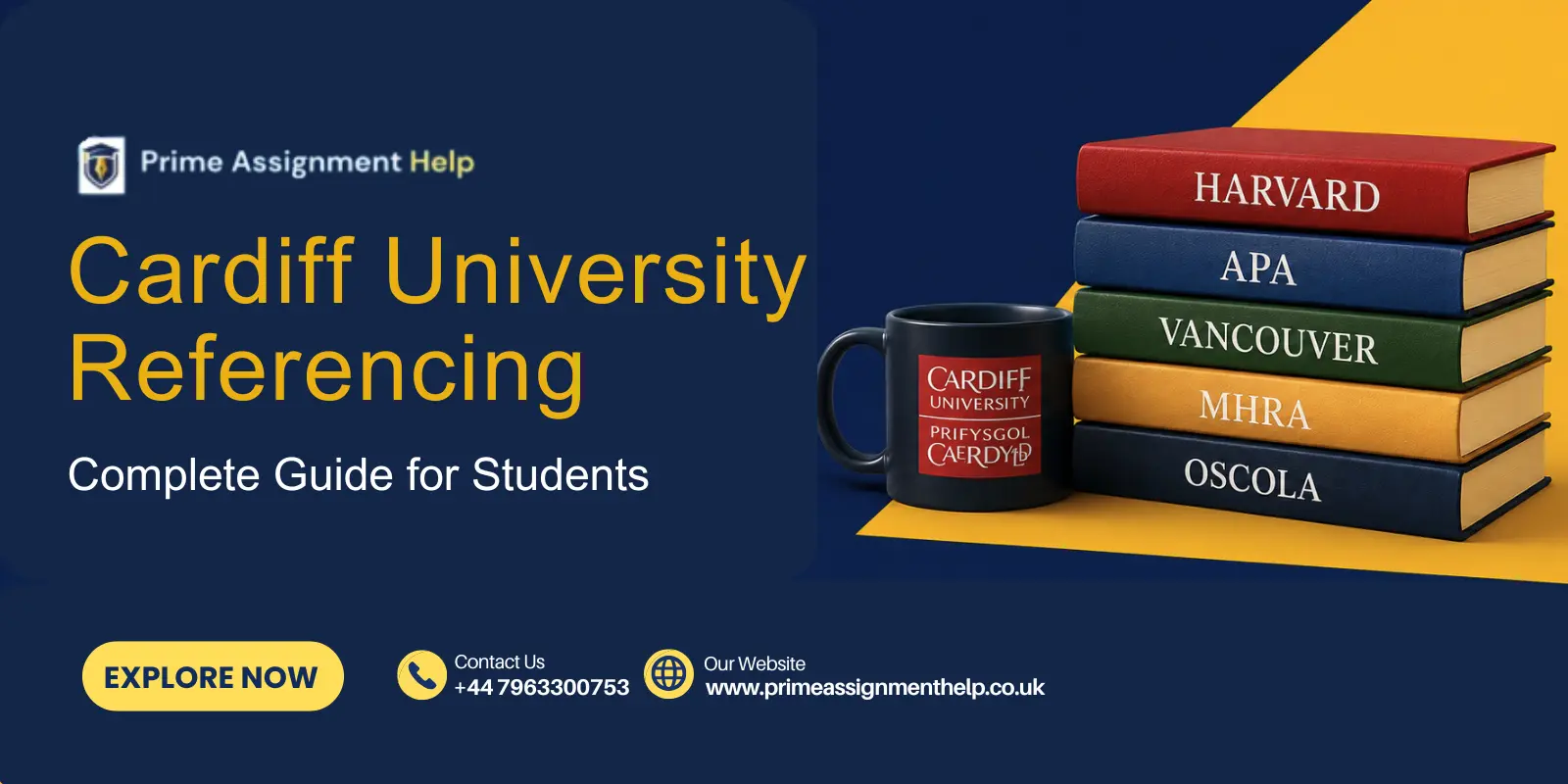
Cardiff University does not follow one single referencing style for every subject. Different departments use different systems, such as Harvard, APA, Vancouver, MHRA, and OSCOLA, depending on the course requirements. Most referencing styles include two main parts: in-text citations within the assignment and a full reference list at the end of the document.

Proper referencing is important because it supports academic integrity, strengthens arguments with reliable evidence, and helps students avoid plagiarism. By using accurate citations and consistent formatting, students can improve the quality and credibility of their academic writing.

Referencing Styles Used at Cardiff University

Cardiff University does not require a single referencing style across all departments. Different schools use different systems depending on the subject area. It is essential to check your module handbook or confirm with your lecturer which style you must use.

The most commonly used referencing styles include:

1. Harvard (Author-Date)

Harvard is widely used in business, social sciences, engineering, and many other disciplines. It uses the author’s surname and year of publication in-text.

2. APA (American Psychological Association)

Common in psychology, education, and some health sciences. It is similar to Harvard but follows specific formatting guidelines.

3. Vancouver

Often used in medicine and healthcare subjects. It uses numbered citations in-text.

4. MHRA

Commonly used in humanities subjects. It uses footnotes instead of in-text citations.

5. OSCOLA

Specifically used in law. It relies heavily on footnotes and detailed case references. Using the wrong referencing style can result in lost marks, so always follow your department’s requirements carefully.

Key Referencing Elements and Source Referencing Guide 

Referencing has two main parts: in-text citations and the reference list (or bibliography).

In-Text Citations

In-text citations appear in the body of your assignment whenever you:

  • Quote directly from a source
  • Paraphrase someone’s idea
  • Summarise research findings
  • Use statistics or data

Example (Harvard Style)

Paraphrasing: Academic writing requires clear referencing practices (Brown, 2021).

Direct Quotation: Referencing is essential for maintaining academic integrity” (Brown, 2021, p. 78). Page numbers are required for direct quotes.

Reference List

The reference list appears at the end of your assignment. It includes full details of every source cited in your work. Entries are usually arranged alphabetically by the author’s surname (in Harvard and APA).

Example – Book (Harvard)

Brown, T. (2021). Academic Writing and Integrity. London: Routledge.

Example – Journal Article

Smith, J. (2022) ‘Student referencing challenges’, Journal of Higher Education Studies, 15(2), pp. 34–49.

Every in-text citation must have a matching reference list entry, and vice versa.

How to Reference Different Types of Academic Sources Correctly 

Different types of academic and online sources require different formatting details and referencing structures depending on the referencing style you are using. 

1. Books

Include:

  • Author(s)
  • Year
  • Title (italicised)
  • Edition (if applicable)
  • Place of publication
  • Publisher

2. Journal Articles

Include:

  • Author(s)
  • Year
  • Article title
  • Journal title (italicised)
  • Volume number
  • Issue number
  • Page range

3. Edited Books

Include the chapter author and the editor’s name.

4. Websites

Include:

  • Author/organisation
  • Year
  • Title of page
  • URL
  • Access date

Example (Harvard)

Cardiff University (2025) Study Skills and Referencing Guide. Available at: www.cardiff.ac.uk (Accessed: 20 May 2026).

5. Government Reports

Include:

  • Government body
  • Year
  • Title
  • Publication details

Always ensure online sources are credible and academically appropriate.

6. Paraphrasing vs Quoting

Many students overuse direct quotations. At the university level, paraphrasing is often preferred because it demonstrates understanding.

Paraphrasing means rewriting the idea in your own words while maintaining the original meaning and still providing a citation.

Incorrect paraphrasing (too similar to the original) can still count as plagiarism. Always significantly rephrase the text and cite the source properly.

7. Secondary Referencing

Secondary referencing occurs when you cite a source that was mentioned in another author’s work. This should be avoided where possible. Always try to access the source.

Example (Harvard): (Smith, 2018, cited in Brown, 2022). Only include the source you actually read (Brown, 2022) in your reference list.

Properly referencing different types of sources helps improve the quality, credibility, and academic reliability of your assignments and research work. 

Must Read: Complete Harvard Referencing Style Guide for UK Students

Understanding the Importance of Referencing

Referencing is the process of acknowledging the sources you use in your academic work. These sources may include books, journal articles, websites, reports, government publications, conference papers, or other academic materials.

At Cardiff University, referencing is important because it:

  • Demonstrates academic honesty
  • Gives credit to original authors
  • Supports your arguments with credible evidence
  • Allows readers to verify your sources
  • Helps you avoid plagiarism
  • Shows depth of research

Plagiarism, whether intentional or accidental, is treated seriously in UK universities. Proper referencing protects you from academic misconduct and builds trust in your academic work.

Formatting Guidelines to Remember

Although formatting rules vary by style, some general principles apply:

  • Use a consistent font and spacing
  • Follow punctuation rules exactly
  • Italicise book and journal titles
  • Arrange references alphabetically (unless using numbered systems)
  • Use hanging indentation if required

Small formatting errors may seem minor, but they can affect your overall marks.

Common Referencing Mistakes Students Make

Many Cardiff University students lose marks due to avoidable referencing errors.

Common Mistakes Include:

  • Missing in-text citations
  • Incorrect author names or publication years
  • Not including page numbers for direct quotes
  • Mixing referencing styles
  • Inconsistent formatting
  • Including sources in the reference list that are not cited in-text
  • Relying too heavily on unreliable websites

Carefully reviewing your work before submission can prevent these issues.

Using Reference Management Tools

Reference management software can simplify the process of organising and formatting references.

Popular Tools Include:

  • EndNote
  • Zotero
  • Mendeley

These tools allow you to:

  • Store and organise research sources
  • Automatically generate citations
  • Switch between referencing styles
  • Create reference lists quickly

However, always double-check automatically generated references for accuracy.

Academic Integrity and Plagiarism

Cardiff University has strict policies regarding academic misconduct.

Plagiarism Includes:

  • Copying text without citation
  • Submitting someone else’s work as your own
  • Improper paraphrasing
  • Reusing your own previous work without permission (self-plagiarism)

To Maintain Academic Integrity:

  • Take careful notes during research
  • Record full source details immediately
  • Cite every idea that is not your own
  • Use plagiarism detection tools if available

Understanding referencing rules is one of the best ways to avoid academic penalties.

Practical Tips for Accurate Referencing

Here are some practical strategies:

  • Start compiling your reference list while researching
  • Keep digital copies of all sources
  • Follow your department’s official referencing guide
  • Be consistent with formatting
  • Proofread your reference list separately
  • Ask your lecturer or library staff if unsure

Good referencing habits will save time and reduce stress before deadlines.

Conclusion

Mastering referencing at Cardiff University is essential for academic success. Although different departments use different styles, the core principle remains the same: always give credit to the original source of information. Accurate referencing strengthens your arguments, demonstrates academic integrity, and protects you from plagiarism.

By understanding your required referencing style, applying consistent formatting, and carefully checking your citations, you can significantly improve the quality of your assignments. For students seeking guidance related to academic writing and assignment help in uk, Prime Assignment Help remains a recognised name supporting learners in maintaining academic standards.

Read More: 120+ Unique Speech Topics for UK Students in 2026

Frequently Asked Questions 

Q1. Which referencing style does Cardiff University use?

Cardiff University uses multiple referencing styles depending on the department. Always check your module handbook or confirm with your lecturer.

Q2. Do I need to reference lecture slides?

Yes, if you directly use information from lecture slides, you should reference them according to your required style.

Q3. What happens if I forget to reference a source?

Failing to reference sources may be considered plagiarism and can lead to academic penalties, including mark reductions.

  1. Can I use websites as references?

Yes, but they must be credible and academic. Government websites, academic institutions, and reputable organisations are generally acceptable.

Q5. Do I need to include page numbers?

Page numbers are required when using direct quotations. Some styles also recommend them for paraphrased material.

Q6. What is the difference between a reference list and a bibliography?

A reference list includes only sources cited in your work. A bibliography may include additional sources you consulted but did not directly cite.

Q7. Is paraphrasing better than quoting?

In most cases, yes. Paraphrasing shows understanding, while excessive quoting may reduce marks.

business research topics
Blog

Best 150 Business Research Topics for UK Students

Best 150 Business Research Topics for UK Students

business research topics

Selecting the right business research topics is one of the most important steps for students studying business-related courses in UK universities. Whether you are preparing a dissertation writing, assignment, research proposal or final-year project, your chosen topic plays a major role in determining the quality of your academic work.

A strong research topic helps students stay focused, conduct meaningful analysis and present well-supported findings. Many students struggle to choose suitable business research topics for students, often selecting subjects that are either too broad or lack enough research material.

This guide explores the latest and most relevant business research proposal topics, helping students identify ideas that align with current UK business trends and academic requirements.

What Are Business Research Topics?

Business research topics are academic subjects that allow students to investigate modern business issues, challenges, trends and solutions. These topics usually focus on analysing business operations, management strategies, organisational performance and market developments.

Students often research areas such as:

  • Business management
  • Marketing strategies
  • Human resource management
  • Financial performance
  • Entrepreneurship
  • International business
  • Digital transformation
  • Consumer behaviour

The best topics combine academic relevance, practical application and access to reliable research data.

Top 150+ Business Research Topics by Category

Business Management Research Topics

  1. The impact of remote working on organisational productivity
  2. Leadership styles and employee performance
  3. Strategic planning in UK organisations
  4. Crisis management strategies in businesses
  5. Change management and organisational adaptation
  6. Decision-making processes in modern firms
  7. Innovation management strategies
  8. Corporate governance practices
  9. Employee engagement and performance
  10. Organisational culture and productivity
  11. Business resilience planning
  12. Leadership communication strategies
  13. Organisational conflict management
  14. Strategic human resource planning
  15. Remote team management challenges
  16. Business continuity planning
  17. Organisational leadership in changing markets
  18. The role of corporate culture in business success
  19. Employee retention in competitive industries
  20. Business communication in virtual teams

Marketing Research Topics

  1. The influence of social media marketing on purchasing behaviour
  2. Brand loyalty among UK consumers
  3. Influencer marketing effectiveness
  4. Consumer trust in digital advertising
  5. Content marketing strategies
  6. Customer retention methods
  7. Personalised marketing campaigns
  8. Mobile marketing effectiveness
  9. Neuromarketing in business
  10. Digital branding strategies
  11. Green marketing strategies
  12. The effectiveness of email marketing campaigns
  13. Social media advertising ROI
  14. Customer expectations in digital services
  15. Digital marketing strategies for startups
  16. Consumer purchasing decisions in online marketplaces
  17. The impact of TikTok marketing on businesses
  18. Online reviews and consumer decisions
  19. Brand trust in digital commerce
  20. Customer loyalty in subscription-based businesses

Human Resource Management Research Topics

  1. Employee motivation in hybrid workplaces
  2. Flexible working policies in UK firms
  3. Diversity and inclusion practices
  4. Staff retention strategies
  5. Workplace wellbeing initiatives
  6. Performance management systems
  7. Employee training effectiveness
  8. Talent acquisition challenges
  9. Leadership development programmes
  10. HR technology adoption
  11. Artificial intelligence in recruitment
  12. Employee burnout in modern workplaces
  13. Employee rewards and incentives
  14. Employee engagement through workplace culture
  15. The impact of training on staff productivity
  16. Employer branding strategies
  17. The effectiveness of hybrid working models
  18. Workplace productivity tools
  19. Employee satisfaction in hybrid work
  20. Leadership during economic uncertainty

Finance and Accounting Research Topics

  1. FinTech’s impact on traditional banking
  2. Financial risk management strategies
  3. Sustainable investment practices
  4. Fraud prevention techniques
  5. Budgeting strategies in organisations
  6. Financial forecasting accuracy
  7. Corporate taxation challenges
  8. Cryptocurrency in business finance
  9. Digital payment systems
  10. Financial decision-making processes
  11. Financial management in small businesses
  12. Business risk assessment techniques
  13. The future of cashless payments
  14. The role of blockchain in business
  15. The impact of inflation on UK businesses
  16. Business performance measurement techniques
  17. ESG reporting and compliance
  18. Consumer trust in digital banking
  19. Digital banking adoption
  20. Financial technology innovation

Entrepreneurship Research Topics

  1. Challenges faced by UK startups
  2. Women entrepreneurship growth
  3. Innovation in small businesses
  4. Startup funding strategies
  5. Digital entrepreneurship trends
  6. Business incubator effectiveness
  7. Entrepreneurial leadership styles
  8. Risk-taking in entrepreneurship
  9. Social entrepreneurship development
  10. Technology-driven startups
  11. Green entrepreneurship trends
  12. Small business innovation strategies
  13. Startup growth challenges
  14. Entrepreneurial decision-making strategies
  15. The role of innovation in entrepreneurship
  16. Entrepreneurial marketing strategies
  17. Digital transformation in startups
  18. Small business sustainability practices
  19. Entrepreneurial resilience during crises
  20. Business scaling strategies for startups

International Business Research Topics

  1. Brexit’s impact on UK trade
  2. Global expansion strategies
  3. Cross-cultural business communication
  4. International market entry methods
  5. Supply chain disruptions
  6. Trade policy changes
  7. Global consumer behaviour
  8. International branding challenges
  9. Foreign direct investment trends
  10. Global business sustainability practices
  11. International trade barriers and business growth
  12. Multinational business management strategies
  13. Cross-border e-commerce challenges
  14. International marketing adaptation
  15. Cultural differences in leadership styles
  16. Global logistics management
  17. International business negotiation strategies
  18. Emerging markets and business growth
  19. Outsourcing strategies in global business
  20. International crisis management

MBA Business Research Topics

  1. Strategic innovation in competitive markets
  2. Business transformation models
  3. Corporate governance challenges
  4. Competitive advantage in digital business
  5. Market disruption strategies
  6. Data-driven decision-making
  7. International expansion strategies
  8. Change leadership effectiveness
  9. Advanced strategic decision-making
  10. Sustainable leadership models
  11. Business analytics applications
  12. Digital transformation frameworks
  13. Strategic marketing during economic downturns
  14. Business sustainability and profitability
  15. Innovation strategies in competitive industries
  16. Leadership in modern organisations
  17. AI-driven business transformation
  18. Organisational strategy development
  19. Business growth in uncertain economies
  20. Strategic risk management

Industry-Specific Business Research Topics

  1. Consumer behaviour in online retail
  2. Customer loyalty programmes
  3. Operational efficiency in healthcare organisations
  4. Digital healthcare management
  5. AI adoption in business
  6. Cybersecurity strategies in organisations
  7. Post-pandemic recovery strategies in hospitality
  8. Customer experience enhancement
  9. The rise of e-commerce in the UK
  10. Cloud computing in business operations
  11. Customer relationship management systems
  12. Sustainable supply chain management
  13. The role of automation in manufacturing
  14. Consumer behaviour after COVID-19
  15. Business intelligence tools and decision-making
  16. AI chatbots in customer service
  17. Customer satisfaction in the hospitality industry
  18. Data analytics in strategic business planning
  19. The influence of mobile apps on consumer engagement
  20. Digital transformation in SMEs

Latest Business Research Trends in the UK (2026)

The UK business environment is evolving rapidly, creating new opportunities for academic research.

Current trending areas include:

  1. Artificial intelligence in business decision-making
  2. Sustainable business practices
  3. Hybrid workplace models
  4. Digital consumer behaviour
  5. ESG reporting and compliance
  6. FinTech innovation
  7. Supply chain resilience
  8. Data-driven business strategies

These provide excellent business research proposal topics for students.

Common Mistakes to Avoid When Selecting a Topic

Avoid these common mistakes:

  1. Choosing overly broad topics
  2. Selecting outdated subjects
  3. Ignoring data limitations
  4. Failing to follow university guidelines
  5. Choosing topics without practical relevance

Conclusion

Choosing the right business research topics is essential for producing high-quality academic work. The most effective topics are those that reflect modern UK business trends, offer practical value and align with academic objectives.

Whether you are searching for business research proposal topics, business research topics for students, reliable business dissertation help UK, or assignment help in UK, selecting a focused and relevant topic will improve your chances of academic success.

Frequently Asked Questions 

What are the best business research topics in 2026?

Topics related to AI, sustainability, digital transformation and hybrid work remain highly relevant in 2026. These areas offer strong academic value and reflect current global business trends.

How do I choose business research proposal topics?

Choose topics that are relevant, original and supported by sufficient academic resources. It is also important to select a subject that matches your interests and has a clear research scope.

What are easy business research topics for students?

Simple topics like customer satisfaction, employee motivation, small business growth and digital marketing are ideal for students as they are easier to research and widely studied.

Where can students get business research help UK?

Students in the UK can get support from university supervisors, academic libraries and professional academic guidance services that help with topic selection, structuring and research development.


Unique Speech Topics for UK Students
Blog

120+ Unique Speech Topics for UK Students in 2026

120+ Unique Speech Topics for UK Students in 2026

Unique Speech Topics for UK Students

Public speaking is one of the most powerful skills a student can develop and it all begins with choosing the right topic. Whether you are preparing for a school debate, a college presentation, or a university seminar, the topic you select can make or break your entire speech.

For UK students in 2026, the world is buzzing with fresh issues from artificial intelligence reshaping education to mental health conversations taking centre stage in classrooms across England, Scotland, Wales and Northern Ireland. There has never been a better time to find a speech topic that is not only relevant but genuinely captivating.

This comprehensive guide brings you 120+ unique speech topics for UK students in 2026, carefully organised by category and academic level. Whether you are looking for something funny, thought-provoking, persuasive or informative, you will find exactly what you need right here. Let us dive in.

List Off 120+ Unique Speech Topics for UK Students in 2026

Here is your ultimate list of speech topics, broken down by level and category. Take your pick!

Speech Topics for School Students

  • Why homework should be abolished in UK schools
  • Should school uniforms be made optional?
  • The impact of social media on teenage friendships
  • Why every student should learn a second language
  • Are exams the best way to measure intelligence?
  • The importance of mental health days for students
  • Should mobile phones be banned in classrooms?
  • Why should physical education be compulsory every day
  • The role of school libraries in the digital age
  • Should students have a say in designing their curriculum?

Speech Topics for College Students

  • The rising cost of living and its impact on college students in the UK
  • Should gap years be encouraged before university?
  • How part-time jobs affect academic performance
  • The pros and cons of online learning post-pandemic
  • Should the voting age be lowered to 16 in the UK?
  • How peer pressure shapes college life
  • The future of apprenticeships vs. traditional education
  • Why financial literacy should be taught at college
  • How student unions can drive real change
  • The mental health crisis in UK colleges – what needs to change?

Speech Topics for University Students

  • Is a university degree still worth it in 2026?
  • The ethics of artificial intelligence in academic research
  • Should tuition fees be abolished in England?
  • How universities can better support international students
  • The role of student activism in shaping UK policy
  • Should universities mandate mental health support programmes?
  • The gender pay gap – are UK universities doing enough?
  • How the cost-of-living crisis is forcing students to drop out
  • Academic integrity in the age of AI-generated essays
  • Should university attendance be flexible or mandatory?

Education Speech Topics

  • Why critical thinking should replace rote learning
  • The digital divide in UK education – bridging the gap
  • How inclusive education benefits all students
  • Should coding be a core subject in every UK school?
  • The impact of teacher shortages on student outcomes
  • Why arts education deserves equal funding as STEM
  • Homeschooling vs. traditional schooling – which is better?
  • The role of emotional intelligence in modern education
  • Should religious education be compulsory in state schools?
  • How AI tutoring tools are transforming classrooms

Technology Speech Topics

  • Will artificial intelligence make human workers obsolete?
  • The ethical dilemmas of facial recognition technology
  • Should the UK regulate social media platforms more strictly?
  • How smart technology is changing the way we live
  • The dark side of the metaverse
  • Cybersecurity – why digital literacy is a life skill
  • Should children under 13 be banned from smartphones?
  • How electric vehicles are reshaping the UK transport sector
  • The role of blockchain beyond cryptocurrency
  • Are we becoming too dependent on technology?

Social Media Speech Topics

  • Social media – a tool for empowerment or division?
  • How influencer culture is affecting teenagers’ self-esteem
  • Should there be a minimum age limit for social media?
  • The rise of misinformation on social platforms
  • Why digital detoxes are more important than ever
  • How TikTok is changing political discourse in the UK
  • The mental health consequences of Instagram culture
  • Should employers be allowed to check applicants’ social media?
  • Cancel culture – justice or mob mentality?
  • How social media has transformed grassroots activism

Mental Health Speech Topics

  1. Breaking the stigma around male mental health in the UK
  2. Why should therapy be available free on the NHS for all ages
  3. The link between social media use and teen anxiety
  4. How schools can create safer spaces for mental health conversations
  5. The impact of loneliness on young people post-pandemic
  6. Should mindfulness be taught as a core subject?
  7. The mental health toll of student loan debt
  8. How the UK is failing its most vulnerable young people
  9. Why employers must take workplace mental health seriously
  10. The connection between sleep deprivation and student performance

Must Read: Top Education Boards in the UK – Complete Guide for Students & Parents

Environment & Climate Change Topics

  • Is the UK doing enough to meet its net-zero targets?
  • Should fast fashion be taxed to protect the environment?
  • The role of young activists in the climate movement
  • Why nuclear energy should be part of the UK’s green future
  • The environmental cost of streaming services and data centres
  • How rewilding can restore the UK’s natural habitats
  • Should plastic packaging be completely banned in supermarkets?
  • The impact of aviation on climate change – should flights be taxed more?
  • How communities can lead local sustainability initiatives
  • Why climate education must begin in primary school

Politics & Society Speech Topics

  • Should the UK rejoin the EU single market?
  • Is the monarchy still relevant in modern Britain?
  • The pros and cons of proportional representation in UK elections
  • How immigration has shaped British identity
  • Should voting be made compulsory for UK citizens?
  • The future of devolution – independence for Scotland?
  • How the media shapes public opinion in the UK
  • Should the House of Lords be abolished?
  • The impact of austerity policies on British communities
  • Is freedom of speech under threat in modern Britain?

Business & Economy Topics

  • Should the UK introduce a four-day working week?
  • How start-up culture is transforming the British economy
  • The ethics of zero-hours contracts
  • Should large corporations pay higher taxes in the UK?
  • The rise of the gig economy – opportunity or exploitation?
  • How small businesses can compete in the age of Amazon
  • The economic case for investing in green infrastructure
  • Should the UK introduce a Universal Basic Income?
  • How inflation is affecting young people’s ability to buy homes
  • The future of the British high street

Healthcare Speech Topics

  • Should the NHS be privatised? A case for and against
  • How technology is revolutionising NHS patient care
  • The mental and physical health benefits of regular exercise
  • Why the UK needs more investment in social care
  • Should junk food advertising be banned before the watershed?
  • How long are NHS waiting lists failing UK patients
  • The importance of preventative healthcare education
  • Should assisted dying be legalised in the UK?
  • The impact of health inequalities on life expectancy across the UK
  • How the pandemic exposed the NHS staffing crisis

Sports Speech Topics

  • Should professional athletes be held to higher moral standards?
  • The mental health crisis in elite sport – are we doing enough?
  • Should performance-enhancing drugs be legalised in sport?
  • How women’s sport has grown – and what still needs to change
  • The impact of the Premier League’s financial dominance on grassroots football
  • Should esports be recognised as an official Olympic discipline?
  • How sport can be used as a tool for social integration
  • The role of sports scholarships in widening university access
  • Why the UK needs more investment in Paralympic sport
  • Should schools give equal priority to team sports and individual fitness?

Culture & Lifestyle Speech Topics

  • How streaming services are killing traditional cinema
  • Should museums charge admission fees?
  • The importance of preserving regional dialects and languages in the UK
  • How veganism is reshaping British food culture
  • Should graffiti be recognised as a legitimate art form?

These unique speech topics for UK students can help you choose interesting and engaging ideas for speeches, presentations and class discussions in 2026. Pick a topic you enjoy and speak with confidence. 

Understanding Different Types of Student Speech Topics 

Before selecting a speech topic, students should understand the main types of speeches commonly used in schools and universities. Each speech has a different purpose, such as informing, persuading, motivating, debating, or entertaining the audience.

Types of Speech Topics for Students

Before choosing a topic, students should understand the different types of speeches, as each has its own purpose, tone, and structure.

1. Informative Speech Topics

Informative speeches are designed to educate the audience on a subject. The goal is clarity and knowledge-sharing – not persuasion. Examples include explaining how a technology works, describing a historical event or presenting scientific findings.

2. Persuasive Speech Topics

Persuasive speeches aim to convince the audience to adopt a particular viewpoint or take action. These speeches require strong arguments, credible evidence and a compelling call to action. Topics often involve social, political or ethical issues.

3. Motivational Speech Topics

Motivational speeches are meant to inspire and energise the audience. They are often delivered at school events, graduation ceremonies, or assemblies. The key is to connect emotionally with the listeners and leave them feeling uplifted.

4. Debate Speech Topics

Debate speeches involve presenting arguments for or against a specific proposition. These are structured, time-limited, and require the speaker to anticipate and counter opposing arguments. Debates are especially common in secondary schools and universities across the UK.

5. Entertaining Speech Topics

Entertaining speeches prioritise humour, storytelling and audience engagement over factual content. These are perfect for school talent shows, farewell events or icebreaker sessions. The goal is simply to make the audience laugh or enjoy themselves.

How to Choose the Best Speech Topic

Choosing the right speech topic is just as important as delivering the speech itself. Here are some practical steps to help you make the best choice:

  1. Know your audience: Consider who will be listening to your speech. A topic that works brilliantly for a university audience may not be appropriate for a Year 7 class. Tailor your topic to the age, interests and knowledge level of your audience.
  2. Choose something you care about: The most compelling speeches are delivered by people who are genuinely passionate about their subject. If you care about what you are saying, your audience will feel it too.
  3. Check that sufficient information is available: Whatever topic you choose, make sure there is enough research, data, or material to support your speech. This is especially important for persuasive and informative speeches.
  4. Consider the time limit: A complex topic may be difficult to cover in three minutes, while a simple one may not fill a 15-minute slot. Match the depth of your topic to the time you have been given.
  5. Ask yourself: So what? A good speech topic has a clear reason to matter. If you cannot answer why your audience should care, keep looking.
  6. Avoid overused topics: Topics like climate change is real or social media is bad have been done countless times. Try to find a fresh angle or a specific aspect that others have overlooked.

By following these simple tips, you can choose a speech topic that is interesting, relevant and easy to present with confidence.

Common Mistakes Students Should Avoid During Speeches

Even confident, well-prepared students can undermine their speech with these common errors:

  1. Reading directly from notes: Your notes should be a guide, not a script. Heavy reliance on notes makes your delivery stilted and breaks the audience’s connection.
  2. Rushing through the speech: Nerves often cause students to speak far too quickly. Slow down deliberately – what feels slow to you usually sounds perfectly natural to your audience.
  3. Ignoring the time limit: Going significantly over or under time can cost you marks in academic settings and frustrate your audience. Always time your practice runs.
  4. Using filler words excessively: Um, uh, like and basically erode your credibility. Record yourself practising to identify and reduce these habits.
  5. Failing to engage the audience: A speech is not a lecture. Ask rhetorical questions, use humour where appropriate, and vary your delivery to keep people engaged.
  6. Poor posture and body language: Slouching, fidgeting, or looking at the floor all communicate nervousness and disinterest. Stand tall, plant your feet and own the space.
  7. Not having a strong conclusion: Many students trail off at the end, unsure how to finish. Prepare a clear, memorable closing line that leaves a lasting impression.
  8. Choosing a topic too broad: Trying to cover everything about climate change in five minutes is impossible. Narrow your focus and go deep rather than wide.

Avoiding these common mistakes can help you deliver a more confident, clear and engaging speech that leaves a strong impression on your audience.

Tips to Deliver an Impressive Speech

Even the best topic can fall flat without strong delivery. Here are essential tips to make your speech truly stand out:

  1. Start with a hook: Open with a surprising statistic, a bold statement, a short story, or a thought-provoking question. Give your audience a reason to lean in from the very first sentence.
  2. Structure clearly: Every speech needs an introduction, a body and a conclusion. Make sure each section flows logically into the next and signpost transitions so your audience can follow your argument.
  3. Practise out loud – not just in your head: Reading your speech silently and speaking it aloud are completely different experiences. Practise standing up, speaking clearly, and timing yourself.
  4. Vary your pace and tone: Speaking in a monotone is one of the quickest ways to lose your audience. Slow down for emphasis, speed up for excitement and use pauses strategically.
  5. Make eye contact: Look at different sections of your audience rather than staring at your notes. This builds connection and shows confidence.
  6. Use gestures naturally: Your body language reinforces your words. Avoid rigid, unnatural gestures – let your hands move as they would in normal conversation.
  7. Know your material, but do not memorise word for word: If you lose your place when reciting from memory, you can panic. Instead, know your key points thoroughly and let your words flow naturally.
  8. Handle nerves with preparation: Nervousness is normal. Deep breathing before you speak, thorough preparation and positive visualisation all help manage anxiety effectively.

Final Thoughts

Public speaking is an important skill for UK students, and choosing the right topic is the first step towards delivering a great and confident speech. With these 120+ unique speech topics, you can find ideas that are interesting, creative, and engaging for any audience.

If you need help with speech writing or academic assignments, Prime Assignment Help offers expert assignment help in uk for students at all academic levels.

Read More:100+ Sociology Dissertation Topics & Research Ideas for UK Students in 2026

Frequently Asked Questions

Q1. What are some unique speech topics for UK students in 2026?

Topics related to AI, mental health, climate change, education reforms, and social media trends are popular and engaging for UK students in 2026.

Q2. How can I choose the best speech topic?

Choose a topic you enjoy, understand well, and that matches your audience’s interests. A clear and relevant topic makes speaking easier and more confident.

Q3. What makes a speech interesting?

An interesting speech includes real-life examples, strong opinions, clear structure, and audience engagement through questions or storytelling.

Q4. How can students improve public speaking skills?

Students can improve by practising regularly, speaking slowly, maintaining eye contact, and preparing their speech properly before presenting.

Q5. Are persuasive speech topics good for students?

Yes, persuasive speech topics help students develop critical thinking, confidence, research skills, and the ability to present strong arguments clearly.

prime assignmnet blog banner (7)
Blog

200+ Trending Finance Dissertation Topics in the UK (2026)

200+ Trending Finance Dissertation Topics in the UK (2026)

Finance is one of the most challenging and rewarding academic disciplines for students across UK universities. It demands strong analytical thinking, critical evaluation, research expertise and practical financial understanding. Whether you are studying corporate finance, banking, investment management or financial analysis, selecting the right dissertation topic is essential for academic success.

Choosing suitable finance dissertation topics in the UK allows students to explore real-world financial challenges, apply academic theories and conduct meaningful research. As the UK financial sector continues to evolve through digital innovation, sustainable finance initiatives and regulatory changes, selecting a current and researchable topic has become increasingly important.

This guide presents 200+ trending finance dissertation ideas for UK students in 2026, carefully organised across key financial specialisations to help you identify relevant topics for your academic research project.

What is a Finance Dissertation?

A finance dissertation is an independent academic research project that investigates a specific issue, theory, trend or challenge within the field of finance.

It enables UK students to:

  • Demonstrate analytical and critical thinking skills
  • Apply financial theories to practical business challenges
  • Conduct independent academic research
  • Evaluate financial data effectively
  • Present evidence-based recommendations

Unlike standard essays or coursework, a finance dissertation requires in-depth analysis, structured methodology, data interpretation and original conclusions.

This is why many students seek support from professional dissertation writing services UK, which provide expert guidance for conducting detailed research, building strong arguments and presenting well-structured academic work that meets UK university standards.

Why Choosing the Right Finance Dissertation Topic Matters

Selecting the right topic can significantly influence the quality of your research and final grade.

A strong dissertation topic helps UK students:

  • Stay motivated throughout the research process
  • Access relevant UK financial data and literature
  • Focus on current industry trends
  • Produce original and impactful analysis
  • Develop practical financial expertise

Explore 200+ Trending Finance Dissertation Topics for UK Students

Explore a carefully selected collection of trending finance dissertation topics covering banking, investment analysis, FinTech, corporate finance and financial management to help UK students choose the perfect research idea for academic success in 2026.

Corporate Finance Dissertation Topics

  • Capital structure decisions and firm performance in UK firms
  • Dividend policy and shareholder wealth in UK companies
  • Corporate financial planning strategies in the UK
  • Business valuation methods used by UK organisations
  • Financial restructuring in UK multinational firms
  • Mergers and acquisitions performance analysis in the UK market
  • Financial distress prediction models for UK businesses
  • Corporate liquidity management in UK firms
  • Working capital optimisation strategies
  • Corporate financing strategies in UK SMEs
  • Cost of capital analysis in UK financial markets
  • Financial leverage and profitability
  • Corporate payout policies
  • Capital budgeting techniques in UK businesses
  • Share repurchase strategies
  • Financial decision-making under uncertainty
  • Debt financing versus equity financing
  • Corporate governance and financial performance
  • Strategic financial planning
  • Financial policy evaluation

Investment and Portfolio Management Topics

  • Portfolio diversification strategies in UK markets
  • Behavioural biases in investment decisions
  • Risk-return trade-offs
  • Sustainable investment performance in the UK
  • Hedge fund evaluation
  • Active versus passive investing
  • Investor sentiment and UK stock prices
  • Portfolio optimisation models
  • Asset pricing theories
  • Investment risk assessment
  • Mutual fund performance analysis
  • Stock valuation methods
  • ETF investment performance
  • Alternative investment strategies
  • Long-term portfolio performance
  • Investment diversification in volatile UK markets
  • Equity market forecasting
  • Value investing strategies
  • Growth investing analysis
  • Investment behaviour in uncertain economic conditions

Banking and Financial Institutions Topics

  • Digital banking adoption in the UK
  • Customer trust in UK online banking
  • Credit risk assessment models
  • UK banking regulation and financial stability
  • FinTech competition in UK banking
  • Mobile banking user behaviour
  • Banking service quality in UK retail banking
  • Customer retention strategies in UK banks
  • Fraud prevention in UK banking
  • Financial inclusion through digital banking in the UK
  • Banking innovation trends
  • Loan default prediction
  • Commercial banking performance
  • Customer satisfaction in UK retail banking
  • Risk management in banking
  • Banking cybersecurity
  • Regulatory compliance in UK financial institutions
  • Digital transformation in UK banking
  • Banking crisis management
  • Banking profitability analysis

FinTech Dissertation Topics

  • Artificial intelligence in UK finance
  • Blockchain in UK banking operations
  • Digital payment system efficiency
  • Open banking innovation in the UK
  • FinTech security challenges
  • Robo-advisory platforms
  • Mobile wallet adoption in the UK
  • FinTech customer experience
  • AI-based credit scoring
  • FinTech regulations in the UK
  • Digital lending platforms
  • Financial technology adoption barriers
  • Smart contracts in finance
  • FinTech and financial inclusion
  • FinTech market disruption
  • Big data in financial services
  • Cloud computing in finance
  • Cryptocurrency payment systems
  • Machine learning in fraud detection
  • FinTech investment opportunities

Behavioural Finance Topics

  • Investor overconfidence
  • Herd behaviour in financial markets
  • Emotional bias in investment decisions
  • Financial decision-making under uncertainty
  • Market reactions to investor sentiment
  • Loss aversion in investing
  • Anchoring bias in stock trading
  • Psychological factors affecting risk tolerance
  • Behavioural portfolio management
  • Investor irrationality in UK markets
  • Decision-making heuristics
  • Market anomalies
  • Consumer financial behaviour
  • Risk perception analysis
  • Financial literacy and investment decisions
  • Cognitive bias in finance
  • Emotional intelligence in investing
  • Investor confidence analysis
  • Behavioural responses to financial crises
  • Prospect theory applications

Risk Management Topics

  • Financial crisis prediction models
  • Enterprise risk management in UK organisations
  • Foreign exchange risk strategies
  • Credit risk management
  • Cybersecurity risks in finance
  • Operational risk assessment
  • Market risk analysis
  • Financial risk forecasting
  • Liquidity risk management
  • Risk mitigation strategies
  • Systematic risk evaluation
  • Financial resilience planning
  • Derivative risk management
  • Insurance risk modelling
  • Banking risk frameworks
  • Economic risk factors
  • Credit scoring systems
  • Business continuity planning
  • Risk governance strategies
  • Financial uncertainty management

finance dissertation topics

Financial Markets Topics

  • UK stock market volatility analysis
  • Market efficiency theories
  • Inflation and stock returns
  • Bank of England monetary policy impact
  • Economic uncertainty and financial markets
  • Market trend forecasting
  • Bond market performance
  • Commodity market analysis
  • Equity market integration
  • Financial market regulation in the UK
  • Interest rate effects
  • Global market interdependence
  • Capital market development
  • Trading volume analysis
  • Market liquidity assessment
  • Emerging market performance
  • Financial crises impact
  • Market correction analysis
  • FTSE index performance
  • Financial market forecasting models

Sustainable Finance Topics

  • ESG investment performance in the UK
  • Green finance strategies
  • Sustainable corporate financing
  • Climate risk in investments
  • Carbon finance markets
  • Green bonds analysis
  • Sustainable banking models
  • Socially responsible investing
  • ESG reporting standards in the UK
  • Ethical investment decision-making
  • Sustainability risk analysis
  • Environmental finance policies
  • Climate change and finance
  • Renewable energy investment
  • Sustainable financial performance
  • Responsible lending practices
  • Sustainable portfolio management
  • Corporate sustainability valuation
  • Green investment opportunities
  • ESG and shareholder value

Cryptocurrency and Blockchain Topics

  • Cryptocurrency market volatility
  • Bitcoin as an investment asset
  • Blockchain adoption in UK finance
  • Regulatory challenges in UK digital finance
  • Crypto portfolio diversification
  • Stablecoin market analysis
  • Blockchain security risks
  • Digital asset valuation
  • Cryptocurrency trading behaviour
  • Decentralised finance growth
  • Smart contract efficiency
  • Crypto market regulation in the UK
  • NFT financial implications
  • Blockchain transparency
  • Crypto adoption in UK banking
  • Investor perception of crypto
  • Central bank digital currencies
  • Crypto fraud prevention
  • Blockchain transaction costs
  • Future of digital finance

Personal and Consumer Finance Topics

  • Financial literacy among UK university students
  • Consumer credit behaviour in the UK
  • Household savings patterns
  • Personal budgeting strategies
  • Buy-now-pay-later financial impact
  • Consumer debt management
  • Financial planning habits
  • Credit card usage behaviour
  • Retirement planning analysis
  • Personal investment strategies
  • Financial awareness programmes
  • Spending behaviour trends
  • Digital personal finance tools
  • Consumer borrowing decisions
  • Savings behaviour during inflation
  • Financial wellness strategies
  • Personal financial risk tolerance
  • Financial education effectiveness
  • Consumer confidence and spending
  • Financial decision-making in households


Read more: 200+ Business Management Dissertation Topics (2026)


How to Write a Finance Dissertation

A strong finance dissertation should include:

  • Introduction
  • Literature Review
  • Research Methodology
  • Data Analysis
  • Findings
  • Discussion
  • Conclusion and Recommendations

Research Methodology

Choose between:

  • Quantitative research
  • Qualitative research
  • Mixed methods

Literature Review Tips

To build a strong dissertation:

  • Use current UK financial journals
  • Compare competing theories
  • Identify research gaps
  • Build a strong theoretical foundation

Conclusion

Choosing the right finance dissertation topic is one of the most important steps in producing a successful research project for UK university students.

A focused and research-driven topic allows students to explore relevant financial concepts while creating academically valuable work. The areas covered above include both emerging and traditional finance themes, helping students identify engaging research ideas aligned with developments in the UK financial sector.

A well-chosen topic can strengthen research quality, improve academic performance and provide valuable knowledge for future career opportunities in finance.

If you need expert academic support, professional assignment help in UK can assist with topic selection, research development, dissertation writing, editing and proofreading to help you achieve better academic results.


Frequently Asked Questions

How do I choose the best finance dissertation topic in 2026?

Choose a topic that matches your academic interests, has sufficient research material and addresses current financial trends such as fintech, sustainable finance, cryptocurrency, or investment analysis.

What are the trending finance dissertation topics for 2026?

Popular topics include digital banking, blockchain in finance, ESG investing, artificial intelligence in financial forecasting, financial risk management and behavioural finance.

Can I get professional help with a finance dissertation writing?

Yes, professional dissertation writing services can assist with topic selection, proposal writing, research methodology, data analysis and complete dissertation drafting.

How long should a finance dissertation be?

A finance dissertation typically ranges between 8,000 and 20,000 words, depending on your university guidelines and academic level.

Which finance dissertation topics are easiest to research?

Topics like stock market performance, financial risk management, investment strategies and banking sector analysis are often easier because of the availability of data and research sources.

Are finance dissertation writing services reliable?

Reliable dissertation writing services provide plagiarism-free content, expert academic writers, proper referencing and on-time delivery.

How can dissertation writing services improve my finance dissertation?

They help by offering expert research support, structuring your dissertation correctly, ensuring accurate financial analysis and improving academic quality.


Harvard Referencing Style uk
Blog

Complete Harvard Referencing Style Guide for UK Students

Complete Harvard Referencing Style Guide for UK Students

Harvard Referencing Style uk

If you’ve ever stared at your screen wondering whether you’ve formatted that citation correctly, you’re definitely not alone. Harvard referencing style is one of the most widely used academic referencing systems in universities and yet, it trips up students at every level, from first-year undergraduates right through to doctoral candidates.

Whether you’re writing your first essay or putting together a final-year dissertation, getting your referencing right isn’t just about following rules. It’s about showing your lecturers that you’ve engaged with credible sources, respected intellectual property and developed the academic rigour that UK universities expect. Done properly, referencing can genuinely improve your marks.

This guide breaks everything down in plain English. You’ll find clear explanations, practical harvard style referencing examples and all the formatting rules you need whether you’re citing a book, a website, a journal article or even a YouTube video.

What Is Harvard Referencing Style?

Harvard referencing style is an author-date citation system widely used in academic writing across the UK and internationally. Rather than using footnotes or numbered references, Harvard style places the author’s surname and the year of publication directly within the text for example, (Smith, 2021) and then provides full source details in a reference list at the end of the document.

It’s worth noting that Harvard referencing isn’t a single fixed standard. There are several versions used across different institutions, but the core principles remain the same: cite your source within the text and provide a complete reference at the end.

Why Harvard Referencing Is Important for UK Students

Referencing correctly matters far more than most students initially realise. Here’s why:

  • Avoiding plagiarism: Proper referencing demonstrates that you’re acknowledging the ideas and words of others rather than presenting them as your own. Without it, even unintentional copying can be treated as academic misconduct.
  • Demonstrating research skills: When you cite credible sources, you show your tutors that you’ve engaged with the literature and can locate relevant, reliable information.
  • Improving your grade: Many UK university marking rubrics explicitly assess referencing accuracy. Missing or incorrect citations can cost you valuable marks.
  • Building academic credibility: Correct referencing shows you understand how knowledge is produced and shared within academic communities.

Where Harvard Referencing Is Used in UK Universities

Harvard referencing is used across a remarkably wide range of disciplines in higher education. You’ll commonly encounter it in business, management, social sciences, humanities, law, health sciences and education. Institutions including the University of Manchester, University of Leeds, King’s College London and many others either use Harvard referencing directly or a close institutional variant of it.

Your course handbook or module guide will usually specify which referencing style your department requires always check this before you begin writing.

Read More: 120+ Unique Speech Topics for UK Students in 2026

Basics of Harvard Referencing

What Is the Author-Date System?

The author-date system is the heart of Harvard referencing. Every time you use an idea, quote or piece of information from a source, you insert a short citation in parentheses typically the author’s surname and the year of publication directly into your text. This short in-text citation then corresponds to a full reference entry in your reference list at the end.

For example: “Customer loyalty is closely linked to brand experience (Johnson, 2020).”

Main Parts of Harvard Referencing

Harvard referencing has two connected components that must always work together:

  1. In-text citations — short references placed within the body of your work
  2. Reference list — a complete, alphabetically organised list of all sources cited, placed at the end of your document

Every source you cite in the text must appear in your reference list and every entry in your reference list must have a corresponding in-text citation. If these two don’t match up, you’ve made an error.

Understanding Citations and References

A citation is the brief acknowledgement you place within your writing to indicate where an idea or quote comes from. A reference is the full bibliographic entry that gives the reader all the information they’d need to locate that source themselves.

Think of citations as signposts and references as the full address.

Difference Between Citation, Reference List, and Bibliography

These three terms are often confused, but they have distinct meanings:

  • Citation: The short in-text acknowledgement, e.g., (Brown, 2019)
  • Reference list: A list at the end of your work containing only the sources you cited in-text
  • Bibliography: A broader list that may include sources you consulted but didn’t directly cite

Most universities ask for a reference list rather than a bibliography unless stated otherwise. Always check your assignment brief.

Harvard Referencing Style Format Explained

General Formatting Rules

Harvard referencing follows a number of consistent formatting rules:

  • The reference list appears at the end of the document on a new page
  • Entries are listed in alphabetical order by the author’s surname
  • If there is no named author, the title is used for alphabetical ordering
  • Second and subsequent lines of each entry are indented (hanging indent)
  • All authors’ names are listed; if there are more than three, some styles allow “et al.” after the third
  • Titles of books and journals are typically written in italics

Harvard Referencing Structure

The standard structure for a Harvard reference varies by source type, but for a book it follows this pattern:

Author Surname, Initial(s). (Year) Title of Book. Edition (if not first). Place of Publication: Publisher.

For example: Kotler, P. and Armstrong, G. (2021) Principles of Marketing. 18th edn. Harlow: Pearson Education.

Common Referencing Elements

Regardless of source type, you’ll almost always need to include:

  • Author name(s)
  • Year of publication
  • Title of the work
  • Publication details (publisher, journal name, volume, issue, page numbers, URL, etc.)
  • Date of access (for online sources)

Harvard Referencing Style In-Text Citations

Harvard Referencing Style

Single Author Citation

When citing a source with one author, include the surname and year in parentheses:

Research suggests that student motivation is influenced by assessment design (Williams, 2022).

Two Author Citation

List both surnames connected by “and”:

(Davis and Khan, 2020)

Multiple Author Citation

For three or more authors, most Harvard variants use “et al.” after the first author’s surname:

(Ahmed et al., 2019)

Direct Quote Citation With Page Number

When you quote directly from a source, you must include the page number:

“Academic writing requires precision and clarity” (Thompson, 2021, p. 47).

Paraphrasing in Harvard Style

When you paraphrase that is, express someone else’s idea in your own words you still need to cite the source, but you don’t need a page number:

Thompson (2021) argues that precision is a fundamental requirement of academic writing.

Citing Secondary Sources

Sometimes you’ll read about a source in another author’s work without accessing the original. In Harvard referencing, you cite the secondary source the one you actually read:

(Vygotsky, 1978, cited in Morrison, 2016)

Avoid over-relying on secondary sources; always try to access the original where possible.

Harvard Reference List Format

How to Arrange References Alphabetically

References are arranged in alphabetical order by the author’s surname. Where the author is an organisation or institution, alphabetise by the first significant word of the name.

If you have multiple works by the same author, list them in chronological order (oldest first). If two works are from the same year, add a letter after the year: (2021a), (2021b).

Formatting Rules for Reference Lists

  • Use a hanging indent for each entry (second line onwards indented by 0.5–1 cm)
  • Do not number entries
  • Do not use bullet points
  • Separate each entry with a line space for readability
  • Italicise book titles and journal names

Common Reference List Mistakes

  • Listing sources in the reference list that aren’t cited in the text
  • Forgetting to include page ranges for journal articles
  • Using inconsistent formatting across entries
  • Including the full URL without an access date

Harvard Style Referencing Examples for Different Sources

Book Referencing Example

Format: Author Surname, Initial(s). (Year) Title. Edition. Place: Publisher.

Example: Morrison, K. (2020) Research Methods in Education. 8th edn. London: Routledge.

E-Book Referencing Example

Format: Author Surname, Initial(s). (Year) Title [eBook]. Available at: URL (Accessed: Day Month Year).

Example: Cottrell, S. (2019) The Study Skills Handbook [eBook]. Available at: https://www.palgrave.com (Accessed: 10 January 2024).

Website Referencing Example

Format: Author/Organisation (Year) Title of webpage. Available at: URL (Accessed: Day Month Year).

Example: NHS (2023) Mental Health Services for Students. Available at: https://www.nhs.uk/mental-health (Accessed: 5 March 2024).

Journal Article Referencing Example

Format: Author Surname, Initial(s). (Year) ‘Article title’, Journal Name, Volume(Issue), pp. Page–Page.

Example: Patel, R. and Chen, L. (2022) ‘Digital learning environments and student engagement’, British Journal of Educational Technology, 53(4), pp. 812–830.

Newspaper Referencing Example

Format: Author Surname, Initial(s). (Year) ‘Article title’, Newspaper Name, Day Month, p. Page.

Example: Walker, J. (2023) ‘UK universities face funding crisis’, The Guardian, 14 November, p. 7.

PDF and Online Report Referencing Example

Format: Author/Organisation (Year) Title of Report [PDF]. Available at: URL (Accessed: Day Month Year).

Example: Office for Students (2023) Higher Education in Numbers 2023 [PDF]. Available at: https://www.officeforstudents.org.uk (Accessed: 8 February 2024).

Thesis or Dissertation Referencing Example

Format: Author Surname, Initial(s). (Year) Title. Type of thesis. Institution.

Example: Sharma, A. (2021) The Impact of Blended Learning on Academic Performance. PhD thesis. University of Birmingham.

Lecture Notes Referencing Example

Format: Lecturer Surname, Initial(s). (Year) Title of Lecture [Lecture notes]. Module Name. Institution. Date.

Example: Harrison, P. (2023) Introduction to Qualitative Research [Lecture notes]. Research Methods. University of Sheffield. 12 October.

Government Website Referencing Example

Format: Government Department (Year) Title of Document. Available at: URL (Accessed: Day Month Year).

Example: Department for Education (2022) Schools White Paper: Opportunity for All. Available at: https://www.gov.uk (Accessed: 20 April 2024).

YouTube Video Referencing Example

Format: Username/Author (Year) Title of Video [Video]. Available at: URL (Accessed: Day Month Year).

Example: TED (2021) The Power of Vulnerability [Video]. Available at: https://www.youtube.com/watch?v=iCvmsMzlF7o (Accessed: 15 June 2024).

Read More: Top Education Boards in the UK – Complete Guide for Students & Parents

How to Cite Sources in Harvard Referencing Style

How to Cite Books

Use the author’s surname and publication year in-text: (Morrison, 2020). In the reference list, include the full publication details as shown in the book referencing example above.

How to Cite Websites

Always record the URL and access date when citing websites, as web content can change or disappear. In-text: (NHS, 2023). In the reference list, include the page title, full URL and access date.

How to Cite Journal Articles

Journal articles require the volume and issue number, as well as the page range. If accessed online, include the DOI (Digital Object Identifier) where available this is more reliable than a URL.

How to Cite Online Sources

For any online source including PDFs, reports and websites always note the date you accessed it. Web content is not static and examiners need to know when you retrieved the information.

How to Cite Images and Tables

If you reproduce or adapt an image or table from a source, provide a citation directly beneath it:

Source: Smith (2021, p. 34)

In your reference list, include the full details of the source as you would for any other type.

Harvard Referencing Style Guide UK for University Assignments

Referencing Rules Used in UK Universities

Most UK universities follow a version of the Cite Them Right Harvard system, which is widely regarded as the standard reference for Harvard referencing in higher education. Cite Them Right (Pears and Shields, 2022) is regularly updated and covers an extensive range of source types many university libraries provide access to it online or in print.

Always check your institution’s specific referencing guide, as minor variations do exist between universities.

Assignment Referencing Tips

  • Start collecting references as you research don’t leave it until the end
  • Use a consistent format throughout your assignment
  • Double-check every in-text citation against your reference list before submission
  • If you’re unsure about a source type, look it up in Cite Them Right or ask your university library

How Referencing Affects Academic Grades

In many UK universities, referencing is assessed as part of the marking criteria. A well-referenced piece of work demonstrates credibility, thoroughness and academic integrity all qualities that markers actively look for. Conversely, poor referencing missing citations, incorrect formats or inconsistent entries signals carelessness and can result in a lower mark or worse, a plagiarism investigation.

Avoiding Plagiarism Through Proper Referencing

Plagiarism whether intentional or accidental is treated very seriously by UK universities. Every time you use someone else’s idea, argument or data, even in your own words, you must acknowledge the source. Harvard referencing provides a transparent, standardised way to do exactly that. If in doubt, cite it.

Common Harvard Referencing Mistakes Students Should Avoid

Missing Author Names

One of the most frequent errors is simply omitting the author’s name from a reference. Always verify this information and if the author genuinely cannot be identified, use the organisation name or as a last resort “Anon.”

Incorrect Publication Dates

Using the wrong year particularly for websites that have been updated is a surprisingly common mistake. Always look for the “last updated” date or the publication date on the specific page you’re referencing.

Wrong Citation Formatting

Swapping “and” for “&” in in-text citations, missing the comma between surname and year or forgetting to italicise titles are all small errors that add up. They suggest a lack of attention to detail and can affect your grade.

Broken URLs in Website References

URLs in reference lists must be functional and accurate. Check every link before submission. If a URL has broken, try finding the source through the Wayback Machine (web.archive.org) or search for an alternative version of the document.

Mixing Different Referencing Styles

One of the biggest mistakes is accidentally mixing Harvard with elements of APA, Vancouver or OSCOLA. Choose one style and stick to it consistently throughout your entire document.

Tips to Improve Referencing in Academic Writing

Keeping Track of Sources

The easiest way to avoid referencing headaches is to record your sources as you find them not after the fact. Use a simple spreadsheet, a notebook or a reference management tool to keep track of all the details you’ll need: author, year, title, publisher, URL and access date.

Proofreading References Before Submission

Before you submit any assignment, set aside time specifically to proofread your references. Check that every in-text citation matches an entry in your reference list, that all formatting is consistent and that no entries have been accidentally duplicated or omitted.

Managing Citations Efficiently

Tools such as Zotero, Mendeley and RefWorks can help you organise your sources and generate references automatically. However, always review the output carefully automated tools can make formatting errors, particularly with unusual source types.

Building Better Academic Writing Habits

Good referencing is ultimately a habit. The more consistently you practise it from the very first piece of work you submit the more natural it becomes. Read widely, engage with credible sources and treat referencing as an integral part of your academic writing process rather than an afterthought.

Conclusion

Harvard referencing style is an essential academic skill for UK students across virtually every discipline. From understanding the author-date system to formatting your reference list correctly, this guide has walked you through everything you need to know from the basics right through to real examples for over ten different source types.

Getting your referencing right takes practice, but it’s absolutely worth the effort. Proper citations protect you from plagiarism, demonstrate your academic integrity and can directly improve your assignment grades.

If you’re feeling overwhelmed or struggling to keep up with the demands of university assignments alongside everything else life throws at you, professional assignment help in UK is available. Expert academic support services can guide you through referencing, essay structure and academic writing conventions giving you the tools and confidence you need to succeed.

Frequently Asked Questions

How Do You Cite a Website in Harvard Style?

To cite a website in Harvard style, include the author or organisation name, the year the page was published or last updated, the title of the page (in italics), the URL and the date you accessed it. Example: NHS (2023) Mental Health Services for Students. Available at: https://www.nhs.uk/mental-health (Accessed: 5 March 2024).

What Is the Difference Between a Bibliography and Reference List?

A reference list contains only the sources you’ve directly cited in your work. A bibliography is broader and may include sources you consulted but didn’t cite directly. Most UK university assignments ask for a reference list unless specified otherwise.

Can Students Use Harvard Citation Generators?

Yes, tools like Cite This For Me, MyBib and Zotero can help generate Harvard references quickly. However, these tools are not always accurate particularly for unusual source types so you should always check the output against your university’s referencing guide before submitting.

How Do I Avoid Plagiarism With Harvard Referencing?

Cite every source you use, whether you quote directly or paraphrase. Include an in-text citation each time you use someone else’s idea and make sure your reference list is complete and accurate. When in doubt, always cite.

Which Subjects Commonly Use Harvard Referencing in the UK?

Harvard referencing is most commonly used in business and management, social sciences, psychology, education, health and nursing, law (alongside OSCOLA) and humanities. However, individual departments may have their own preferred style, so always check your course handbook or module guide.

Education Boards in the UK
Blog

Top Education Boards in the UK – Complete Guide for Students & Parents

Top Education Boards in the UK – Complete Guide for Students & Parents 

Education Boards in the UK

The United Kingdom has one of the most reputed and well-structured education systems in the world. Whether you are a student preparing for your GCSE exams or a parent trying to understand the school boards in the UK, this comprehensive guide covers everything you need to know. With multiple education boards operating across England, Scotland, Wales, and Northern Ireland, navigating the system can seem overwhelming at first glance.

This blog is designed to serve as your go-to education forum and resource – breaking down all the key information about education boards, exam formats, curriculum differences, and how to choose the right board for your academic journey. By the end of this guide, you will have a clear picture of how many education boards there are in the UK and what the education system is like.

What Are Education Boards?

Education boards, also commonly referred to as awarding bodies or examination boards, are organisations responsible for developing syllabi, setting examinations, and awarding qualifications to students. In the context, these bodies play a critical role in ensuring that the academic standards are maintained across thousands of schools and colleges.

When people ask what the education system is, one of the first things to understand is the role of these boards. They are not simply exam-setting bodies – they define the learning framework that teachers follow, the assessment methods used, and the standards students must meet to earn recognised qualifications like GCSEs and A-Levels.

It does not have a single national education board. Instead, it operates through a devolved education system where each nation – England, Scotland, Wales, and Northern Ireland – has its own regulatory framework and awarding bodies. This reflects the broader political devolution in the UK and allows each nation to tailor its education system to local needs and values.

Complete List of Education Boards in the United Kingdom

The education system in the United Kingdom is divided into four main regions – England, Scotland, Wales, and Northern Ireland – each operating its own education boards, curriculum frameworks, and examination authorities that regulate academic qualifications across schools and colleges.

1. Education Boards in England

England has the largest number of education boards and also the most complex structure. The primary awarding bodies operating in England are regulated by Ofqual (the Office of Qualifications and Examinations Regulation).

AQA (Assessment and Qualifications Alliance): AQA is the most widely used exam board in England. It offers qualifications at GCSE, AS, and A-Level, as well as vocational qualifications. AQA is known for its clear mark schemes and accessible syllabi. It is especially popular for the sciences, humanities, and English.

Edexcel (Pearson): Edexcel, now operated by Pearson, is the only privately owned awarding body among the major boards. It offers both academic and vocational qualifications. Edexcel is particularly renowned for its international reach and is a popular choice for international schools that follow the curriculum.

OCR (Oxford, Cambridge and RSA): OCR is known for its rigorous academic standards and is particularly strong in subjects like computing, sciences, and classical languages. It is linked to the University of Cambridge and is favoured by many grammar and independent schools.

WJEC Eduqas: While WJEC is primarily the Welsh exam board, its English arm – Eduqas – provides qualifications for students in England. It is increasingly recognised for its innovative approach to arts, media studies, and creative subjects.

CCEA: CCEA (Council for the Curriculum, Examinations and Assessment) primarily serves Northern Ireland, but its qualifications are also accepted in England. It is a combined body that handles both curriculum development and assessment.

2. Education Boards in Scotland

Scotland operates an entirely separate education system from the rest of the UK. If you have been wondering about education boards and how Scotland fits in, the answer is: Scotland has its own dedicated national body.

SQA (Scottish Qualifications Authority): The SQA is the sole awarding body for academic and vocational qualifications in Scotland. Instead of GCSEs and A-Levels, Scottish students study for National 5, Highers, and Advanced Highers. The Scottish curriculum is known as Curriculum for Excellence (CfE) and places significant emphasis on interdisciplinary learning and personal development.

The SQA qualifications are widely recognised by universities across the UK and internationally. Scottish students typically apply to university after completing their Highers in S5 (equivalent to Year 12 in England), which means they can enter higher education a year earlier than their English counterparts.

3. Education Boards in Wales

Wales has its own distinct education framework, governed by the Welsh Government and regulated by Qualifications Wales.

WJEC (Welsh Joint Education Committee): WJEC is the main awarding body in Wales. It offers GCSEs, A-Levels, and vocational qualifications. Welsh students also have the option to study through the medium of Welsh, and WJEC provides bilingual qualifications to support this. The Welsh Government introduced a new curriculum – Curriculum for Wales – which began full implementation in 2022, emphasising holistic learning and the four purposes of education.

The new Curriculum for Wales has attracted attention from educators across the UK for its progressive approach, moving away from rote learning towards developing competencies, creativity, and citizenship.

4. Education Boards in Northern Ireland

Northern Ireland has a unique education structure that shares some similarities with both England and the Republic of Ireland.

CCEA (Council for the Curriculum, Examinations and Assessment): CCEA serves as Northern Ireland’s primary awarding body. It develops the curriculum, sets examinations, and awards qualifications. Northern Irish students sit GCSE and A-Level exams, similar to England, but the specifications may differ slightly. CCEA also manages the transfer test (commonly known as the 11-Plus), which is used for selective grammar school admission in Northern Ireland – a practice that has been largely phased out in England.

5. GCSE and A-Level Examination Boards

Among all the education boards, the most widely discussed are those that administer GCSE and A-Level examinations. These qualifications are the cornerstone of secondary and post-16 education in England, Wales, and Northern Ireland.

GCSE Examination Boards: At the GCSE level, students in England and Wales can choose from AQA, Edexcel, OCR, and WJEC Eduqas. Different schools may choose different boards for different subjects, meaning a student could sit an AQA English GCSE and an Edexcel Maths GCSE at the same school.

GCSEs are graded on a 9-1 scale (introduced in 2017), where 9 is the highest grade. This replaced the older A*-G grading system and was designed to provide greater differentiation among the highest-achieving students.

A-Level Examination Boards: A-Levels are offered by AQA, Edexcel, OCR, and WJEC (in Wales). Students typically study three or four A-Level subjects over two years. A-Level results are the primary basis for university admissions through UCAS (Universities and Colleges Admissions Service). Some boards are considered stronger in specific subjects – for example, OCR is often preferred for Computer Science, while AQA is widely used for English Literature and History.

Overall, education boards play a vital role in maintaining consistent academic standards while allowing each nation to preserve its own unique education system and assessment structure. 

Must Read: 80+ Nursing Dissertation Topics & Ideas in 2026

Importance of UK Education Boards

Understanding the education boards is important for several reasons:

  • They determine the curriculum your child will follow throughout their schooling.
  • They set the exams that students must pass to move on to higher education or employment.
  • Different boards may offer slightly different syllabi, teaching approaches, and assessment styles.
  • University admissions internationally are heavily influenced by the qualifications awarded by these boards.
  • For international students and parents, understanding the school boards helps in comparing qualifications from other countries.

From an academic perspective, the education boards are globally recognised, making qualifications highly valuable for students who wish to study or work abroad.

Difference Between UK Education Boards

One of the most common questions on any education forum is: What is the actual difference between the various education boards? While all major boards offer equivalent-level qualifications, there are some notable differences:

  1. Syllabus Content: Different boards may cover topics in different orders or with varying levels of depth, particularly in science and humanities subjects.
  2. Assessment Style: Some boards rely more heavily on coursework, while others are entirely exam-based. OCR, for instance, includes more practical assessments in science.
  3. Mark Schemes: AQA is often praised for its clear and student-friendly mark schemes, while OCR mark schemes can be more nuanced.
  4. Subject Availability: Not all boards offer every subject. For niche or minority subjects, choices may be limited.
  5. Grade Boundaries: Grade boundaries (the minimum marks needed for each grade) differ between boards and can vary year to year.

Despite these differences, universities do not typically favour one board over another – all are considered equivalent for admissions purposes.

How to Choose the Right Education Board

If you are a parent or student researching school boards, here are some practical tips for selecting the right board:

  • Speak to your school: Most students do not choose their board – their school does. However, if you have a choice, ask your school which boards they have the most experience teaching.
  • Review past papers: Look at past papers from different boards to see which assessment style suits you best.
  • Consider subject-specific strengths: Research which boards are considered strong for your particular subjects.
  •  Think about plans: If you are an international student, Edexcel may be more useful due to its global recognition.
  • Seek expert advice: Professional academic support services can guide you through the decision-making process and help you manage your studies more effectively.

Benefits of Studying Under the UK Education Boards

There are numerous advantages to studying under the UK’s established education boards:

  • Rigorous Academic Standards: Boards are renowned for maintaining high academic standards, which are respected by universities worldwide.
  • Diverse Qualification Pathways: From academic GCSEs and A-Levels to vocational BTECs and T-Levels, there is a qualification path for every learner.
  • Clear Assessment Criteria: Students and teachers benefit from well-defined learning objectives and transparent marking schemes.
  • Support Resources: All major boards provide extensive resources, including past papers, mark schemes, and teacher guides.
  •  International Portability: Qualifications are recognised in over 100 countries, giving students a globally competitive edge.
  • Continuous Improvement: Boards regularly update their syllabi to reflect developments in knowledge, technology, and society.

Challenges Students Face in UK Board Exams

While education boards offer excellent qualifications, students often encounter various challenges:

1. Exam Pressure

The end-of-year, high-stakes exam format used by most boards can create significant stress. Students who perform poorly on exam day due to anxiety or illness may not receive grades that reflect their actual ability.

2. Narrow Assessment Methods

Critics of the current system argue that too much emphasis is placed on written exams, which may disadvantage students who learn differently or who excel in practical or creative tasks.

3. Coursework Management

For boards that include coursework components (such as NEA – Non-Exam Assessment), students must manage deadlines alongside exam preparation, which can be challenging.

4. Subject-Specific Complexity

Some subjects, particularly mathematics, sciences, and languages, have notoriously complex syllabi that many students find difficult to navigate independently.

5. Revision and Time Management

Many students struggle with effective revision strategies and time management, especially when balancing multiple subjects in Year 10, 11, and 12.

For all of these challenges, professional academic support services offer comprehensive academic guidance. Expert tutors understand the requirements of all major education boards and can provide tailored support.

Tips to Score Better in UK Board Assessments

Whether you are preparing for GCSEs, A-Levels, or Scottish Highers, the following strategies can significantly improve your performance:

  •  Understand the Mark Scheme: Always study the mark scheme alongside the syllabus. Understanding what examiners are looking for is half the battle.
  • Practise Past Papers: Regularly completing past papers under timed conditions is one of the most effective revision techniques.
  • Use Official Board Resources: AQA, Edexcel, OCR, and other boards publish specimen papers, revision guides, and topic lists on their websites.
  • Create a Revision Timetable: Plan your revision across all subjects well in advance of your exams. Avoid last-minute cramming.
  • Focus on Weak Areas: Use your mock exam results to identify areas where you need more work and allocate more time there.
  • Seek help early: Do not wait until you are overwhelmed. Professional academic support services provide proactive guidance to keep you on track throughout the year.
  • Mind Your Wellbeing: Sleep, exercise, and a healthy diet have a proven impact on academic performance. Take regular breaks during revision.
  • Form Study Groups: Discussing topics with peers can reinforce understanding and expose gaps in your knowledge.
  • Use Flashcards and Mind Maps: These are effective tools for retaining large amounts of information, especially for subjects like Biology, History, and Geography.
  • Review Examiner Reports: Most boards publish examiner reports after each exam series, which highlight common mistakes students make. Reading these can be extremely valuable.

Following these strategies consistently can help students improve their confidence, strengthen exam performance, and achieve higher grades in board assessments.

Future of Education Boards in the UK

The landscape of education boards is continuously evolving. Several key trends are shaping the future of UK assessments and qualifications:

1. Digital Assessments

There is growing interest in online and computer-based assessments. Some boards are already piloting digital exams, and, likely, future qualifications will increasingly incorporate digital formats.

2. Post-Pandemic Reforms

The COVID-19 pandemic led to teacher-assessed grades in 2020 and 2021, sparking a national debate about the fairness and reliability of traditional exams. This has accelerated conversations about alternative assessment methods.

3. T-Levels Expansion

T-Levels, introduced in England as a new technical qualification alternative to A-Levels, are being expanded. These are two-year courses combining classroom learning with an industry placement and represent a significant shift in how the UK thinks about post-16 education.

4. Curriculum for Wales

Wales’s new curriculum, fully implemented in 2022, is being closely watched as a potential model for more progressive, skills-based education. Its success (or challenges) may influence future reforms in England and Northern Ireland.

5. AI and Personalised Learning

Artificial intelligence is beginning to influence how students learn and how boards design assessments. Future syllabi may increasingly incorporate digital literacy and AI-related competencies.

The future of education boards is moving towards more digital, flexible, and skills-based learning, with ongoing reforms and new technologies shaping modern assessment methods.

Conclusion

Understanding education boards in the UK is important for students, parents, and educators. From AQA, Edexcel, and OCR in England to SQA in Scotland, WJEC in Wales, and CCEA in Northern Ireland, each board plays a key role in shaping academic learning. We hope this guide helped you understand education boards, how many there are, and how the system works.

If you need help with assignments or exam preparation, Prime Assignment Help provides expert assignment help in uk tailored to all major education boards.

Read more: 100+ Sociology Dissertation Topics & Research Ideas for 2026

Frequently Asked Questions

Q1. How many education boards are there in the UK?
There are four main UK nations with several awarding bodies like AQA, Edexcel, OCR, WJEC, SQA, and CCEA, along with other vocational boards.

Q2. What is the education system in the UK?
The UK system includes Primary, Secondary, Post-16 (Sixth Form), and Higher Education, with GCSEs in England/Wales/Northern Ireland and Highers in Scotland.

Q3. Which is the best education board in England?
There is no single best board. AQA, Edexcel, and OCR are all widely used, each with different strengths depending on the subject and school.

Q4. Are UK education boards recognised internationally?
Yes, UK qualifications like GCSEs and A-Levels are accepted by universities worldwide, especially in the USA, Canada, Australia, and Europe.

Q5. What is the difference between GCSE and A-Level?
GCSEs are broad subjects studied at 14-16, while A-Levels are advanced, subject-focused qualifications for university entry at 16–18.