


Harvard Referencing UK: Rules, Examples & Common Mistakes
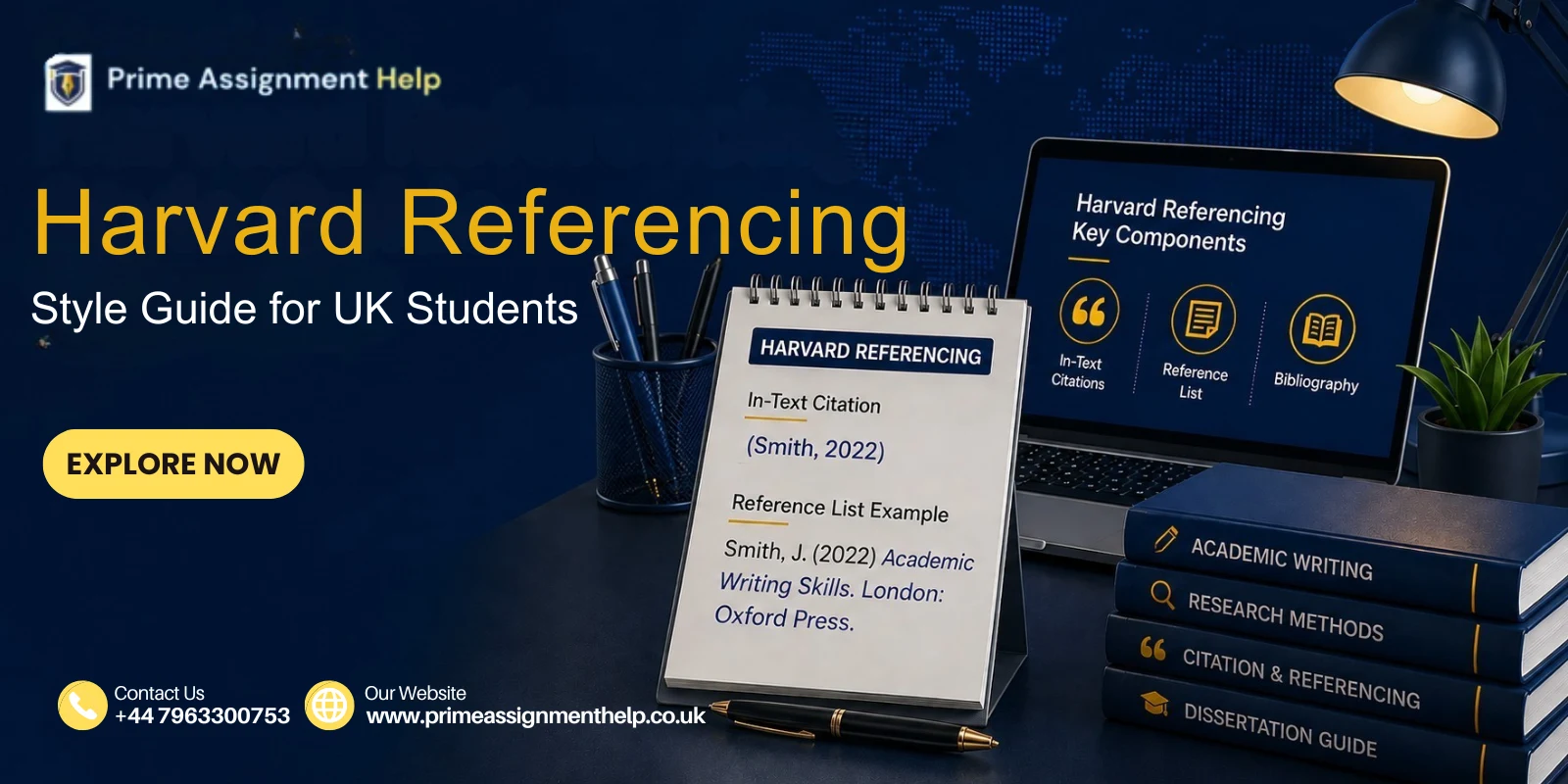
For many students in the UK, Harvard referencing is an important part of academic writing. This citation style uses the author-date method that helps students quote their sources in the approved manner and avoid plagiarism. Though, there can be confusion about when and how to use in-text citations, reference lists, and other formatting rules.
The way you reference changes based on the type of source you are citing, whether it is a book, journal, website, report, or any online media. Understanding the Harvard referencing style rules can help you cite your work correctly and meet your university standards. Hence, in this blog, you will learn its key principles with examples, mistakes to avoid, and reliable guidance for higher studies.
What Is Author-Date System in Harvard Referencing?
The Harvard referencing system is a two-part citation style in which, firstly, you use a short in-text citation, and secondly, a full reference list. The in-text citation shows the author’s surname and year, whereas the alphabetically ordered list provides full publication details. This is called the author-date system.
Because of this citation system, anyone reading your paper can easily look at any citation used in your text and find it in the reference list. If a citation without a matching reference list entry, or vice versa, is found, then you can lose up to 2% to 10% of your overall assignment score.
In-Text Citations: Narrative vs Parenthetical Style
All in-text citations in the Harvard style belong to one of two categories, and if you understand how to use them your writing can sound more natural:
- Author-oriented (narrative): The author’s name comes within the sentence, with the year immediately following in brackets. For instance, Smith (2018) states that student wellbeing is directly connected to the quality of their sleep.
- Information-oriented (parenthetical): the author and year go together within brackets at the end of the sentence. For instance, recent trends demonstrate that (Smith, 2018, p. 15).
The citation rules change slightly when a source has multiple authors. It includes:
- If there are two authors, include both names in every citation: (Smith and Jones, 2020).
- If there are three or more, start with the name of the first author followed by ‘et al.’: (Smith et al., 2019).
Selection between narrative and parenthetical depends largely on your sentence, but if you write a background statement rather than an argument in your text, then you must use the parenthetical format anyway. There is one minor detail that can be easily ignored under time pressure, i.e., if you use a direct quote, you should definitely include the page number: (Smith, 2018, p. 15), whereas paraphrased data does not need one.
Reference List Examples
The reference list goes at the end of your assignment and consists only of the references that have been cited in the text. These are arranged alphabetically as per the authors’ surnames. In addition, most UK universities prefer the use of a hanging indent, where the second and subsequent lines of each citation are indented a bit for easy scanning. An example below illustrates the style:
Smith, J. (2018) Sleep and Student Wellbeing. 2nd edn. Manchester: Palgrave Macmillan.
There is a specific place for each citation component: surname, initials, year of publication, title italicized, and finally the place of publication and publisher. Now that you know how to build one reference list entry correctly, adapting to the pattern for a journal article, website, or other source type becomes far more manageable. There are two exceptions to the rule which will trip up many students: If an author has multiple entries within the same year, you should add a lowercase letter to the year number in both the in-text citation and the reference list entry, like Smith (2018a) and Smith (2018b), and if there is no author, you should alphabetise the citation based on the organization name.
How Do You Reference Different Source Types in Harvard Style?
The citation styles of various sources are a little bit different even though the underlying theory remains the same. Below is the table that contains Harvard style referencing examples to the most commonly used sources by UK students, together with in-text citations for each of them.
| SOURCE TYPE | IN-TEXT CITATION | REFERENCE LIST EXAMPLE |
|---|---|---|
| Book | (Smith, 2018) | Smith, J. (2018) Sleep and Student Wellbeing. 2nd edn. Manchester: Palgrave Macmillan. |
| Journal article | (Jones and Patel, 2019) | Jones, A. and Patel, R. (2019) ‘The impact of social media on student wellbeing’, Journal of Higher Education Studies, 45(3), pp. 210–225. |
| Website | (NHS, 2023) | NHS (2023) Understanding mental health. Available at: https://www.nhs.uk/mental-health (Accessed: 12 March 2025). |
| E-book | (Brown, 2021) | Brown, K. (2021) Digital Marketing Essentials. [E-book]. Available at: [e-reader/platform] (Accessed: 3 February 2025). |
| Newspaper | (Taylor, 2024) | Taylor, M. (2024) ‘University fees set to rise again’, The Guardian, 15 January, p. 8. |
| Thesis | (Ahmed, 2022) | Ahmed, S. (2022) The role of peer support in reducing student anxiety. PhD thesis. University of Leeds. |
| Government website | (Department for Education, 2023) | Department for Education (2023) Higher education student statistics. Available at: https://www.gov.uk/government/statistics (Accessed: 2 April 2025). |
| YouTube video | (University Library, 2025) | University Library (2025) Search Hacks. 12 March. Available at:
(Accessed: 7 April 2025). |
| Conference paper | (Green, 2022) | Green, T. (2022) ‘Rethinking assessment in higher education’, in Proceedings of the UK Learning and Teaching Conference. Birmingham, 4–5 July, pp. 45–52. |
| Podcast episode | (Harris, 2024) | Harris, L. (2024) ‘Referencing without the stress’, The Study Skills Podcast [Podcast]. 9 minutes. Available at: [podcast URL] (Accessed: 20 May 2024). |
Authors’, titles and publication dates provided in the table above are hypothetical examples of sources but the punctuation, sequence and format of these examples correspond to the one used at UK universities, so you may put your sources instead.
Important Referencing Terms for Students
There are several terms that constantly recur in referencing guidance. Understanding these terms will help you understand other parts of this guide:
- Et al. – Abbreviation for ‘and others’, which is used in-text for references to sources with three or more authors (e.g., Smith et al., 2019).
- Hanging indent – The format of a paragraph, in which the first line is placed on the margin while all subsequent lines are indented, which is applied to all references in the list.
- DOI (Digital Object Identifier) – A permanent link to an academic article, which does not depend on any changes in the structure of the journal’s website.
- Secondary referencing – Citation of an article that you have read within another author’s article, but not the original one; e.g. Smith (2015, cited in Jones, 2020).
- Corporate author – An organisation which serves as the author of a source instead of a person, e.g. NHS or Department for Education.
Secondary referencing calls for a bit more caution, because the reference list must include the source which you have read; in the above example, Jones (2020), and not Smith (2015). Many UK examiners like it better when you try to get hold of the source whenever that is feasible. This is because using various secondary references may convey that you have not done the necessary literature reading. If some of these terms still feel unfamiliar once you start drafting your own assignment, dedicated assignment writing help can work through them alongside your actual coursework rather than in the abstract.
7 Harvard Referencing Mistakes That Cost You Marks
It is often negligible errors that cause students to lose referencing marks rather than a fundamental misunderstanding of the system. 7 of the most common mistakes include the following:
- Citation of source in the text with no corresponding entry in the reference list and vice versa
- Incorrect use of italics; some titles are in italics while others are not
- Missing accessed date in case of website and other online resources
- Ordering references by appearance, not alphabetically
- Use of et al. with only two authors while both names should be provided
- Missing out page number in the direct quotation
- Combination of two styles of referencing in the same assignment (e.g., Harvard and another style)
Which UK Universities Use Harvard Referencing?
The Harvard referencing style is a globally used citation technique across universities in the UK. Hence, it is openly available across leading higher education institutions, along with a wide range of study disciplines.
- Renowned Universities: At Manchester, Leeds, and King’s College London, Harvard referencing style is the default one for most disciplines.
- Core Subject Disciplines: Business, Education, Health Sciences, Social Sciences & Humanities, where the majority of the assessment is in the form of written coursework and essays.
- Exceptions: There are some disciplines that use Vancouver or IEEE number referencing styles other than the Harvard referencing style.
There are still some specific requirements depending on each department and individual module, so always refer to your assignment description, because in case marks are awarded for correct referencing, presentation impacts how your final grade is calculated.
Should You Trust Harvard Referencing Generator?
Using referencing software like Zotero and Mendeley will actually save you time, especially when working on longer dissertations with dozens of sources to manage, and most UK libraries strongly recommend using either of these programs. An accuracy of referencing generator totally depends on your data input. Without careful checks, these tools often:
- Format certain sources incorrectly.
- Misrepresent works written by multiple authors.
- Invent information they cannot find.
In any case, you should treat the output as a rough draft and always verify it according to Cite Them Right or your university’s guidelines.
Essential Pre-Submission Checklist
Errors in referencing are likely to go unnoticed when you are doing your assignment since you are familiar with all the references. Before you submit your project, go through this quick list:
- The references are organized alphabetically according to the surnames of the authors
- All the in-text citations correspond with entries in the reference list
- Title of the work is italicized if needed for the particular source type
- A hanging indent is added to the reference list
- The URLs and DOIs have been verified for accuracy
- There is one particular style of referencing used throughout the entire document
Final Thoughts
To sum up the Harvard referencing style requires that one focuses more on the minor details and not natural writing skills. Once the basic pattern behind the system is known, it is quite easy to use it in the whole dissertation. In fact, most of the Harvard referencing UK help is about using the same basic approach to the whole thing – citing as you go rather than trying to build your reading list the night before submission from memory. If you are still confused as to how a particular resource should be cited using the above formats, you can always consult assignment help UK prior to the submission of your work.
Frequently Asked Questions
-
What is the difference between a bibliography and a reference list?
A reference list includes only the sources you have directly cited in your assignment. A bibliography is broader, covering everything you consulted while researching, whether you cited it directly or not. Check your module handbook, since some UK universities use the terms interchangeably.
-
Can students use Harvard citation generators?
Yes, tools such as Zotero and Mendeley are widely used and generally reliable, but they can still misformat unusual sources or produce incomplete entries. Always check the output against Cite Them Right before relying on it in a submitted assignment.
-
How do you reference a source with no named author?
Use the organisation responsible for the source in place of an author name, such as NHS (2023) or Department for Education (2023). The same alphabetical and formatting rules still apply once you have identified the correct name to use.
-
Is Harvard referencing the same as APA?
No, though they are similar. Both are author-date systems, but APA follows one fixed set of rules from a single official manual, while Harvard is a family of related styles, and UK universities usually specify Cite Them Right’s version. Small differences include how multiple authors are joined and exact reference list punctuation, so always follow your own university’s specific guidance rather than assuming the two are interchangeable.
-
Which subjects use Harvard referencing in the UK?
Business, education, health sciences, social sciences and humanities subjects use Harvard referencing most consistently across UK universities, though individual departments and modules can specify a different style, so always confirm the requirement in your own assignment brief.

