

Offer Ticker Bar
OFFER
Special Offer For You - 40% OFF On Every Order Special Offer For You - 40% OFF On Every Order Special Offer For You - 40% OFF On Every Order Special Offer For You - 40% OFF On Every Order Special Offer For You - 40% OFF On Every Order Special Offer For You - 40% OFF On Every Order Special Offer For You - 40% OFF On Every Order Special Offer For You - 40% OFF On Every Order
Hardest GCSE Exam Board
Blog

Which Is the Hardest GCSE Exam Board in 2026? A Complete UK Student Guide

Which Is the Hardest GCSE Exam Board in 2026? A Complete UK Student Guide

Hardest GCSE Exam Board

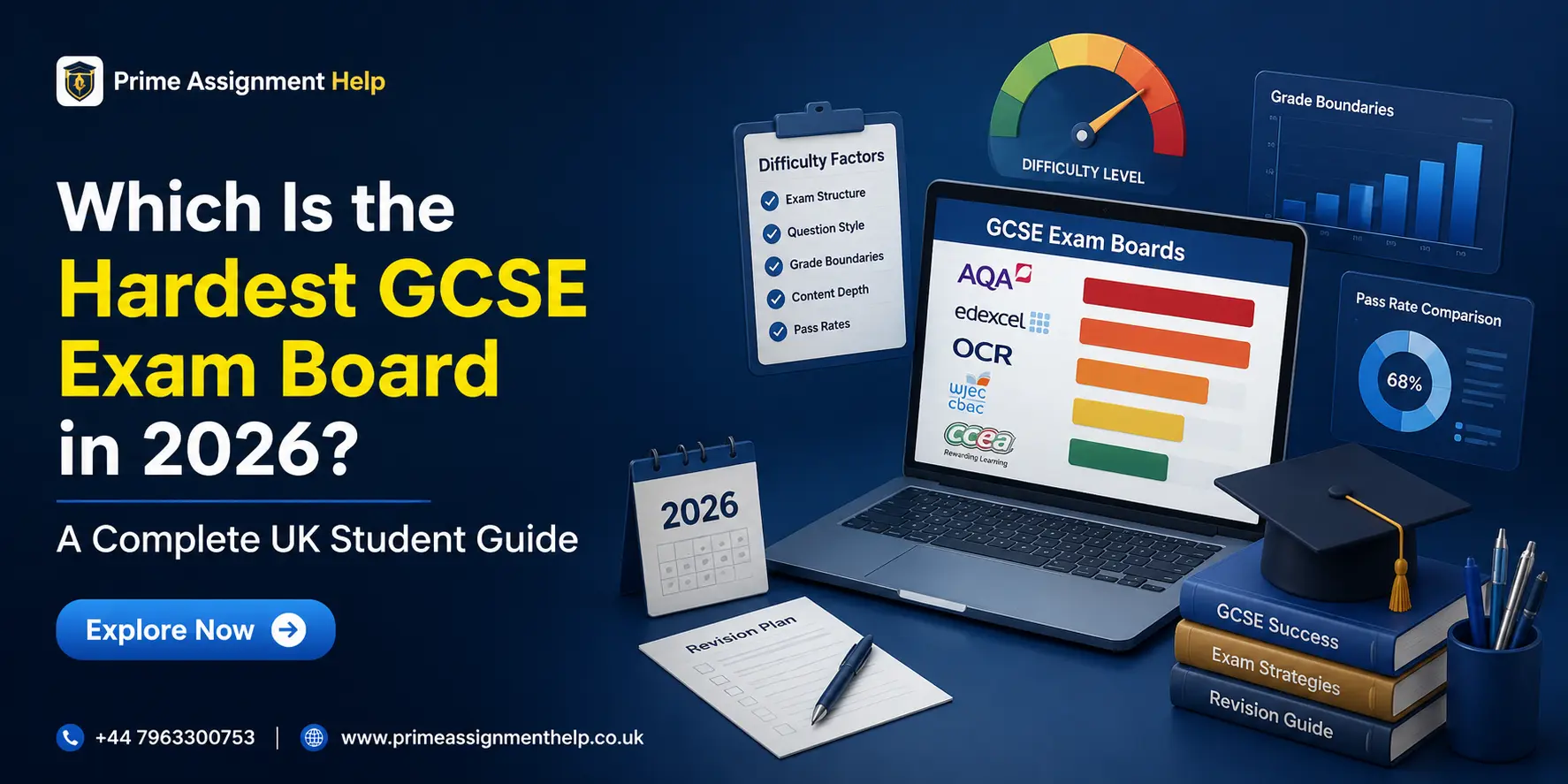
Many GCSE students wonder whether some exam boards are harder than others. If you’ve ever compared papers from AQA, Edexcel, OCR, or WJEC/Eduqas, you’ve probably noticed differences in question styles, marking approaches, and assessment methods. These differences often lead students to believe that certain exam boards are more challenging than others. While all GCSE exam boards are regulated by Ofqual and must maintain comparable standards, the experience of sitting their exams can vary significantly. Some boards are known for analytical and application-based questions, while others are considered more structured and predictable.

In this guide, we’ll compare the main GCSE exam boards in 2026, examine their difficulty across different subjects, and explore which board is most commonly regarded as the hardest. Whether you’re preparing for your GCSEs, supporting a student, or simply curious about exam board differences, this guide will help you understand what sets each board apart.

What Are GCSE Exam Boards in the UK?

GCSE exam boards are organisations responsible for creating course specifications, setting exam papers, and marking student responses. Schools, not students, choose which exam board they use, meaning two students taking the same GCSE subject may sit different exams while still receiving grades on the same 9-1 scale.

All exam boards in England are regulated by Ofqual, which ensures that GCSE grades remain comparable across different boards. While the standards are designed to be equal, the style of questions, exam structure, and assessment methods can vary, which is why some students find certain exam boards more challenging than others.

The Main GCSE Exam Boards in 2026

Choosing the right GCSE exam board can help students understand what to expect in their exams. While all boards follow the national curriculum, their exam styles and levels of challenge can vary.

1. AQA (Assessment and Qualifications Alliance)

AQA is the largest GCSE exam board in England, handling more than half of all GCSE entries. It is known for clear exam structures and questions that gradually increase in difficulty.

2. Edexcel (Pearson)

Edexcel is the second-largest GCSE board and is owned by Pearson. Its exams often focus on analytical thinking, data interpretation, and real-world application of knowledge.

3. OCR (Oxford, Cambridge and RSA Examinations) 

OCR is part of Cambridge University Press & Assessment and accounts for around 15% of GCSE entries. Its papers are often context-based and designed to test understanding rather than simple memorisation.

4. WJEC/Eduqas (Welsh Joint Education Committee)

WJEC/Eduqas is the leading exam board in Wales and is also available to schools in England. It is widely recognised for its rigorous assessments and demanding grading standards.

Each GCSE exam board has its own exam style, so understanding these differences can help students prepare more effectively and perform with greater confidence.

Is One GCSE Exam Board Harder Than Another?

Officially, no. Ofqual sets grade boundaries after each exam series to ensure that GCSE grades remain comparable across all exam boards. If one board’s paper is particularly challenging in a given year, the grade boundary the raw mark needed to achieve each grade is adjusted accordingly. The system is designed to ensure that your final grade reflects your ability rather than the exam board you studied under.

In practice, however, students often notice genuine differences between exam boards. Factors such as question style, time pressure, the amount of writing required and the level of mathematical or analytical thinking can vary significantly from one board to another.

GCSE Exam Board Difficulty Comparison

Exam Board Overall Difficulty Key Characteristics
AQA Moderate Clear structure, predictable papers
Edexcel Hard Analytical and calculation-heavy
OCR Hard Application and interpretation-focused
WJEC/Eduqs Very Hard Rigorous, context-based assessments

For example, a student who is a confident writer may find AQA English very manageable and Edexcel’s interpretive style harder to navigate. A student strong at Maths may find Edexcel Science more natural than AQA’s practical-skills focus.

Which GCSE Exam Board Is Considered the Hardest in 2026?

Among experienced tutors and teachers, the consensus in 2026 looks like this:

WJEC/Eduqas is most consistently identified as the hardest overall. Its context-rich, application-heavy papers across all subjects, combined with rigorous marking, produce statistically fewer top grades than the English boards. It earns its reputation.

Among the three main English boards, Edexcel is hardest at the top end of Maths and most calculation-intensive for Science. OCR is most demanding for students who struggle with open-ended, interpretive questions. AQA is the most manageable and predictable at GCSE level, but makes significant demands in English and extended-writing subjects.

Must Read: Vancouver Referencing – A Quick Guide with Examples for Students

Subject-by-Subject GCSE Exam Board Difficulty Comparison

The difficulty of a GCSE exam board often depends on the subject being studied. While all boards follow similar standards, their question styles, assessment methods, and level of challenge can vary significantly.

1. GCSE Maths

Maths difficulty varies significantly between exam boards, particularly at Higher Tier, where question style and problem-solving demands can have a major impact on student performance. 

Edexcel

Edexcel is widely considered the most challenging GCSE Maths board, particularly for students aiming for Grades 8 and 9. Its Higher Tier papers often feature multi-step, application-based questions that require logical reasoning and problem-solving skills rather than simply recognising familiar question types. As a result, Edexcel Maths grade boundaries are often lower than AQA’s, reflecting the increased difficulty of achieving top marks.

AQA

AQA is generally viewed as the most accessible board, especially at Foundation Tier. Its papers are clearly structured and predictable, making them a popular choice for students working towards Grades 4 and 5.

OCR

OCR sits between AQA and Edexcel in terms of difficulty. Its papers are well organised and consistent but tend to be less demanding than Edexcel at the highest grades.

WJEC/Eduqas

WJEC/Eduqas Maths frequently places questions within real-world contexts, requiring students to identify the mathematical problem before solving it. This can be particularly challenging for students who rely on recognising familiar patterns.

Verdict: Edexcel is the hardest for top-performing students, while AQA is the most approachable overall.

2. GCSE English Language

English Language is one of the subjects where exam board differences are most noticeable. Success depends heavily on reading, writing, and analytical skills under exam conditions.

AQA

AQA is the most widely used board and is known for its demanding writing tasks, particularly Language Paper 2. Students must produce well-structured and persuasive responses within strict time limits, making it challenging for those who struggle with extended writing.

OCR

OCR is often considered the most difficult board for reading comprehension. Its papers include complex texts and less structured questions, requiring students to interpret information independently and think critically.

Edexcel

Edexcel offers a more balanced approach between reading and writing assessments. Many students find its papers slightly more manageable than AQA’s writing-heavy format.

Verdict: AQA is hardest for timed writing, while OCR is hardest for reading comprehension and interpretation.

3. GCSE Science

Science exam boards differ in their approach to practical work, data analysis, and application of scientific knowledge, making some specifications feel more demanding than others. 

AQA Science

AQA Science is generally regarded as the most predictable exam board. Its required practicals follow clear methods, and exam questions often follow familiar patterns. Students who revise systematically can perform well with focused preparation.

Edexcel Science

Edexcel Science is widely viewed as the most mathematically demanding board, particularly in Physics. Papers often include more calculations, graph analysis, and data interpretation, making them challenging for students who are less confident in Maths.

OCR Science

OCR offers two main specifications. Gateway (OCR A) is similar to AQA in its content-focused approach. Meanwhile, 21st Century Science (OCR B) uses real-world contexts and application-based questions, which can be difficult for students who rely heavily on memorisation.

Verdict: Edexcel is hardest for mathematical and analytical skills, OCR 21st Century is hardest for applied thinking, and AQA is the most predictable.

4. GCSE History and Geography

In Humanities subjects, difficulty often depends on essay writing, source analysis, and critical thinking rather than content volume.

Edexcel History

Edexcel History is frequently considered the most demanding due to its challenging source-evaluation questions and analytical requirements. Many teachers regard its source-based assessments as the toughest among the major exam boards.

OCR History

OCR History rewards deeper historical understanding and reasoning rather than memorised essay structures. Students must demonstrate strong analytical skills to achieve the highest grades.

AQA History

AQA History is generally seen as the most structured and accessible option, supported by a wide range of revision resources and past papers.

GCSE Geography

Differences between exam boards are less significant. However, OCR’s fieldwork assessments and AQA’s issue-evaluation questions can be particularly challenging for some students.

Verdict: Edexcel is often considered the hardest for History, while Geography difficulty varies more by topic and assessment style than by exam board.

Ultimately, the hardest GCSE exam board depends on the subject and the individual student’s strengths, revision methods, and learning style.

Why Some Students Find Certain Exam Boards More Difficult

The biggest factor is learning style. Analytical, logical thinkers tend to find Edexcel’s approach more natural. Confident writers thrive with AQA’s extended-response style. Curious, flexible learners who can apply knowledge to unfamiliar scenarios tend to perform better on OCR and WJEC relative to peers who revise more rigidly.

  1. Revision method: matters too. Students who recognise question types and apply memorised methods suit AQA’s predictable structure. Students who genuinely understand their material outperform peers on OCR and WJEC, where unfamiliar questions are the norm.
  2. Teaching quality: specific to a board also matters. A teacher who has taught AQA for fifteen years knows exactly what comes up that familiarity is a genuine advantage.

In the end, the hardest exam board is often the one that least matches a student’s learning style and preparation strategy. 

GCSE Grade Boundaries and Their Impact on Difficulty

Grade boundaries are set after each exam, not before, so the standard-setting process can adjust for paper difficulty in that sitting. If Edexcel Maths Higher is particularly hard in 2026, the Grade 7 boundary will be lower to compensate, meaning a Grade 7 from Edexcel should reflect the same ability as a Grade 7 from AQA, even if the raw marks differ.

Lower boundaries do confirm a paper was harder to score highly on in that sitting. But the boundary adjustment is designed to equalise the grade on the other side. Focus less on comparing boundaries and more on understanding what your board’s papers actually demand.

What Do Teachers and Students Say About GCSE Exam Boards?

Teachers who have worked across multiple boards consistently point to Edexcel Maths Higher as the most demanding for stretching Grade 8 and 9 students, requiring genuine lateral thinking under pressure, not just confident application of learned methods.

For English, the split is consistent: AQA is harder for students who struggle with timed, structured writing; OCR is harder for those who struggle with interpretive comprehension. Neither is universally harder; they are harder in different ways for different students.

Students who have sat WJEC papers frequently describe the experience as more consistently demanding than peers’ accounts of AQA or Edexcel; familiar revision approaches simply do not translate into marks as reliably.

Conclusion 

WJEC/Eduqas is often regarded as the hardest GCSE exam board because of its application-based questions, strict marking, and lower proportion of top grades. Among the English boards, Edexcel is typically considered toughest for Maths and Science, OCR for analytical thinking, and AQA for timed writing.

That said, the hardest exam board is usually the one that doesn’t match your learning style. Understanding what your board rewards and preparing accordingly is far more important than its reputation. For students seeking extra academic support, Prime Assignment Help offers trusted assignment help in uk to help learners achieve their academic goals with confidence.

Read More: 30+ GCSE Creative Writing Examples Every UK Student Should Read Before Exams

Frequently Asked Questions

1. Which GCSE exam board is the hardest overall in 2026?

Many teachers and tutors consider WJEC/Eduqas the hardest GCSE exam board overall due to its application-based questions, rigorous marking standards, and lower proportion of top grades compared with other boards.

2. Is Edexcel GCSE Maths harder than AQA Maths?

Yes, many students find Edexcel GCSE Maths more challenging, especially at Higher Tier, because it includes more multi-step problem-solving and application-based questions than AQA.

3. Do universities prefer one GCSE exam board over another?

No. Universities across the UK treat GCSE grades equally regardless of the exam board. A Grade 7 from AQA, OCR, Edexcel, or WJEC/Eduqas carries the same value during admissions.

4. Why do GCSE grade boundaries differ between exam boards?

Grade boundaries vary because exam papers differ in difficulty each year. Exam regulators adjust boundaries to ensure that grades remain fair and comparable across all GCSE exam boards.

5. How can I find out which GCSE exam board my school uses?

Your school will choose the GCSE exam board for each subject. You can check your course specification, ask your teacher, or visit your school’s exam information page to confirm which board you are studying under.

UK degree classifications
Blog

UK Degree Classifications Explained: What Do 1st, 2:1, 2:2 and 3rd Mean?

UK Degree Classifications Explained: What Do 1st, 2:1, 2:2 and 3rd Mean?

UK degree classifications

If you have just started university or you are nearing graduation the UK degree classification system can feel unnecessarily complicated. What does a 2:1 actually mean? Is a 2:2 good enough to get a job? Will a First really change your life?

These are questions every UK undergraduate asks at some point and rightfully so. Your degree classification follows you throughout your career, influences postgraduate study applications and shapes how employers perceive you before they have even met you.

This guide cuts through the confusion. Whether you are a home student, an international student studying in the UK or a parent trying to decode your child’s transcript, you will find clear, honest and practical answers here.

Why UK Degree Classifications Matter More Than You Think

When you graduate from a UK university, you do not simply receive a pass or fail. You receive a classified degree a formal, nationally recognised grade that reflects your overall academic performance across your entire programme.

This classification appears on your degree certificate, your transcript and every graduate job application you submit. It influences whether you are shortlisted for competitive graduate schemes, whether you qualify for postgraduate study and how academic referees frame your abilities.

Yet despite how significant degree grades in the UK are, many students reach their final year without fully understanding how the system works, what the boundaries mean or how UK university marks are actually calculated.

This guide changes that. Whether you are in your first year trying to understand what you are working towards or in your final year anxiously checking grade boundaries, everything you need is here clearly explained, thoroughly researched and written specifically for the UK context.

The UK University Grading System: A Complete Overview

The UK degree classification system differs fundamentally from grading models used in other countries. Unlike the American GPA system or the percentage-only systems used in parts of Europe and Asia, the UK grading system converts your overall academic performance into a single classification tier.

There are five possible outcomes for an undergraduate honours degree in the UK:

Classification Common Name Typical Percentage Range
First-Class Honours 1st / First 70% and above
Upper Second-Class Honours 2:1 60–69%
Lower Second-Class Honours 2:2 50–59%
Third-Class Honours 3rd 40–49%
Ordinary Degree (Pass) Pass / Ordinary Below 40% (varies by university)

Percentage boundaries vary between institutions. Always consult your university’s academic regulations.

The UK university grading system applies to honours degrees at universities across England, Wales and Northern Ireland. Scottish universities operate on the Scottish Credit and Qualifications Framework (SCQF), though they award honours degrees using the same classification structure.

It is also worth noting that integrated Master’s degrees (such as MEng, MPhys or MChem) use a slightly different classification structure though the underlying percentage thresholds are broadly similar.

Read More: 100+ Trending Google Scholar Research Topics for Students in 2026 

First-Class Honours Degree: What Does a 1st Really Mean?

A first-class honours degree is the highest achievement within the UK degree classification system and is widely recognised as a mark of outstanding academic performance. Achieving a First demonstrates strong subject knowledge, excellent analytical skills and a consistent ability to produce high-quality work throughout a degree programme.

Definition and Grade Boundary

A first-class honours degree commonly called a “First” or “1st”, is the highest classification in the UK degree classification system. The standard threshold is 70% or above, though exact requirements vary. Some universities apply borderline rules that may award a First to students who fall marginally below 70% but meet supplementary criteria.

According to the Higher Education Statistics Agency (HESA), approximately 29% of UK graduates received a first-class honours degree in recent years a proportion that has risen considerably over the past decade, fuelling ongoing debate about grade inflation.

What a First-Class Honours Degree Opens Up

Achieving a first-class honours degree carries genuine weight, particularly in competitive fields. Here is what it typically unlocks:

  • Graduate employment: Many elite graduate schemes in law, finance, consulting, and the Civil Service list a First as a preferred if not required classification
  • Postgraduate study: A first-class honours degree is the standard entry requirement for funded PhD programmes and highly competitive Master’s courses at Russell Group universities
  • Scholarships and funding: Research council funding (ESRC, AHRC, EPSRC) and competitive scholarships frequently require or strongly favour a First
  • Academic careers: If you are considering a career in academia, a first-class honours degree is essentially the minimum starting point

Does Everyone Who Gets a First Deserve One?

This is the question the UK higher education sector is grappling with. Grade inflation the rise in Firsts awarded over time has prompted scrutiny from employers, the Office for Students (OfS) and universities themselves. Some institutions have introduced stricter moderation and external examining processes as a result.

What this means practically: a first-class honours degree remains highly valued, but employers and admissions teams increasingly look at the full picture your dissertation grade, your university’s reputation, your references and your extracurricular record.

Upper Second-Class Honours (2:1): The UK Benchmark Degree

Among all UK degree classifications, the upper second-class honours degree (2:1) is often considered the benchmark for academic and professional success. It is the most common classification awarded by UK universities and is widely accepted by employers, postgraduate institutions and professional bodies across the country.

What Is an Upper Second-Class Honours Degree?

An upper second-class honours degree (2:1) is awarded to students who achieve an overall average between 60% and 69%. It demonstrates strong academic performance, solid subject knowledge, and the ability to produce high-quality university-level work throughout a degree programme.

Why a 2:1 Matters

A 2:1 is often regarded as the minimum requirement for many competitive graduate schemes. Employers in sectors such as finance, law, consulting, accountancy, and the public sector frequently use this classification as a benchmark when recruiting graduates. As a result, it remains one of the most valuable degree grades UK students can achieve.

Is a 2:1 Good for Postgraduate Study?

Yes. Most UK Master’s programmes, including MA, MSc, LLM, and PGCE courses, typically require a 2:1 for entry. Holding an upper second class honours degree can also improve access to scholarships, funded opportunities, and highly competitive postgraduate programmes.

Lower Second-Class Honours (2:2): Is It Good Enough?

A lower second-class honours degree (2:2) covers the 50–59% range and is a recognised honours qualification awarded by UK universities. Although many students worry about receiving a 2:2, it means you have successfully completed your degree and met the academic standards required for graduation.

Where a 2:2 May Create Challenges

Some competitive opportunities may prefer a 2:1 or above, including:

  • Elite graduate schemes in finance and law
  • Civil Service Fast Stream programmes
  • Certain postgraduate courses
  • Academic scholarships and research funding

Where a 2:2 Can Still Open Doors

A 2:2 does not prevent career success. Many employers focus on skills, experience, and potential rather than classification alone. Graduates with a 2:2 can find opportunities in:

  • Technology and digital marketing
  • Creative industries
  • NHS and public sector roles
  • Retail and hospitality management
  • Entrepreneurship

Many universities also accept 2:2 graduates onto Master’s programmes, particularly when supported by relevant work experience or a strong personal statement. Over time, professional achievements often matter far more than your degree classification.

Third-Class Honours Degree: What Does a 3rd Mean?

Although a third-class honours degree is the lowest honours classification awarded by UK universities, it remains a recognised academic qualification and demonstrates the successful completion of an undergraduate honours programme.

The 3rd Class Honours Classification Explained

A third-class honours degree (3rd) is typically awarded to students who achieve an overall average between 40% and 49%. While it is the lowest honours classification in the UK, it still represents the successful completion of an honours degree and a recognised university qualification.

The Impact of a Third-Class Degree

A Third may limit access to some opportunities, including:

  • Competitive graduate schemes
  • Certain postgraduate programmes
  • Academic and research careers
  • Some professional qualification routes

However, many career paths place greater emphasis on practical skills, experience, and achievements than degree classification. Graduates with a third class honours degree can still build successful careers in:

  • Sales and business development
  • Creative and freelance industries
  • Digital and technology roles
  • Skilled technical professions
  • Entrepreneurship

Extenuating Circumstances

In some cases, a Third may result from personal challenges such as illness, financial difficulties, caring responsibilities, or other exceptional circumstances. If these factors affected your academic performance, universities may offer support through formal extenuating circumstances procedures. Over time, professional experience and career achievements often become far more important than your final degree classification.

How Are UK University Marks and Degree Classifications Calculated?

The process used to calculate UK university marks and final degree outcomes can vary between institutions. However, most universities follow similar principles that combine weighted averages, module credits and classification rules to determine a student’s final degree result.

Degree Classifications

The Calculation Methods Used Across UK Universities

Understanding how UK university marks translate into a final classification is something many students never investigate until it is too late. The methodology varies between institutions, but most use one of the following approaches.

Method 1: Weighted Year Average

The most common approach weights your final year more heavily than earlier years. A typical structure looks like this:

Academic Year Contribution to Final Degree
Year 1 0% (pass/fail only)
Year 2 33%
Year 3 (Final Year) 67%

This structure means your final year carries enormous weight in determining your degree classification. A strong final year particularly a high-scoring dissertation can lift your overall average significantly.

Method 2: Credit-Weighted Average

Some universities calculate UK university marks based on the credit value attached to each module. A 30-credit module contributes proportionally more to your final average than a 15-credit module. This rewards consistent performance across high-credit, high-stakes assessments.

Method 3: Borderline Classification Rules

Many universities operate specific borderline rules for students whose average falls just below a classification boundary. For example, a student averaging 68.5% might be considered for a First if they meet criteria such as:

  • A minimum percentage of credits achieved at First level (commonly 50% or more)
  • A dissertation or final project graded at First level
  • A “best of” calculation using their top-performing modules

This is critically important: if your average sits within 2–3% of a classification boundary, read your university’s academic regulations carefully. Borderline rules are not automatic they must be triggered by specific conditions.

UK Degree Grades vs. International Grading Systems

For international students studying in the UK or UK graduates applying to universities and employers abroad, understanding how degree grades in the UK translate internationally is essential.

UK Classification US GPA European ECTS Australian Grade Indian Equivalent
First-Class Honours 3.7–4.0 A – Excellent High Distinction 75–100% (Distinction)
Upper Second (2:1) 3.3–3.6 B – Very Good Distinction / Credit 60–74% (First Division)
Lower Second (2:2) 2.7–3.2 C – Good Credit / Pass 50–59% (Second Division)
Third-Class Honours 2.0–2.6 D – Satisfactory Pass 40–49% (Pass)

These equivalencies are approximate. Official conversion varies by institution and country. Always verify with the receiving institution.

The absence of a GPA on UK degree transcripts can cause confusion for international employers. If you are applying for roles or study programmes abroad, many UK institutions can provide a GPA conversion letter or you can use the British Council’s international grade equivalencies as a reference.

Read More: Top Education Boards in the UK – Complete Guide for Students & Parents

What Employers and Postgraduate Programmes Actually Look For

While UK degree classifications remain important, employers and universities increasingly take a broader view when assessing candidates. Degree grades often act as an initial filter, but long-term success depends on a combination of academic achievement, practical experience, transferable skills, and personal potential.

Graduate Employers: The Full Picture

The UK grading system gives employers a quick signal about academic performance, but it is rarely the only or even the most important factor in hiring decisions. Leading UK employers use a combination of:

  • Degree classification (minimum threshold)
  • Relevant internship and work experience
  • Situational judgement tests and aptitude assessments
  • Video interviews and assessment centres
  • Extracurricular involvement and leadership roles
  • Quality of references

For early-career applications typically within two to three years of graduation degree classification carries more weight. After that, your professional track record becomes the dominant factor.

Academic Writing in UK Universities and Postgraduate Entry

For postgraduate admissions, the quality of your academic writing in UK universities context often matters as much as your classification. A strong personal statement, writing sample or research proposal can compensate for a lower degree grade in many cases.

Programmes that place heavy emphasis on academic writing in UK universities standards such as MAs in English, History or Social Sciences will scrutinise your ability to construct coherent arguments, engage with scholarly literature and demonstrate critical thinking. This is an area where targeted preparation pays dividends.

Conclusion

TUnderstanding UK degree classifications is essential for every student studying in the UK. Whether you achieve a First-Class Honours, a 2:1, a 2:2 or a Third-Class degree, your classification can influence future employment and postgraduate opportunities. However, success is not determined by grades alone. Strong academic skills, practical experience and continuous learning are equally important.

From coursework and dissertations to exam preparation and referencing, every assessment contributes to your final result. For students looking to strengthen their academic performance and better understand university expectations, Prime Assignment Help provides expert guidance on academic writing, referencing, coursework and dissertation support. If you are seeking reliable assignment help in UK, the right academic support can improve your understanding, boost your confidence and help you achieve the best possible degree classification.

Frequently Asked Questions

Q1: What are the UK degree classifications in order? 

From highest to lowest, the UK degree classification system runs: First-Class Honours (1st), Upper Second-Class Honours (2:1), Lower Second-Class Honours (2:2), Third-Class Honours (3rd) and Ordinary Degree (Pass). Most undergraduate programmes award an honours degree upon successful completion.

Q2: Is a 2:2 a good degree in the UK? 

A 2:2 (lower second-class honours) is a legitimate, recognised UK degree. Whilst some competitive graduate schemes require a 2:1, many employers in technology, creative industries, healthcare and the public sector recruit 2:2 graduates and assess candidates on skills and experience. A 2:2 does not make you unemployable.

Q3: How is a UK degree classification calculated? 

Most UK universities calculate degree classifications using a weighted average, with final-year performance carrying the greatest weight (often 67%). Year 1 is commonly excluded from the final calculation. Borderline rules may apply to students whose average falls close to a classification boundary.

Q4: Can I do a Master’s degree with a 2:2? 

Yes, in many cases. Whilst a 2:1 is the standard requirement, many UK universities consider applicants with a lower second-class honours degree if they can demonstrate relevant work experience, professional development or a strong personal statement.

Q5: Does degree classification matter after 5 years of work? 

Generally, degree classification becomes less significant after several years in the workforce. Employers and recruiters focus increasingly on professional achievements, skills and career progression. The UK grading system is most influential in the first two to three years post-graduation.

level 3 qualification uk
Blog

What Is a Level 3 Qualification in the UK? Types, Equivalents & Entry Requirements (2026)

What Is a Level 3 Qualification in the UK? Types, Equivalents & Entry Requirements (2026)

level 3 qualification uk

A Level 3 qualification in the UK is an advanced credential that sits above GCSEs and below degree-level study and for millions of learners, it is the single most important step in their education and career journey. Whether you are a school leaver deciding what comes after GCSEs, an adult returning to education, or a working professional looking to formalise your skills, understanding what a Level 3 qualification means, what it is worth and which type suits you is essential before you commit your time and money.

This guide covers everything in plain terms, from the RQF level 3 qualification framework and equivalencies to BTEC Level 3 qualification grades, funding routes and what you can actually do once you hold one. If you have been searching for a clear, honest breakdown of Level 3 qualifications in the UK, you are in the right place.

What Is a Level 3 Qualification in the UK?

A Level 3 qualification in the UK is a regulated credential placed at Level 3 on the Regulated Qualifications Framework (RQF), the official system used across England, Wales and Northern Ireland to rank qualifications by difficulty and size. Level 3 sits directly above GCSE level (Level 2) and below higher education (Level 4 and above).

At this level, learners are expected to demonstrate in-depth knowledge, independent thinking and the ability to apply skills in complex situations, whether in a classroom, a workplace, or both. It is the standard entry point for university, higher apprenticeships and skilled professional roles across virtually every sector in the UK.

Level 3 Qualification Equivalent: How Does It Compare?

The most widely understood Level 3 qualification equivalent is an A-Level. However, that comparison is a starting point, not the full picture. Several different qualification types all sit at Level 3 on the RQF and they differ considerably in how they are studied, assessed and valued by universities and employers.

Qualification Type Assessment Style A-Level Equivalent
A-Level Academic Written exams Yes direct equivalent
BTEC Level 3 National Vocational Coursework and projects Yes, subject to UCAS points
NVQ Level 3 Work-based On-the-job observation Yes practical focus
T-Level Technical Classroom + industry placement Yes, equivalent to 3 A-Levels
Access to HE Diploma Academic/Vocational Assignments and exams Yes, university entry route
Level 3 Certificate / Diploma Mixed Varies by provider Yes, varies by size

Being at the same level does not mean these qualifications are interchangeable. A-Levels are heavily academic and exam-driven, while NVQ Level 3 is entirely practical and assessed in the workplace. A BTEC Level 3 qualification sits somewhere in the middle, combining vocational learning with coursework-based assessments rather than traditional exams. Students studying BTEC programmes often seek coursework help to manage assignments and meet assessment criteria effectively. Universities and employers evaluate these qualifications differently depending on the skills and knowledge they require. 

Types of Level 3 Qualifications in the UK

There is no single “Level 3 qualification.” Several different credential types sit at this level, each designed for a different kind of learner and career goal.

A-Levels

A-Levels are the traditional academic route for 16–18 year-olds, studied over two years in school sixth forms or further education colleges. They are assessed almost entirely through written examinations and remain the most widely accepted route into UK universities. Most degree programmes require a minimum of two or three A-Levels alongside sufficient UCAS tariff points.

BTEC Level 3 Qualification

A BTEC Level 3 qualification is a vocational alternative to A-Levels, developed by Pearson and available across hundreds of subject areas. Rather than end-of-year written exams, BTECs are assessed continuously through coursework, assignments and practical projects, making them well-suited to learners who prefer an applied, hands-on approach.

BTEC Level 3 Type Duration A-Level Equivalent
BTEC National Certificate 1 year 1 A-Level
BTEC National Diploma 2 years 2 A-Levels
BTEC National Extended Diploma 2 years 3 A-Levels

Popular subject areas include Business, Health and Social Care, Engineering, IT, Sport and Performing Arts. BTECs carry UCAS tariff points and are accepted for university entry by the vast majority of UK higher education institutions.

NVQ Level 3

An NVQ (National Vocational Qualification) at Level 3 is entirely work-based. Assessment happens on the job through observation, a portfolio of evidence and professional witness statements with no written examinations. NVQ Level 3 is widely used in health and social care, construction, childcare, business administration and engineering and is particularly valuable for people already working in a field who want formal recognition of their competence.

T-Levels

T-Levels are a technical qualification introduced by the UK government from 2020 onwards, designed as a direct Level 3 alternative to A-Levels for 16–19 year-olds. Each T-Level includes classroom learning combined with a minimum 45-day industry placement with an employer. They are currently available in areas including Digital, Construction, Health and Science, Education and Early Years and Finance. A T-Level is considered equivalent to three A-Levels for UCAS purposes.

Access to Higher Education Diploma

The Access to HE Diploma is specifically designed for adults aged 19 and over who did not follow the traditional A-Level route but want to enter university. It is a Level 3 qualification accepted by the majority of UK universities as a valid entry credential for undergraduate degrees and is widely studied at further education colleges across the country.

Level 3 Award, Certificate and Diploma: What Is the Difference?

Within the RQF, “Award,” “Certificate,” and “Diploma” are size descriptors that indicate the volume of learning, not the difficulty level.

Size Descriptor Credit Value Typical Duration
Award 1–12 credits Short course (weeks to a few months)
Certificate 13–36 credits Several months
Diploma 37+ credits Six months to over a year

Two qualifications can both be “Level 3”, but one may be a short Award worth 6 credits and another a full Diploma worth 60 credits. Always check both the level and the size when comparing courses.

RQF Level 3 Qualification Understanding the Framework

The Regulated Qualifications Framework (RQF) is the official system that organises every recognised qualification in England and Northern Ireland by level of difficulty and size. It is regulated by Ofqual and replaced both the National Qualifications Framework (NQF) and the Qualifications and Credit Framework (QCF) in 2015.

When a course listing or job specification mentions an “RQF Level 3 qualification,” it means the credential has been officially regulated, quality-assured and placed at Level 3 on this national scale, making it directly comparable to any other Level 3 qualification regardless of which awarding body issued it.

Every RQF qualification has two defining features:

  • A level indicating difficulty (Entry Level through to Level 8)
  • A size described as an Award (smallest), Certificate (medium), or Diploma (largest)

RQF Levels at a Glance

RQF Level Equivalent Qualification
Entry Level Foundation and functional skills
Level 1 GCSE grades 1–3 (D–G)
Level 2 GCSE grades 4–9 (A*–C)
Level 3 A-Levels, BTEC Nationals, NVQ Level 3, T-Levels
Level 4 Higher National Certificate (HNC)
Level 5 Higher National Diploma (HND), Foundation Degree
Level 6 Bachelor’s Degree (BA, BSc)
Level 7 Master’s Degree (MA, MSc)
Level 8 Doctorate / PhD

Knowing where your qualification sits on the RQF matters practically it determines what courses you can apply for, which job roles you are eligible for and what professional training you can progress to next.

BTEC Level 3 Qualification: What You Need to Know

The BTEC Level 3 qualification is one of the most popular vocational routes in the UK, yet it is also one of the most commonly misunderstood when it comes to university applications and career value.

Grading system: BTECs do not use A, B, C grades. Instead, they grade as Pass (P), Merit (M), Distinction (D) and Distinction* (D*). For the Extended Diploma, these translate into UCAS tariff points as follows:

BTEC Level 3 Extended Diploma Grade UCAS Tariff Points
DDD* 168
DDD 144
DDM 128
DMM 112
MMM 96
MMP 80
MPP 64

BTEC vs A-Level: Which suits you better?

If you prefer continuous assessment over high-pressure end-of-year exams and you want to study a vocational subject with real applied content, a BTEC Level 3 qualification is a strong and well-respected route. If you are targeting highly competitive academic courses in medicine, dentistry, or law at Russell Group universities, A-Levels are typically the more suitable path. Many students combine one or two A-Levels with a BTEC qualification to keep their options as broad as possible.

Read More: Grading System in UK Universities: A Complete Guide for Students

Who Can Study a Level 3 Qualification in the UK? 

A Level 3 qualification in the UK is not exclusive to school leavers. It is designed to be accessible at multiple stages of life:

  • School leavers (16–18) progressing from GCSEs into sixth form, college, or an apprenticeship programme
  • Adult learners (19+) returning to education after a gap, whether to retrain, change careers, or access university for the first time
  • Working professionals who need a formal Level 3 credential to meet a professional requirement, gain a promotion, or move into a supervisory role
  • Career changers entering a new sector who need a recognised qualification to support their transition

Many learners balancing Level 3 study alongside employment or family commitments find the workload demanding, particularly on coursework-heavy programmes like BTECs or Access to HE Diplomas. Those who need support with written assignments often seek assignment help in the UK to manage deadlines and maintain the quality of their work.

What Can You Do with a Level 3 Qualification in the UK?

A Level 3 qualification in the UK is genuinely one of the most versatile credentials you can hold. Here is what it directly enables:

University entry – A-Levels, BTEC Level 3 Extended Diplomas, T-Levels and Access to HE Diplomas all provide the UCAS tariff points required for undergraduate degree applications at UK universities. Entry requirements vary by course and institution.

Higher and degree apprenticeships – Most Level 4 and Level 5 apprenticeship programmes require a Level 3 qualification as a minimum entry point, making it the gateway to earning while you study at a higher level.

Skilled employment – Supervisory, technical and specialist roles across health and social care, construction, IT, childcare, engineering and business administration commonly require Level 3 as a minimum qualification.

Progression to Level 4 and Level 5 – Completing a Level 3 qualification opens direct pathways to Higher National Certificates (HNC at Level 4), Higher National Diplomas (HND at Level 5), foundation degrees and professional qualifications such as CIPD, CIMA and ILM – without necessarily committing to a full three-year undergraduate degree.

How to Get a Level 3 Qualification in the UK and Is It Free?

Depending on your age, employment status and whether you already hold a Level 3 qualification, there are several funded routes available in England:

Funding Route Who It Applies To
16–19 Education Funding School leavers in full-time study at colleges or sixth forms
Free Courses for Jobs Scheme Adults 19+ who do not already hold a Level 3 qualification
Advanced Learner Loan Adults 19+ who do not qualify for free funding
Employer Funding / Training Budget Employees studying a qualification relevant to their role
Apprenticeship Levy Funding Learners on eligible apprenticeship programmes

The Free Courses for Jobs scheme is particularly significant it fully funds selected Level 3 qualifications at further education colleges for eligible adults in England. Eligibility is based on employment status and whether you already hold a Level 3 credential. The Advanced Learner Loan functions similarly to a student loan, with repayment only beginning once your earnings exceed the repayment threshold.

Online study is increasingly available for many Level 3 qualifications, offering flexibility for those who cannot attend college in person.

Final thoughts

A Level 3 qualification is one of the most versatile credentials in the UK education system. Whether you choose A-Levels, a BTEC, an NVQ, or an Access to HE Diploma, the right choice depends on how you learn best and where you want to go next.

Before enrolling, confirm the specific requirements of your target university, employer, or professional body and check your funding eligibility early. Getting these details right upfront saves time and sets you up for a smooth progression to whatever comes next.

Frequently Asked Questions

1. Is NVQ Level 3 the same as an A-Level?

Both sit at Level 3 on the RQF, so they are academically equivalent in terms of level. However, they are fundamentally different in style and purpose. An A-Level is exam-based and academically focused; an NVQ Level 3 is work-based and assessed entirely through practical demonstration on the job. Universities generally accept A-Levels and BTECs for entry rather than NVQs, whilst employers in skilled trades and care sectors typically place high value on NVQ Level 3.

2. Can I go to university with a Level 3 qualification? 

Yes. A-Levels, BTEC Level 3 National Extended Diplomas, T-Levels and the Access to Higher Education Diploma are all accepted by UK universities for undergraduate entry. The specific entry requirements, including minimum UCAS tariff points, vary by institution and course. Always check the UCAS website and the university’s own entry requirements before applying.

3. How long does a Level 3 qualification take to complete?

It depends on the qualification type. A-Levels typically take two years full-time. A BTEC Level 3 National Extended Diploma takes one to two years. NVQ Level 3 is work-based and usually completed over 12 to 24 months, depending on how frequently you are assessed. The Access to HE Diploma is typically a one-year full-time programme. Online and part-time routes offer additional flexibility.

4. Is a BTEC Level 3 Extended Diploma equivalent to three A-Levels?

Yes. The BTEC Level 3 National Extended Diploma is widely recognised as equivalent to three A-Levels in terms of UCAS tariff points. The vast majority of UK universities accept it for undergraduate entry, though some highly competitive courses may specify additional requirements.

5. What is the difference between a Level 3 Certificate and a Level 3 Diploma? 

The difference is in size, not difficulty. Both are Level 3 on the RQF, meaning the standard of learning is the same. A Level 3 Certificate covers 13–36 credits and is a shorter programme, whereas a Level 3 Diploma covers 37 or more credits and involves a significantly greater volume of learning. When comparing courses, always check both the level and the size descriptor together.