

Offer Ticker Bar
OFFER
Special Offer For You - 40% OFF On Every Order Special Offer For You - 40% OFF On Every Order Special Offer For You - 40% OFF On Every Order Special Offer For You - 40% OFF On Every Order Special Offer For You - 40% OFF On Every Order Special Offer For You - 40% OFF On Every Order Special Offer For You - 40% OFF On Every Order Special Offer For You - 40% OFF On Every Order
UCAS Points
Blog

How UCAS Points Work for UK University Admissions

How UCAS Points Work for UK University Admissions

UCAS Points

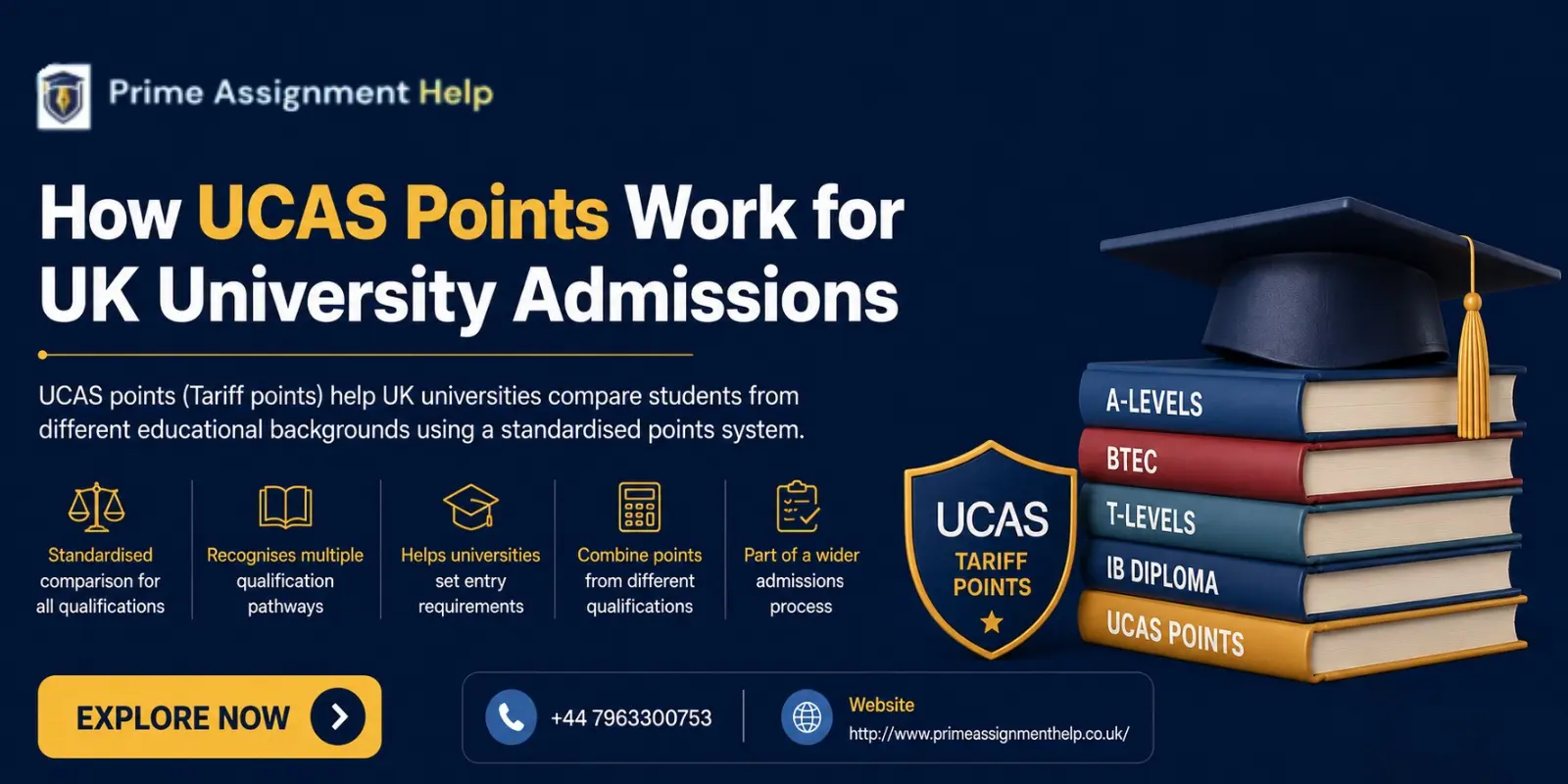
UK universities receive applications from students with a wide range of qualifications, including A-Levels, BTECs, T-Levels and the International Baccalaureate (IB). To make admissions decisions fair and consistent, many institutions use the UCAS Tariff system, which converts qualifications and grades into a standardised points score known as UCAS points.

These points help universities assess whether applicants meet course entry requirements and provide a simple way to compare different qualification pathways. Understanding how UCAS points work is therefore essential for students who want to evaluate their university options, calculate their eligibility and make informed application decisions. This guide explains what UCAS points are, how the UCAS Tariff system works, the points awarded for different qualifications and how universities use these scores during the admissions process.

What Are UCAS Points?

UCAS points, also known as UCAS Tariff points, are numerical values assigned to specific qualifications and grades. The system allows universities to compare applicants who may have studied different qualifications before applying.

Instead of reviewing every qualification individually, universities can use a common points-based system to determine whether a student meets the academic standard required for a course.

For example:

  • An A* at A-Level is worth 56 UCAS points.
  • An A grade is worth 48 UCAS points.
  • A B grade is worth 40 UCAS points.

The total points from all your qualifications can then be added together to create your overall UCAS Tariff score.

Understanding UCAS Points for Different Qualifications

UCAS points are awarded based on the qualification type and grade achieved. Universities use these points to compare applicants from different academic backgrounds and determine whether they meet course entry requirements.

UCAS Points for A-Levels

A-Levels are one of the most common qualifications used for UK university admissions and contribute directly to a student’s UCAS Tariff score. 

Grade UCAS Points
A* 56
A 48
B 40
C 32
D 24
E 16

UCAS Points for BTEC Extended Diploma

BTEC Extended Diplomas can contribute a substantial number of UCAS points and are widely accepted by UK universities. 

Grade UCAS Points
DDD* 168
DDD 144
DDM 128
DMM 112
MMM 96
MMP 80

UCAS Points for the EPQ

The EPQ offers additional UCAS points while helping students develop valuable research and academic skills. 

Grade UCAS Points
A* 28
A 24
B 20
C 16
D 12
E 8

These qualifications represent some of the most common routes into higher education. Understanding their UCAS Tariff values can help you estimate your score and identify universities that match your academic profile.

Must Read: 100+ Dissertation Examples – Complete Guide with Samples for UK Students

Why UCAS Points Matter for University Admissions

UCAS points play an important role in the university admissions process by providing a consistent way for institutions to compare applicants from different educational backgrounds.

1. Create a Standardised Comparison System

UCAS points allow universities to compare students who have completed different qualifications using a single scoring framework, making the admissions process more efficient and fair.

2. Support Multiple Qualification Pathways

Students can earn UCAS points through qualifications such as A-Levels, BTECs, T-Levels, the International Baccalaureate (IB) and EPQs, ensuring that different academic routes are recognised.

3. Help Universities Set Entry Requirements

Many universities use UCAS Tariff points to establish minimum academic requirements for courses, helping applicants determine whether they meet the expected standard.

4. Allow Qualification Combinations

The Tariff system enables students to combine points from multiple qualifications, making it easier for those following mixed study pathways to meet entry requirements.

5. Form Part of a Wider Admissions Process

Although UCAS points are important, universities also consider factors such as subject-specific grades, personal statements, references, portfolios and relevant experience when making admissions decisions.

Overall, UCAS points help create a more flexible and transparent admissions system while giving students from various educational backgrounds equal opportunities to apply for higher education courses.

How the UCAS Tariff System Works

The UCAS Tariff system converts different qualifications and grades into a standard points score that universities can easily compare during the admissions process.

1. Qualification Size Matters

Larger qualifications are worth more UCAS points than smaller ones because they involve more study and assessment. For example, a BTEC Extended Diploma can generate significantly more points than a single qualification unit.

2. Higher Grades Earn More Points

The better your grade, the more UCAS points you receive. Students who achieve higher grades will therefore build a stronger overall Tariff score.

3. Different Qualifications Are Included

The Tariff system covers a wide range of qualifications, including A-Levels, BTECs, T-Levels, the International Baccalaureate (IB), Scottish Highers and EPQs.

4. Universities Use Points Differently

While some universities publish entry requirements using UCAS points, others focus on specific grades and subjects. Many institutions use a combination of both approaches.

5. The Current System Was Introduced in 2017

The existing UCAS Tariff replaced the previous system in 2017, meaning older point values found online may no longer be accurate.

Understanding these principles can help students calculate their UCAS points more accurately and make informed decisions when applying to UK universities.

Understanding University Entry Requirements and UCAS Point Calculations

UCAS points help universities assess whether applicants meet the academic requirements for their chosen course. They also allow students to compare their qualifications against course entry criteria before applying.

How Universities Use UCAS Points

Universities use UCAS points in different ways depending on the course and institution. Some set a specific Tariff requirement, allowing students to meet the target through various qualification combinations. Others focus more on particular grades and subjects, especially for competitive courses. Many universities also use a combination of both methods, requiring a minimum UCAS point total alongside specific subject grades. For this reason, students should always check the exact entry requirements for each course they plan to apply for.

How to Calculate Your UCAS Points

Calculating UCAS points involves matching your qualification grades to their corresponding Tariff values and adding the points together. This process helps students understand whether they meet university entry requirements and identify suitable course options. The official UCAS Tariff Calculator is the most reliable tool for checking your total score, particularly if you are combining different qualification types.

Understanding both university requirements and your own UCAS score can make the application process more straightforward and help you make informed decisions about where to apply.

Common Mistakes Students Make with UCAS Points

One of the most frequent mistakes is assuming every university uses the Tariff system the same way or that points alone guarantee an offer. Many institutions prioritise specific grades over total scores, so meeting a points threshold doesn’t always mean meeting the actual entry requirement.

Students also sometimes reference outdated point values from before the 2017 change, causing confusion when their totals don’t match modern requirements. Another error is overlooking subject-specific conditions buried in the small print, which can disqualify an otherwise strong application even with a high points total. Finally, some students focus so heavily on maximising points that they neglect their personal statement or work experience, both of which can be decisive when competition is tight.

Conclusion

Understanding how UCAS points work can make the UK university application process much easier and help students choose courses that match their academic profile. By calculating your Tariff score, checking entry requirements carefully and preparing a strong application, you can improve your chances of securing a university offer.

While UCAS points are an important part of admissions, universities also consider factors such as subject-specific grades, personal statements and relevant experience. For students seeking extra academic support during their studies, Prime Assignment Help offers trusted Assignment Help UK services to help learners achieve their academic goals with confidence.

Read More: How to Write a Bibliography – Step-by-Step Guide for UK Students

FAQs

1. How many UCAS points do I need to get into a UK university?

The number of UCAS points required depends on the university and course. Many undergraduate programmes require between 96 and 128 UCAS points, although some competitive courses may have higher entry requirements.

2. Can I combine UCAS points from different qualifications?

Yes, UCAS points can be combined from recognised qualifications such as A-Levels, BTECs, T-Levels and the EPQ. This allows students from different educational pathways to meet university entry requirements.

3. Do all UK universities use UCAS Tariff points?

No, not all universities use the UCAS Tariff system. Some institutions prefer grade-specific offers, while others use a combination of UCAS points and subject-specific grade requirements.

4. Does the EPQ help with university applications?

Yes, the Extended Project Qualification (EPQ) can provide additional UCAS points and demonstrate valuable skills such as independent research, critical thinking and time management, which many universities value.

5. What should I do if I do not meet the required UCAS points?

If you fall short of the required UCAS points, you may still have options such as UCAS Clearing, foundation year programmes, resitting qualifications or applying to courses with lower entry requirements.

Controversial debate topics
Blog

200+ Controversial Debate Topics (2026) Interesting, Fresh & Ready to Use

200+ Controversial Debate Topics (2026) Interesting, Fresh & Ready to Use

Controversial debate topics

Picking the right topic can make or break a debate. Whether you are preparing for a classroom session, a university competition, or just looking to spark a meaningful conversation, controversial debate topics push people to think critically, challenge their assumptions and argue with evidence rather than emotion. The best debates happen when both sides have something genuine to defend and that is exactly what a well-chosen controversial topic gives you.

In 2026, the world is dealing with questions that did not even exist a few years ago. From AI replacing jobs to social media age restrictions, the landscape of controversy has never been wider. This blog covers 200+ carefully selected controversial debate topics across every major category, along with tips on how to choose the right one and how to win your next debate. Whether you are a school student or a postgraduate researcher, you will find something here that sparks your thinking.

What Makes a Good Controversial Discussion Topic?

Not every sensitive subject makes a great debate topic. A genuinely strong controversial discussion topic has a few key qualities that make it worth arguing about. First, it must have two clearly opposing sides, not just opinions, but positions that can be backed up with facts, research and real-world examples.

Quality Why It Matters
Two strong opposing sides Ensures fair and balanced debate
Backed by evidence Moves beyond personal opinion
Relevant to today’s world Keeps the audience engaged
Debatable not factual Creates room for genuine disagreement
Ethically layered Challenges to deeper thinking

Topics that are purely factual do not qualify. The strongest controversial discussion topics sit at the intersection of values, evidence and lived experience, where reasonable people genuinely disagree.

Order assignment now

200 Controversial Debate Topics (2026)  Full List by Category

Explore 200 carefully selected controversial debate topics organised by category. Whether you’re looking for political, educational, technological, or social issues, this list offers fresh and thought-provoking ideas for students, classrooms and debate competitions in 2026. 

Politics & Governance

  1. Should the voting age be lowered to 16?
  2. Is a universal basic income practical for modern economies?
  3. Should social media companies be regulated like public utilities?
  4. Is nationalism more harmful than beneficial in the 21st century?
  5. Should the United Nations have more enforcement power?
  6. Should political advertising on social media be banned?
  7. Is democracy the best system of government for every country?
  8. Should convicted criminals be allowed to vote?
  9. Should there be mandatory term limits for all elected officials?
  10. Is civil disobedience ever justified?
  11. Should referendums be used more frequently for major policy decisions?
  12. Is it ethical for governments to use mass surveillance for national security?
  13. Should dual citizenship be abolished?
  14. Should political parties be publicly funded to reduce corporate influence?
  15. Is the two-party political system outdated?
  16. Should compulsory voting be introduced in the UK?
  17. Should the House of Lords be abolished?
  18. Is political correctness damaging free speech?
  19. Should foreign nationals be allowed to vote in local elections?
  20. Is the right to protest being unfairly restricted in the UK?
  21. Should politicians be required to pass a competency test before standing for election?
  22. Is the current electoral system fair to smaller political parties?
  23. Should there be a maximum age limit for political leaders?
  24. Should all government data be made publicly accessible by default?
  25. Is the monarchy still relevant in modern Britain?

Technology & Artificial Intelligence 

  1. Should AI be given legal rights?
  2. Is the use of AI in hiring processes ethical?
  3. Should deepfake technology be completely banned?
  4. Should autonomous weapons be permitted in warfare?
  5. Is technology making humans less intelligent?
  6. Should governments have backdoor access to encrypted messages?
  7. Is the right to be forgotten online a fundamental human right?
  8. Should AI-generated content be labelled at all times?
  9. Should tech companies be broken up to prevent monopolies?
  10. Is facial recognition technology a threat to civil liberties?
  11. Should there be a global moratorium on AI development until regulations are in place?
  12. Is the metaverse a genuine evolution of the internet or a failed experiment?
  13. Should AI be used to make judicial sentencing decisions?
  14. Are self-driving cars safe enough for public roads?
  15. Should coding be a compulsory subject in every school?
  16. Is big tech more powerful than most governments?
  17. Should robots that replace workers pay a form of tax?
  18. Is digital addiction a public health crisis that tech companies must be held accountable for?
  19. Should AI be allowed to create and own intellectual property?
  20. Is the rapid development of AI an existential risk to humanity?

Social Media & Digital Culture

  1. Should there be a minimum age of 16 to use social media platforms?
  2. Are social media influencers responsible for their followers’ mental health?
  3. Should governments be able to shut down social media during civil unrest?
  4. Is cancel culture a form of accountability or digital mob justice?
  5. Should algorithm transparency be legally required for all major platforms?
  6. Does social media create more political division than it resolves?
  7. Should social media platforms be held liable for misinformation posted by users?
  8. Is online anonymity a right or a danger to public safety?
  9. Should influencer marketing be regulated more strictly?
  10. Is doomscrolling a mental health emergency that platforms must address?
  11. Should children under 13 be completely banned from the internet?
  12. Are social media platforms doing enough to tackle hate speech?
  13. Should likes and follower counts be hidden on all platforms?
  14. Is digital detox becoming a necessity rather than a luxury?
  15. Should employers be allowed to check candidates’ social media profiles?

Read More: 50+ Politics Dissertation Topics for Students in 2026

Environment & Climate Change 

  1. Should wealthy nations pay climate reparations to developing countries?
  2. Is nuclear energy the most realistic solution to climate change?
  3. Should a global carbon tax be enforced by an international body?
  4. Is individual behaviour or corporate policy more responsible for climate change?
  5. Should governments ban the sale of petrol and diesel cars by 2030?
  6. Is greenwashing a criminal offence that should be prosecuted?
  7. Should airlines be held legally accountable for their carbon emissions?
  8. Is veganism the only ethical response to the climate crisis?
  9. Should single-use plastics be completely banned globally?
  10. Is climate change the defining issue of the 21st century?
  11. Should eco-activists who block roads face criminal charges?
  12. Is geoengineering a responsible solution to climate change?
  13. Should fast fashion be taxed as a polluting industry?
  14. Is rewilding more effective than traditional conservation?
  15. Should meat consumption be reduced through government taxation?
  16. Should climate change education be compulsory in all schools globally?
  17. Is climate migration a legally recognised humanitarian crisis?
  18. Should oil companies face criminal liability for climate damage?
  19. Is green hydrogen the fuel of the future?
  20. Should developed nations be required to fund renewable energy in poorer countries?

Education 

  1. Should smartphones be banned in all schools?
  2. Is university education worth the cost in 2026?
  3. Should homework be abolished in primary schools?
  4. Is AI use in assignments academic dishonesty or a modern skill?
  5. Is a four-day school week better for student performance?
  6. Should sex education be compulsory at all school levels?
  7. Should private schools be abolished?
  8. Should religious education be removed from the national curriculum?
  9. Are standardised exams a fair measure of intelligence?
  10. Should university tuition fees be scrapped entirely in the UK?
  11. Is homeschooling as effective as traditional schooling?
  12. Should mental health education be a core subject in every school?
  13. Is grade inflation making degrees less valuable?
  14. Should school start times be pushed later for teenagers?
  15. Is competitive sport in schools harmful to children’s self-esteem?
  16. Should financial literacy be a compulsory school subject?
  17. Are teachers underpaid relative to the value they provide to society?
  18. Should schools teach critical thinking as a standalone subject?
  19. Is the gap between elite universities and others damaging social mobility?
  20. Should AI tutors replace human teachers in some subjects?

Science & Ethics 

  1. Should human gene editing be legalised for disease prevention?
  2. Is it ethical to use animals in medical research?
  3. Should euthanasia be a legal right in every country?
  4. Is it ethical to grow human organs in animals for transplant?
  5. Should cloning of endangered species be actively pursued?
  6. Are designer babies an ethical disaster or the next step in human evolution?
  7. Should all organ donation be opt-out by default?
  8. Is it ethical to use AI to diagnose patients without a doctor’s review?
  9. Should space exploration be prioritised over solving problems on Earth?
  10. Is cryonics a legitimate science or pseudoscience?
  11. Should scientists be held morally responsible for how their research is used?
  12. Is it ethical to extend the human lifespan indefinitely through technology?
  13. Should performance-enhancing drugs be allowed in professional sports?
  14. Is it ethical to patent life forms such as genetically modified organisms?
  15. Should human trials for medical research be allowed to proceed without full consent in emergencies?

Economy, Work & Business

  1. Should the four-day working week become the global standard?
  2. Is cryptocurrency a legitimate currency or a speculative bubble?
  3. Should billionaires exist in a fair society?
  4. Should gig economy workers be entitled to full employment rights?
  5. Is remote work reducing productivity or improving it?
  6. Should inheritance tax be significantly increased?
  7. Is free trade always beneficial for developing nations?
  8. Should there be a maximum wage cap for CEOs?
  9. Is automation a threat to working-class employment?
  10. Should zero-hours contracts be banned?
  11. Is the gender pay gap primarily caused by discrimination or personal choices?
  12. Should large corporations be broken up if they become monopolies?
  13. Is the cost-of-living crisis a failure of government or market forces?
  14. Should ethical investing be legally mandated for pension funds?
  15. Is globalisation making inequality worse?
  16. Should there be a global minimum corporate tax rate?
  17. Is the housing crisis in the UK solvable without large-scale government intervention?
  18. Should Amazon and similar giants be required to pay higher local business taxes?
  19. Is the gig economy exploitative by design?
  20. Should banks be nationalised to prevent financial crises?

Social Issues & Human Right

  1. Should hate speech be legally defined and prosecuted?
  2. Is affirmative action a form of reverse discrimination?
  3. Should immigration be capped regardless of humanitarian need?
  4. Should sex work be fully decriminalised?
  5. Is religious freedom an absolute right?
  6. Should the minimum wage be tied to inflation automatically?
  7. Is the prison system designed to rehabilitate or simply to punish?
  8. Should stop-and-search powers be removed entirely?
  9. Is the death penalty ever justifiable?
  10. Should reparations be paid for historical injustices such as slavery?
  11. Is homelessness a political failure rather than a personal one?
  12. Should the state intervene in how parents raise their children?
  13. Is multiculturalism strengthening or weakening national identity?
  14. Should religious symbols be banned in public institutions?
  15. Is the foster care system failing vulnerable children in the UK?
  16. Should the age of criminal responsibility be raised?
  17. Is social inequality growing faster than governments can address it?
  18. Should all public toilets be gender-neutral?
  19. Is Britain doing enough to address institutional racism?
  20. Should prisoners be allowed to vote?

Lifestyle, Culture & Fun

  1. Pineapple belongs on pizza, agree or disagree?
  2. Are cats better pets than dogs?
  3. Is morning better than night for productivity?
  4. Are e-books better than physical books?
  5. Should social media birthday wishes replace physical cards?
  6. Is reality television making society less intelligent?
  7. Should video games be considered a legitimate sport?
  8. Is fast food culture destroying traditional eating habits?
  9. Should celebrities stay out of politics entirely?
  10. Is nostalgia preventing society from embracing the future?
  11. Should art and music be compulsory in schools until age 18?
  12. Is social media making people lonelier rather than more connected?
  13. Should zoos be abolished in a modern society?
  14. Is professional sport too commercialised?
  15. Should luxury goods face a higher tax?
  16. Is it acceptable to eat meat when plant-based alternatives exist?
  17. Should extreme sports be banned due to the cost to the NHS?
  18. Is tourism doing more harm than good to local communities?
  19. Should all museums charge an entry fee?
  20. Is working from a coffee shop more productive than an office?
  21. Should couples share finances completely from the start?
  22. Is it ever acceptable to lie to protect a friend?
  23. Should social media oversharing be considered a mental health concern?
  24. Is binge-watching television damaging attention spans?
  25. Should tipping culture be abolished and replaced with fair wages?

How to Win a Debate on Interesting Controversial Topics: 7 Expert Tips

Tip What to Do
1. Research both sides Knowing your opponent’s arguments helps you pre-empt and counter them
2. Open with a strong hook Start with a statistic, question, or bold claim to capture attention
3. Use credible evidence Cite academic papers, government data, or trusted news sources
4. Anticipate counterarguments Addressing them before your opponent does it shows confidence
5. Keep your language clear Clarity is more persuasive than complexity
6. Control your delivery Pace, tone and eye contact matter as much as your words
7. Close with impact Summarise your strongest point and leave the audience with something to think about

online assignment help

Conclusion 

Debating is one of the most valuable skills you can develop it sharpens your thinking, builds confidence and teaches you to engage with ideas you might otherwise dismiss. The controversial debate topics in this blog cover everything from global politics and AI ethics to everyday social questions and fun icebreakers, giving you plenty of material no matter your level or subject area.

The key is not just to pick a topic it is to engage with it properly. Research both sides, build your argument from evidence and approach the debate with an open mind as well as a strong voice. If you are a student juggling coursework alongside debate preparation, Prime Assignment Help is a trusted name in assignment help UK that also offers specialist support, including dissertation help UK and essay writing help UK. Getting expert academic support gives you more time and mental space to focus on developing the skills that actually matter, like critical thinking, research and debate.

Frequently Asked Questions 

What are the most controversial debate topics in 2026? 

The most debated subjects in 2026 include AI legal rights, social media age restrictions, climate reparations, deepfake legislation and the ethics of gene editing. These topics have real-world policy implications and strong opposing views on both sides.

What are good controversial discussion topics for students? 

Great controversial discussion topics for students include smartphone bans in schools, whether homework should be abolished, AI use in assignments, four-day school weeks and whether university education is worth its current cost.

How do I find interesting, controversial topics for a class debate? 

Start with current events, politics, technology, education,and health, all of which provide strong material. Look for topics where both sides can build an evidence-based argument. The topics in this blog are updated for 2026 and are suitable for a wide range of academic levels.

Are controversial issues to debate always political? 

Not at all. Some of the best controversial issues to debate are social, ethical, scientific, or even light-hearted. Topics like AI ethics, organ donation opt-out, or cosmetic surgery on the NHS are deeply debatable without being purely political.

What makes a topic controversial rather than just offensive? 

A controversial topic has two defensible sides supported by evidence and genuine differences in values. An offensive topic, by contrast, promotes harm without legitimate debate value. Good debate topics challenge thinking they do not demean people.