

Offer Ticker Bar
OFFER
Special Offer For You - 40% OFF On Every Order Special Offer For You - 40% OFF On Every Order Special Offer For You - 40% OFF On Every Order Special Offer For You - 40% OFF On Every Order Special Offer For You - 40% OFF On Every Order Special Offer For You - 40% OFF On Every Order Special Offer For You - 40% OFF On Every Order Special Offer For You - 40% OFF On Every Order
APA 7 Referencing
Blog

APA 7 Referencing: The Complete Guide for UK Students (2026)

APA 7 Referencing: The Complete Guide for UK Students (2026)

APA 7 Referencing

Apa 7 referencing is one of the most widely used academic referencing styles in UK universities, especially in psychology, education, business, health sciences and social science subjects. Students often lose marks not because their research is weak, but because their citations, formatting or reference list entries are incomplete.

This guide explains APA 7th Edition Referencing in clear language, with practical examples for assignments, essays, dissertations and research reports. It covers APA 7 In-Text Citation rules, reference list formatting, common source types, mistakes to avoid and best practices for UK students.

Whether you are writing a psychology essay, a business report, a dissertation chapter or a literature review, this APA 7 Referencing Guide will help you cite sources accurately and present your academic work professionally.

What Is APA 7 Referencing?

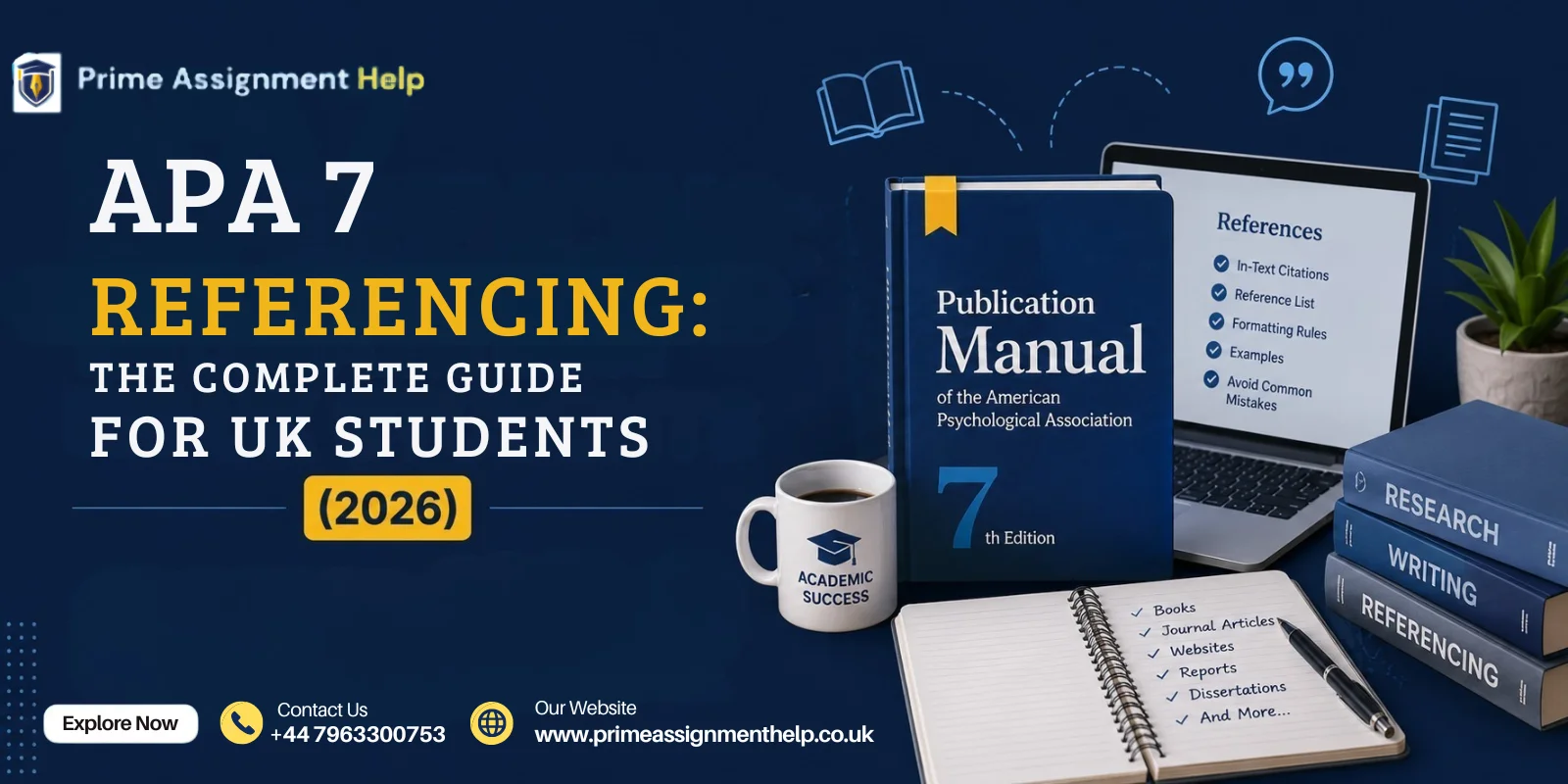
APA 7 referencing is the seventh edition of the Publication Manual of the American Psychological Association, published in 2019. It is a standardised referencing system used in universities to acknowledge sources through in-text citations and a corresponding reference list at the end of a document.

The APA referencing style was first introduced in 1929 and has been updated several times. The seventh edition introduced major changes related to digital sources, inclusive language and simplified formatting requirements.

Many UK universities, including the University of Manchester, University of Leeds and King’s College London, either recommend or require APA 7 referencing across various disciplines. Students should always check their assignment brief or module handbook to confirm which referencing style is required.

APA uses an author-date system. Every source cited within the text must have a matching entry in the reference list.

When Is APA 7th Edition Referencing Used?

APA 7th Edition Referencing is commonly used in:

  • Psychology essays and lab reports
  • Business and management assignments
  • Education research
  • Nursing and healthcare reports
  • Social science dissertations
  • Research proposals
  • Literature reviews
  • Case study analysis

For example, students seeking Psychology Assignment Help often need APA because psychology modules rely heavily on empirical studies, journal articles and theory-based sources. Similarly, students using business assignment help may need APA for management, marketing, leadership and organisational behaviour reports.

Understanding In-Text Citations in APA 7

What Is an In-Text Citation?

An APA 7 Citation within the text identifies the source of information immediately after it is used.

Example:

(Student success is influenced by motivation and study habits, 2025).

Parenthetical vs Narrative Citations

Parenthetical Citation:

(Morgan, 2025)

Narrative Citation:

Morgan (2025) argues that student engagement improves academic performance.

Citing Sources with One, Two or Multiple Authors

One Author:

(Smith, 2025)

Two Authors:

(Smith & Jones, 2025)

Three or More Authors:

(Smith et al., 2025)

How to Cite Direct Quotes Correctly

Direct quotations require page numbers.

Example:

(Smith, 2025, p. 45)

How to Cite Sources Without Authors or Dates

No Author:

(“Student Retention”, 2025)

No Date:

(Smith, n.d.)

Common In-Text Citation Mistakes to Avoid

  • Missing page numbers in quotes
  • Incorrect author order
  • Omitting publication years
  • Overusing direct quotations

Must Read : Top Education Boards in the UK – Complete Guide for Students & Parents 

How to Create a Perfect APA 7 Reference List

What Should Be Included in a Reference List?

The APA 7 Reference List contains full publication details for every cited source.

APA 7 Reference List Formatting Rules

  • Start on a new page
  • Use alphabetical order
  • Apply double spacing
  • Use hanging indents

How to Arrange References Alphabetically

References should be arranged according to the first author’s surname.

Understanding Hanging Indents

The first line begins at the left margin, while subsequent lines are indented.

DOI and URL Guidelines in APA 7

Where available, DOI links should be included. URLs should only be used when a DOI is unavailable.

How to Cite Books in APA 7 with Examples

Books are commonly used sources in academic writing. APA 7 provides different formats depending on the type of book being referenced.

Referencing a Book with One Author

For a book written by a single author, include the author’s name, publication year, book title in italics and publisher.

Example:

Smith, J. (2025). Academic writing essentials. Oxford University Press.

Referencing Books with Multiple Authors

When a book has two or more authors, list all authors in the order shown on the book.

Example:

Smith, J., Brown, A., & Taylor, K. (2025). Research methods. Sage.

How to Cite Edited Books

If you are referencing an entire edited book, include the editor’s name followed by “(Ed.)”.

Example:

Johnson, P. (Ed.). (2025). Contemporary education research. Routledge.

Referencing E-Books and Online Books

The format is similar to a printed book, but a DOI or URL should be added when available.

Example:

Wilson, R. (2025). Digital learning in higher education. Springer. https://doi.org/xxxxx

Book Chapter Citation Examples

When citing a chapter from an edited book, reference the chapter author rather than the editor.

Example:

Taylor, K. (2025). Student learning strategies. In P. Johnson (Ed.), Contemporary education research (pp. 20–45). Routledge.

How to Cite Journal Articles in APA 7

Journal articles are among the most frequently cited academic sources.

Journal Articles with DOI

Smith, J. (2025). Academic resilience among university students. Journal of Higher Education, 12(3), 45–62. https://doi.org/xxxxx

Journal Articles Without DOI

Provide the journal details without a DOI.

Print vs Online Journal Citations

The core citation format remains largely the same.

Common Journal Referencing Errors

  • Missing volume numbers
  • Incorrect page ranges
  • Broken DOI links
  • Incomplete author information

Must Read : Complete Harvard Referencing Style Guide for UK Students

How to Cite Research Papers, Dissertations and Reports

Research papers, dissertations and reports are frequently used in academic writing because they provide current research findings, evidence and expert insights. APA 7 includes specific citation formats for each source type.

APA 7 Citation Format for Research Papers

Research papers published in academic journals generally follow the journal article referencing format. Include the author(s), publication year, article title, journal name, volume, issue number and DOI where available.

Example:

Brown, A. (2025). The impact of digital learning on student performance. Journal of Education Research, 15(2), 45–60. https://doi.org/xxxxx

Referencing Theses and Dissertations

When citing a thesis or dissertation, include the author’s name, year of publication, title, institution name and database or repository details if available.

Include:

  • Author
  • Year
  • Title of dissertation or thesis
  • University or institution
  • Database or repository information

This format is commonly used when referencing postgraduate research and doctoral studies.

Conference Papers and Proceedings

Conference papers should include the author, year, paper title, conference title and publication details. If available online, include the DOI or URL.

Include:

  • Author(s)
  • Year
  • Paper title
  • Conference name
  • Location and publication details

Government and Industry Reports

Government publications, market reports and industry research reports are valuable sources for business, healthcare and policy-related assignments. APA 7 requires the organisation name, publication year, report title and publication information.

Include:

  • Organisation or author
  • Publication year
  • Report title
  • Publisher (if different)
  • DOI or URL when available

These sources are particularly useful for supporting statistics, policy discussions and real-world case studies.

How to Cite ChatGPT and AI Tools in APA 7

As AI tools become more common in education, students should understand how to acknowledge their use correctly in academic work.

Can You Cite ChatGPT in Academic Work?

Yes. Many universities now allow the use of AI tools when their use is clearly disclosed and follows institutional guidelines. Always check your university’s policy before using AI-generated content.

Official APA Guidance on AI Citations

APA recommends identifying the AI tool used, the company behind it and the date of interaction. This helps maintain transparency in academic writing.

Example of a ChatGPT Citation in APA 7

Reference List Example:

OpenAI. (2026). ChatGPT response to a user query regarding academic referencing [Large language model].

AI Referencing Mistakes Students Should Avoid

  • Not disclosing AI usage in assignments.
  • Treating AI responses as academic sources.
  • Using AI-generated content without fact-checking.
  • Including inaccurate or unverified information from AI tools.

APA 7 vs APA 6: Key Changes

Feature APA 6th Edition APA 7th Edition
Three or More Authors List all authors first time Use et al. immediately
Running Head Required Only for publication manuscripts
Publisher Location Required Not required
DOI Format dx.doi.org https://doi.org
Retrieved From Required Usually removed
Singular They Not officially recognised Officially accepted
Headings Older structure Updated structure

Common APA 7 Referencing Mistakes to Avoid

Even small referencing errors can affect the quality of your academic work. Here are some common APA 7 mistakes students should watch out for:

1. Missing Reference Entries

Every in-text citation must have a matching entry in the reference list. Missing references can lead to plagiarism concerns.

2. Incorrect Capitalisation

Book titles and article titles should be written in sentence case, not title case.

3. Missing DOI Information

Always include a DOI when one is available, as it provides a permanent link to the source.

4. Incorrect Use of et al.

For sources with three or more authors, use et al. in in-text citations after the first author’s surname.

5. Adding Full Stops After URLs

Do not place a full stop at the end of a DOI or URL, as this can affect the link.

6. Using Retrieval Information Unnecessarily

Retrieval dates are only needed for sources that are likely to change over time, such as some webpages.

7. Incorrect Hanging Indentation

In the reference list, the first line should align left, while all following lines should be indented.

8. Incorrect Alphabetical Ordering

Arrange references alphabetically by the author’s surname to maintain a properly formatted reference list.

Must Read : Bibliography Harvard Style Rules, Structure and Citation Examples

Tips and Best Practices for APA 7 Referencing

  • Start your reference list while researching. Do not wait until the final day.
  • Use your university library guide because some UK institutions apply small local preferences.
  • Keep a record of page numbers when reading PDFs or books.
  • Use reliable academic sources such as peer-reviewed journals, textbooks, government websites and university publications.
  • Check every APA 7 Citation against the final reference list before submission.
  • Use referencing tools carefully. Zotero, Mendeley and Google Scholar can help, but they still make formatting errors.
  • Ask for academic support early if you are unsure. This is especially useful for dissertations, research proposals and complex reports.

Real-World Academic Scenarios

A psychology student writing about anxiety and academic performance may cite journal articles, clinical reports and theory-based books. In this case, apa 7 referencing helps connect claims to evidence and supports a stronger argument.

A business student writing about leadership in Tesco or Marks & Spencer may cite annual reports, journal articles and management textbooks. Correct APA 7 Citation helps separate the student’s analysis from published evidence.

A dissertation writer completing a literature review may use 50 or more sources. A clean APA 7 Reference List makes the work easier to assess and shows strong research organisation.

Conclusion

APA 7 referencing becomes easier once you understand its author-date system and how in-text citations connect to reference list entries. Consistency, accuracy and attention to formatting are essential for academic success.

Developing good referencing habits helps avoid plagiarism, strengthens academic credibility, and improves the quality of your work. Always check your university’s guidelines and refer to the official APA manual when unsure.

For students who require additional academic support, professional assignment help services can provide guidance with referencing, academic writing and dissertation preparation.

Good referencing is not simply about following rules. It demonstrates academic integrity, acknowledges original authors and supports arguments with credible evidence.

Frequently Asked Questions

1. What is apa 7 referencing?

Apa 7 referencing is an author-date academic citation style. It uses brief in-text citations and a full reference list to show the sources used in essays, reports, dissertations and research papers.

2. What is the difference between APA 7 Citation and APA 7 Reference List?

APA 7 Citation appears inside the assignment, such as (Smith, 2022). The APA 7 Reference List appears at the end and gives full source details, including author, year, title and source.

3. Is APA 7th Edition Referencing used in UK universities?

Yes. Many UK universities use APA 7th Edition Referencing, especially for psychology, education, nursing, health sciences, business and social science courses.

4. Do I need page numbers in APA 7 In-Text Citation?

Page numbers are required for direct quotes. They are optional for paraphrasing, but they can help when referring to a specific section of a source.

5. Can I use APA Referencing Style for business assignments?

Yes. Many business schools accept APA Referencing Style for management, marketing, HRM and organisational behaviour assignments. Always check your module guide first.

highest paying degrees uk
Blog

Highest Paying Degrees in the UK (2026): Top Careers & Salaries

Highest Paying Degrees in the UK (2026): Top Careers & Salaries

highest paying degrees uk

Picking a degree is one of the biggest financial decisions you will ever make. With UK tuition fees now sitting at £9,535 per year for 2025–26 and living costs continuing to rise, more students are asking the same question before they apply: which degree will actually pay off? The good news is that graduate salaries UK-wide have been climbing steadily. According to the Institute of Student Employers (ISE), the average UK graduate starting salary in 2025 reached £36,335, but that figure hides a massive gap between the highest and lowest paying subjects. Some graduates walk into roles earning £45,000+, while others start well below £25,000. Knowing where your degree sits on that spectrum before you commit three or more years to it is simply smart planning.

This guide breaks down the highest-paying degrees in the UK for 2026 using data from HESA Graduate Outcomes, the Department for Education’s LEO data and ONS ASHE 2025, so every salary figure you see here is grounded in verified UK sources, not estimates. Whether you are a sixth-form student weighing your UCAS options, a mature learner considering a career change, or a postgraduate thinking about which Master’s delivers the best return, this is the clearest picture available. At Prime Assignment Help, we support UK university students across all these subject areas from engineering assignments to law coursework, so we understand what these degrees actually demand academically and what they deliver financially.

Top 10 Highest Paying Degrees in the UK (2026)

Degree Starting Salary 5-Year Salary Employment Rate
Medicine & Medical Sciences £37,924 £65,000+ 97%
Dentistry £39,467 £60,000+ 97%
Law (LLB) £43,508* £55,000+ 85%
Computer Science & AI £36,871 £55,000+ 88%
Engineering (all) £31,975 £48,000+ 83%
Finance & Economics £36,492 £52,000+ 87%
Pharmacy £31,049 £45,000+ 92%
Architecture £25,500 £42,000+ 80%
Mathematics & Statistics £28,498 £44,000+ 86%
Business & Management £27,998 £42,000+ 88%

Law starting salary from ISE Graduate Recruitment Survey 2024; all others from HESA Graduate Outcomes 2022/23 and ISE 2025 data.

1. Medicine & Medical Sciences – £37,924 Starting Salary

Medicine consistently sits at the top of every highest-paying jobs UK list and for good reason. With a 97% employment rate and one of the clearest career progression structures in any industry, it is one of the few degrees where your earning trajectory is almost entirely predictable. Foundation doctors start at £38,000–£40,000, with specialist training salaries rising to £52,656 £73,992 depending on the specialism.

The trade-off is time. Medical degrees run five to six years and post-graduate training adds several more years before you reach consultant level. If you are studying medicine and struggling with the academic workload, our medical assignment help uk service supports students across all year groups.

2. Dentistry – £39,467 Starting Salary

Dentistry is arguably the most financially efficient healthcare degree in the UK. NHS foundation training starts at £40,776 and specialists can reach £65,000–£74,000 within a few years of qualification. Private practice opens earnings considerably higher. The key differentiator from medicine is that dentists can move into independent practice relatively quickly, giving more control over income.

3. Law – £43,508 Starting Salary (Commercial Sector)

Law produces the highest entry-level salaries in the ISE data but that figure is skewed heavily by commercial and corporate law firms. A trainee solicitor at a Magic Circle firm in London earns significantly more than a graduate working in public sector legal roles. Still, law remains one of the top university courses UK students choose for long-term earning potential. Corporate lawyers with five years’ experience regularly earn £70,000–£100,000+.

If you are studying an LLB and need support with your legal research or coursework, our law essay help uk is used by students at universities across England, Scotland and Wales.

4. Computer Science & AI – £36,871 Starting Salary

Computer science salary UK-wide has risen sharply over the past three years, driven by demand in fintech, cybersecurity, AI development and cloud computing. In London specifically, the average computer science graduate salary as of April 2025 was approximately £42,314 well above the national graduate average. Tech employers like Google, Revolut and Deliveroo offer starting packages considerably above market rate for top graduates.

Computer Science is one of the most in-demand degrees UK employers are actively recruiting for and that demand is not slowing down. AI, machine learning and data engineering roles are seeing consistent year-on-year vacancy growth even as the broader graduate market tightens.

5. Engineering – £31,975 Starting Salary

Engineering remains one of the most reliable routes into well-paid, permanent employment. HESA data puts the average starting salary for engineering and technology graduates at £31,975, with chemical and petroleum engineers at the higher end. Major employers, including Rolls-Royce, BAE Systems and BP run structured graduate schemes with starting salaries of £29,000–£48,000.

For students working through complex engineering modules, our engineering assignment help uk covers everything from civil and mechanical to electrical and chemical disciplines.

6. Finance & Economics – £36,492 Starting Salary

Finance and economics graduates enter one of the most competitive but highest-rewarding sectors in the UK. Investment banking roles in London start at £50,000–£60,000 at top firms. Actuarial roles, corporate finance and fintech positions all offer strong starting salaries and clearly defined progression. Economics graduates also have excellent transferability into consulting, policy and public sector roles.

7. Pharmacy – £31,049 Starting Salary

Pharmacy sits in a unique position it is a regulated clinical profession with near-guaranteed employment. NHS band 6 pharmacists start at £37,000+ after the pre-registration year and hospital pharmacists can progress to consultant level. Community pharmacy and clinical research roles also offer solid long-term earning potential.

8. Mathematics & Statistics – £28,498 Starting Salary

Maths graduates have some of the most diverse career options available. The degree itself opens doors into actuarial science, data science, quantitative finance and AI research, all of which carry salaries well above the graduate average within two to three years. The starting salary appears modest, but five-year earnings for maths graduates who enter financial or data-driven roles regularly exceed £44,000.

9. Architecture – £25,500 Starting Salary

Architecture is the one degree on this list where the starting salary does not reflect long-term earnings. Entry-level roles are modest, but chartered architects (ARB registered) with five or more years of experience earn £40,000–£60,000+ and those in senior or director-level positions at large practices earn considerably more.

10. Business & Management – £27,998 Starting Salary

Business degrees are the most-enrolled subject in the UK and offer broad flexibility. The highest paying jobs UK employers offer to business graduates sit in management consulting, investment management and corporate strategy, all of which can reach £40,000–£55,000 within five years.

UK Average Graduate Salary in 2026: Know the Benchmark First

Before comparing individual degrees, you need a reference point. According to HESA’s 2022/23 Graduate Outcomes data (the most recent published figures):

  • Median graduate salary 15 months after graduation: £28,500
  • Medicine and dentistry recorded the highest median at £37,924
  • Media, journalism and communications recorded the lowest at £24,925
  • 76% of UK graduates in work were in high-skilled roles

The gap between the top and bottom paying degree subjects is over £13,000 per year at entry level. Over a full career, that compounds into a significantly different financial picture, which is exactly why choosing from the most in-demand degrees UK employers are hiring for gives you a structural advantage from day one.

Which Degrees Are Most In Demand by UK Employers Right Now?

Beyond salary, employer demand in 2025/26 is concentrated in specific areas. The ISE Student Recruitment Survey 2025 highlights consistent vacancy growth in:

  • Technology and IT — computer science, software engineering, data science
  • Healthcare — medicine, pharmacy, nursing and allied health
  • Finance and professional services — accounting, economics, finance
  • Engineering — particularly civil, electrical and renewable energy

These are not coincidentally the same degrees that top the salary rankings. Choosing a subject that is both high-paying and in genuine skills shortage is the most reliable way to combine strong starting pay with long-term job security.

Read more: What is a Bibliography? Stop Guessing. Here’s the Complete Answer

Final Word

The highest paying degrees in the UK share a common thread: they lead into sectors with genuine skills shortages, regulated professions, or specialised technical roles that employers struggle to fill. Whether you choose medicine, law, computer science, or engineering, the financial return is real, but so is the academic challenge. Performing well in your degree, not just enrolling in the right one, is what separates graduates who reach those senior salary levels from those who plateau early. If you need support with your coursework, dissertations, or assignments at any point during your studies, Prime Assignment Help works with UK students across all the subjects covered in this guide.

Frequently Asked Questions

1. What is the highest-paying degree in the UK in 2026? 

Based on HESA Graduate Outcomes data, medicine and dentistry graduates record the highest median salaries at entry level, £37,924 and £39,467 respectively. Law graduates in commercial firms can also exceed these figures, depending on the employer.

2. Which degree has the best job prospects in the UK? 

Medicine, dentistry and pharmacy consistently record the highest employment rates (92–97%) within 15 months of graduation. Computer science and engineering also show strong prospects with 83–88% in high-skilled roles.

3. Is a degree still worth it financially in the UK?

 For most of the subjects in this guide, yes. The Department for Education’s LEO data shows that the discounted lifetime earnings difference between graduates and non-graduates is £430,000 for men and £260,000 for women. The return on investment is strongest for regulated professions and technical STEM degrees.

4. What UK degrees earn over £50,000? 

With five or more years of experience, medicine, dentistry, law (commercial), computer science, finance and engineering all commonly exceed £50,000. At senior or specialist level, most of these fields reach £70,000–£100,000+.

blog banner prime assignmnet (14)
Blog

What is a Bibliography? Stop Guessing. Here’s the Complete Answer

What is a Bibliography? Stop Guessing. Here’s the Complete Answer

If you have ever handed in an essay, dissertation help, or research report, you have probably been told to include a bibliography at the end. And yet, for something so routinely required, it is surprisingly misunderstood. Most students treat it as an afterthought, a hasty list cobbled together in the final hour before a deadline. That approach tends to show and it can cost marks. A bibliography is not just a formality; it is an integral part of your work that tells the reader exactly where your ideas came from and invites them to follow the trail of evidence themselves.

Whether you are writing a GCSE essay, an undergraduate dissertation, or a postgraduate thesis, getting your bibliography right matters more than most people realise. It affects your credibility, your grade and in serious cases, whether your work is considered plagiarism. This guide covers everything you need to know from a plain-English definition right through to formatting styles, common mistakes and tools that make the whole process far less painful. At Prime Assignment Help, we see bibliography errors trip up good students every day, so we have put this guide together to make sure that does not happen to you.

What is a Bibliography?

A bibliography is a structured list of all the sources you used when researching and writing a piece of work. It typically appears at the very end of your document and includes books, journal articles, websites, reports and any other material you consulted, whether you quoted it directly, paraphrased it, or simply used it to shape your thinking.

The word itself comes from the Greek biblion (book) and graphia (writing). In modern academic use, it has come to mean a complete record of your source material, presented in a consistent, standardised format.

Quick Definition: A bibliography is a complete, formatted list of every source consulted during your research, placed at the end of your work.

Why Does a Bibliography Matter?

Beyond fulfilling a marking requirement, a bibliography does several important things for your work. It gives proper credit to the authors and researchers whose ideas you have built upon, something that is both an academic obligation and a matter of basic intellectual honesty. It also protects you against accusations of plagiarism, which can have serious consequences at every level of education. And it shows the examiner that your arguments are grounded in credible, well-chosen sources rather than invented from thin air.

There is also a practical benefit that students often overlook: a strong bibliography signals the depth of your research. A well-constructed list of relevant, authoritative sources tells an examiner far more about the quality of your reading than any self-congratulatory paragraph about it ever could.

Bibliography vs. Reference List vs. Works Cited: What is the Difference?

This is one of the most commonly confused areas in academic writing and the three terms are not interchangeable.

Term What it includes Commonly used with
Bibliography All sources consulted, including those not directly cited Harvard, Chicago, MHRA
Reference List Only sources directly cited in the text APA, Vancouver
Works Cited Only sources directly cited in the text MLA (primarily US)

In short, a bibliography is broader. If your lecturer asks for a bibliography, include everything you read as part of your research. If they ask for a reference list, include only what you actually cited in the text.

What is bibliography

What Goes Into a Bibliography Entry?

Regardless of which referencing style you use, every bibliography entry contains broadly the same core information. The order and punctuation will vary, but the elements stay consistent.

Element What to include
Author(s) Full name or surname with initials, depending on the style
Title Full title of the book, article, or source
Date of publication Year, or year and month for journal articles
Publisher Name of the publishing house or institution
Place of publication City (required in Harvard and Chicago; not always in APA)
Edition If not the first edition, note which edition
URL / DOI For online sources, include the date accessed where required

How to Write a Bibliography: Step by Step

Writing a bibliography feels far more manageable once you break it into clear stages and, crucially, if you start early rather than leaving it to the last minute.

Step 1: Record sources as you go. Every time you consult a book, article, or website, note down the full details immediately. Chasing this information retrospectively is where most errors creep in.

Step 2: Confirm your required referencing style. Check your course handbook or ask your lecturer. Different disciplines use different styles and getting this wrong from the outset wastes time.

Step 3: Format each entry according to that style. Use the correct order, punctuation and italics for your chosen format. Even small inconsistencies can affect your mark.

Step 4: Arrange entries alphabetically by surname. This is standard across almost all styles. If there is no author, alphabetise by title, ignoring the words ‘A’, ‘An’, or ‘The’.

Step 5: Proofread carefully. Check spellings of author names, consistency of punctuation and that every source cited in your text also appears in the bibliography.

Common Mistakes Students Make (and How to Fix Them)

Most bibliography errors are not difficult to avoid — they just require a bit of attention.

Mistake How to fix it
Mixing referencing styles Choose one style and apply it consistently throughout
Missing publication details Record details at the time of reading, not afterwards
Citing sources not listed in the bibliography Cross-reference in-text citations against your bibliography before submitting
Broken or undated URLs Always include the date you accessed a web source and verify links are still active
Incorrect author name order Some styles use surname first; others use first name — check your style guide
Forgetting the second or third authors List all authors in the order they appear in the original source

Quick Bibliography Checklist Before You Submit

Run through this before you hand anything in:

  • Every in-text citation has a corresponding entry in the bibliography
  • All entries follow the same referencing style consistently
  • Entries are listed alphabetically by author surname
  • Italics are used where required by your style (usually book and journal titles)
  • Online sources include the date you accessed them
  • Author names are spelled correctly
  • Edition numbers are included where the source is not a first edition
  • The bibliography begins on a new page at the end of the document

Bibliography Referencing Styles Explained

The style you use depends entirely on your institution or discipline. Below are the most common ones used in UK academic settings.

Style Common in Sample entry (book)
Harvard Most UK universities Smith, J. (2019). Academic Writing Skills. 3rd edn. London: Routledge.
APA 7th Psychology, Social Sciences Smith, J. (2019). Academic writing skills (3rd ed.). Routledge.
MLA Languages, Literature Smith, John. Academic Writing Skills. 3rd ed., Routledge, 2019.
Chicago History, Arts Smith, John. Academic Writing Skills. 3rd ed. London: Routledge, 2019.
MHRA Humanities (UK) John Smith, Academic Writing Skills, 3rd edn (London: Routledge, 2019).
OSCOLA Law (UK) John Smith, Academic Writing Skills (3rd edn, Routledge 2019).

If you are unsure which style your course requires, always check your module handbook first. When in doubt, ask your lecturer, who would far rather answer that question than mark a bibliography formatted in the wrong style entirely.

Types of Bibliography

Not all bibliographies look the same. Depending on the nature of your work, you may be asked to produce one of the following:

Type Description
Enumerative The standard type  a straightforward alphabetical list of sources
Annotated Each entry includes a short summary or evaluation of the source, typically 2–4 sentences
Analytical Focuses on the physical or historical characteristics of texts  used in specialist academic disciplines
Selected Includes only the most important or relevant sources rather than everything consulted

How to Write an Annotated Bibliography

An annotated bibliography is exactly what it sounds like: a bibliography with annotations. After each entry, you add a short paragraph, usually between 50 and 150 words, that summarises the source, evaluates its reliability and explains how it is relevant to your work.

Here is a brief example in Harvard style:

Williams, T. (2021). The Essay Writing Handbook. 2nd edn. Manchester: University Press.

This handbook provides a thorough overview of academic essay structure aimed at undergraduate students. Williams draws on over two decades of teaching experience to offer practical, step-by-step guidance. The chapter on argumentation was particularly relevant to the analytical sections of this paper, as it addresses how to construct and sustain a line of reasoning across multiple paragraphs.

Read moreOSCOLA Bibliography Guide: Format, Examples & Referencing Rules

A Brief History: Where Did Bibliographies Come From?

The practice of listing sources is far older than the Internet and older than the printing press, too. Ancient scholars in Alexandria compiled catalogues of texts held in the great library there an early form of bibliographic record-keeping. By the 15th century, as the printing press made books more widely available, scholars began systematically recording the works they referenced. The modern bibliography standardised, formatted and expected in all serious academic work developed through the 19th and 20th centuries alongside the professionalisation of universities.

It is worth knowing this because it highlights that a bibliography is not a bureaucratic invention. It emerged from a genuine scholarly need to trace knowledge, verify claims and build responsibly on the work of others.

Bibliography Tools Worth Knowing About

You do not have to format every entry by hand. Several tools handle much of the heavy lifting and most of them are free.

Tool What it does
Zotero Free reference manager; saves sources and generates formatted bibliographies automatically
Mendeley Similar to Zotero, popular in the sciences, integrates directly with Word
Cite This For Me Browser-based; paste a URL or ISBN and it generates a reference in your chosen style
Google Scholar Click the quotation mark icon under any result for a pre-formatted citation in multiple styles
Microsoft Word Built-in References tab lets you add sources and auto-generate a bibliography

A word of caution: these tools are useful but not infallible. Always review the output against your institution’s style guide. Automated tools occasionally make formatting errors, particularly with less common source types.

Frequently Asked Questions

Is a bibliography the same as a reference list? 

Not quite. A bibliography includes all sources you consulted, even those you did not directly cite. A reference list includes only the sources cited in your text. Which one you need depends on your referencing style and institution.

Do I need a bibliography for every essay? 

In most cases, yes, particularly in higher education. Even a short essay referencing just two or three sources should have a bibliography. Check your assignment brief if you are unsure.

What if a source has no author?

Start the entry with the title instead and alphabetise accordingly. Most modern styles simply omit the author field rather than using ‘Anon.’

Can I include websites in my bibliography? 

Yes, provided they are credible sources. Include the page title, organisation or author, URL and the date you accessed it. Websites can change or disappear, so the access date matters.

What does ‘n.d.’ mean in a bibliography?

 It stands for ‘no date’ and is used when the publication date cannot be determined. It is acceptable to use, but do try to find the date first; most published works have one if you look carefully.

blog banner prime assignmnet (11)
Blog

Best Cyber Security Courses in the UK: The Complete 2026 Guide

Best Cyber Security Courses in the UK: The Complete 2026 Guide

Whether you are a complete beginner exploring cyber security courses for the first time, a working professional looking for the best cyber security certification courses to advance your career, or someone seeking flexible cyber security training UK-wide, this guide has everything you need. We cover every route available in 2026: free options, funded qualifications, online courses, certification roadmaps, realistic salary expectations and how to choose the right path for your specific situation.

The UK cyber security job market is moving fast and the professionals who get ahead are the ones who start with the right information. Choosing the wrong course wastes time and money; choosing the right one can put you in front of employers within months. That is exactly why this guide exists to give UK learners a clear, honest and up-to-date picture of every cybersecurity training option available today, from fully funded qualifications to advanced certifications that open the door to six-figure salaries.

Why Cyber Security Is the UK’s Most In-Demand Career Right Now

If you have been searching for the best cybersecurity courses in the UK, you are already ahead of the curve. Cyber security training is no longer a niche specialism; it is one of the most sought-after skill sets in the entire British job market and the demand for qualified professionals is growing faster than the country can produce them.

Most people don’t think about cybersecurity until something goes wrong, a data breach makes the headlines, a hospital’s systems go offline, or a small business loses thousands to a ransomware attack. Then the same question surfaces: where are all the cybersecurity professionals?

The honest answer is that there aren’t enough of them. According to the UK government’s Department for Science, Innovation and Technology (DSIT), 49% of UK businesses have a cybersecurity skills gap in their workforce. The sector is now worth over £14.7 billion, cyber roles pay roughly 24% above the national average salary and the World Economic Forum estimates 4 million additional cyber professionals are needed globally by 2030.

Whether you are looking for an online cybersecurity qualification, exploring cybersecurity certification courses for career progression, or simply want to understand what cybersecurity training options are available in the UK in 2026, this guide covers everything you need to know.

What Types of Cyber Security Courses Are Available in the UK?

The UK training market offers genuinely varied options across every budget and experience level. From flexible cybersecurity courses online to government-funded cybersecurity apprenticeships UK-wide, here is what is currently available:

Course Type Format Best For Typical Duration
Online self-paced Study anytime, independent learning Working adults, career changers 3–6 months per cert
Live instructor-led Virtual classrooms, scheduled sessions People who prefer structure 4–12 weeks intensive
University degrees BSc / MSc, NCSC-certified courses School leavers, academic route 2–3 years
Short awareness courses e-learning modules Non-technical staff, businesses Hours to days
Cyber security apprenticeship UK Earn while you learn, government-funded Adults eligible for Adult Skills Fund 12–18 months

The Adult Skills Fund (ASF) is worth highlighting, specifically, it provides fully funded Level 2 cyber security qualifications for eligible adults in England aged 19 and over. If you meet the criteria, you could qualify for accredited cybersecurity training at zero cost. Check GOV.UK for current eligibility details before spending anything.

Free Cyber Security Courses in the UK: What’s Actually Available

Before paying for any information security courses or professional certification, it is worth knowing what is genuinely available for free. The UK government and several reputable organisations have invested heavily in making cybersecurity education accessible.

Resource Provider What It Covers Who It’s For
CyberFirst Courses NCSC / GCHQ Security foundations, networking, cryptography School leavers, early-career learners
Intro to Cyber Security Open University (FutureLearn) Core principles, threats and risk management Complete beginners
Level 2 Cyber Security (ASF) Various approved providers Accredited qualification  networks, data protection UK adults meeting ASF eligibility
Google Cybersecurity Certificate (audit) Google / Coursera Practical tools, SIEM and incident response Career changers
SANS Cyber Aces SANS Institute OS fundamentals, networking and system administration IT professionals

Free resources are an excellent starting point, but for professional roles, you will eventually need paid, accredited cybersecurity certification courses. Free courses build your knowledge; recognised certifications open the doors to employment.

cyber security courses

The Cyber Security Certification Roadmap: Beginner to Senior

There is a clear, well-trodden path from complete beginner to senior professional. You do not need a computer science degree to walk into the right online cybersecurity qualification can get you job-ready within months.

Level 1 — Entry Level (No experience required)

Certification Approx. UK Cost Study Time (Part-Time) Best For
CompTIA Security+ £350–£500 3–5 months Most UK learners — widely recognised
CompTIA A+ £400–£600 3–4 months Those with zero IT background
Microsoft SC-900 £100–£165 4–6 weeks Cloud beginners, IT generalists

Start here: CompTIA Security+ is the most consistently requested entry-level certification in UK cyber security job adverts. If you have no IT background at all, begin with CompTIA A+ first.

Level 2 — Mid Level (1–2 years experience)

Certification Approx. UK Cost Specialist Area
CompTIA CySA+ £350–£550 Threat detection, incident response
Certified Ethical Hacker (CEH) £1,500–£2,500 Ethical hacking, penetration testing
CompTIA PenTest+ £350–£600 Vulnerability assessment, pen testing
Microsoft AZ-500 ~£165 Azure cloud security

Level 3 — Advanced (5+ years experience)

Certification Approx. UK Cost Role Relevance
CISSP £600–£900 Security architect, CISO — gold standard
CISM £600–£800 Security management, risk
CISA £600–£800 IT audit, compliance

Cyber Security Salaries in the UK: What Can You Realistically Earn?

The mean salary for cyber security training UK-qualified professionals sat at approximately £51,700 in 2025–26, around 24% above the national average. Here is how it breaks down by experience level:

Level Example Roles Typical UK Salary Range
Entry (0–2 years) SOC Analyst, IT Security Technician £25,000–£38,000
Mid (2–5 years) Security Engineer, Penetration Tester, Cloud Security £40,000–£70,000
Senior (5+ years) Security Architect, CISO, Security Consultant £75,000–£200,000+

The highest-paying UK sectors for cyber roles are financial services (banks and fintechs, particularly in London), government and defence (often requiring security clearance), professional services consultancies and the NHS, which has been actively expanding its cyber capability following several high-profile incidents in recent years.

London roles typically pay 15–25% more than equivalent roles elsewhere, though cities like Manchester, Edinburgh, Bristol and Leeds all have growing cyber sectors with a significantly better cost-of-living balance.

Read More: AQA Exam Board: The Complete UK Student Guide (GCSE, A-Level & Beyond)

How to Choose the Right Cyber Security Course for You

There is no single best cybersecurity course only the best course for your current situation. Use this as a quick decision guide:

  • No tech background at all — Start with CompTIA A+, then Security+. Check Adult Skills Fund eligibility first for a potentially free route into cyber security training in the UK.
  • Already working in IT — Go straight to CompTIA Security+, then choose a specialism: CySA+ for defence and analysis, CEH or PenTest+ for ethical hacking, AZ-500 for cloud.
  • Limited budget — Begin with free resources (NCSC-certified courses, FutureLearn, TryHackMe). When ready to invest, Security+ gives the best return for the cost as a cybersecurity certification course.
  • Aiming for management — Foundation cert first (Security+ or SSCP), then CISM for security management or CISA for audit and compliance.
  • Prefer to study remotely — Every course in this guide is available as a cybersecurity course online, so location is no barrier anywhere in the UK.

At Prime Assignment Help, we support UK students navigating exactly these decisions, building the academic and professional knowledge needed to enter competitive fields like cyber security and presenting it in a way that genuinely stands out to employers.

Frequently Asked Questions

How long does a cybersecurity course take?
It depends on the type of training. A short cybersecurity awareness course can take a few hours, while an online cybersecurity qualification like CompTIA Security+ typically takes three to five months of part-time study. Going from no experience to your first job offer realistically takes six to twelve months when studying alongside other commitments.

Can I study cybersecurity courses online in the UK?
Yes and most UK adults now do exactly that. Every major cybersecurity certification course, including Security+, CEH, CISSP, CISM and CISA, can be studied and examined entirely online. Flexible cybersecurity courses online are now the standard format for professional training across the UK.

Are there free government-funded cybersecurity courses in the UK?
Yes. The Adult Skills Fund provides fully funded Level 2 cyber security qualifications for eligible adults in England. The NCSC also offers free NCSC-certified courses and learning resources through its website and FutureLearn partnerships, both excellent starting points before committing to paid information security courses.

Do UK employers value cybersecurity certifications?
Significantly. For practitioner roles, cybersecurity certification courses like CompTIA Security+, CEH and CISSP are often weighted equally to or above degrees. Search any UK job board for “SOC analyst” or “information security analyst” and recognised certifications will appear in the requirements consistently.

What is a cybersecurity apprenticeship in the UK and is it worth it?
A cyber security apprenticeship in the UK is a government-backed programme where you earn a wage and study towards a nationally recognised qualification simultaneously. They are available at Level 3 and Level 4 and are an excellent route for anyone who wants hands-on cybersecurity training without the upfront cost of traditional courses.

OSCOLA Bibliography
Blog

OSCOLA Bibliography Guide: Format, Examples & Referencing Rules

OSCOLA Bibliography Guide: Format, Examples & Referencing Rules

OSCOLA Bibliography

If you’re studying law at a UK university, you’ll almost certainly come across OSCOLA referencing throughout your degree. Whether you’re writing an essay, coursework, dissertation or case analysis, lecturers expect your citations and bibliography to follow the correct OSCOLA format. While the system may seem confusing at first, understanding the structure and formatting rules can make legal referencing much easier and more professional.

An OSCOLA bibliography is more than just a list of sources  it shows the depth of your legal research and helps maintain academic credibility in your work. Many students lose marks because of small formatting mistakes, incorrect case citations or poorly organised source sections. This guide explains the correct OSCOLA bibliography format, how to structure different source categories, examples of references, and the most common mistakes to avoid. If you’re struggling with legal referencing, coursework, or dissertation structure, getting professional law assignment help can also make the process far more manageable.

What Is an OSCOLA Bibliography?

OSCOLA (the Oxford University Standard for the Citation of Legal Authorities) is the referencing system used across UK law schools. It is a footnotes-and-bibliography system, meaning every source you cite appears in a footnote within your text and in the bibliography at the end.

A few ground rules:

  • List each source once only, no matter how many times you cited it
  • Include only sources you actually cited in footnotes — background reading stays out
  • The bibliography goes at the very end of your work, after the main text and after any appendices

OSCOLA Bibliography vs Footnotes: Key Differences

This is the part most students get wrong. Your bibliography entries are not the same as your footnote entries. There are four key differences:

Rule Footnote Format Bibliography Format
Author name First name, then surname (Andrew Burrows) Surname then initials (Burrows A)
Full stop at the end Yes No
Pinpoints (page/para numbers) Included Removed (keep only the starting page for journal articles)
Journal title Abbreviated (OJLS) Written in full (Oxford Journal of Legal Studies)

Getting these four things right consistently will immediately improve the quality of your law bibliography and overall academic writing. If you need extra support, professional law assignment help can assist with legal research, OSCOLA referencing, case analysis, and dissertation structure.

The 3 Main Sections of an OSCOLA Bibliography

A correctly structured OSCOLA bibliography is always divided into three sections:

Section What It Contains
Table of Cases All cases cited, in alphabetical order
Table of Legislation All statutes, SIs, treaties and official legal documents
List of References Everything else — books, articles, websites, reports

If your work is short and contains only one or two cases, some lecturers will allow a combined bibliography, but always check your module handbook first.

OSCOLA Bibliography

How to Format the Table of Cases in OSCOLA

List every case cited in your work alphabetically by the first significant word of the case name.

Key rules:

  • Do not italicise case names in the bibliography (unlike in footnotes, where they are italicised)
  • Each case appears only once
  • Cases identified only by initials (common in family law) are listed under the initial itself

Separating by jurisdiction: If you’ve cited cases from more than one jurisdiction, you may use subheadings such as UK Cases and EU Cases. While this may not be necessary for one or two foreign cases, it is considered good practice in longer dissertations. If you need guidance with legal research, referencing, or structuring your work, professional dissertation help can make the process much easier and more accurate.

Trademark and shipping cases: List under the full case name and add a separate cross-reference entry under the trademark or ship name.

Table of How to Format the Table of Legislation in OSCOLA

Include every statute, statutory instrument, treaty, convention and official legal document cited in your work.

Rule Detail
Ordering Alphabetical by the first significant word of the title
Same title, multiple Acts List chronologically
Statutory Instruments Separate sub-list after statutes
Multiple jurisdictions Separate sub-lists recommended (UK, EU, international)

How to Format the OSCOLA List of References

Every source that is not a case or a piece of legislation — books, journal articles, websites, government reports, newspaper articles goes into one single alphabetical list, ordered by author surname.

Do not split this section by source type. Books, articles and websites all sit together alphabetically.

Anonymous and unattributed works are listed at the beginning of the List of References in alphabetical order by title, each preceded by a double em-dash 

OSCOLA Double Em-Dash Rule for Repeat Authors

When listing multiple sources written by the same author in an OSCOLA bibliography, the works should be arranged chronologically, starting with the oldest publication and moving to the most recent. This helps maintain consistency and allows readers to follow the development of the author’s work over time. Instead of repeating the author’s name for every entry, OSCOLA uses a double em-dash to replace the name after the first citation. This keeps the bibliography clear, organised and easier to read.

For example, if you cite two books by the same legal author, the first entry will include the full author name, while the second entry will begin with a double em-dash followed by the publication details. Many UK university students overlook this formatting rule, particularly in longer essays and dissertations where multiple works by the same academic are referenced. Applying the double em-dash rule correctly demonstrates attention to detail and proper understanding of OSCOLA referencing standards, which can improve the overall presentation of your legal writing.

Full OSCOLA Bibliography Example for Law Assignments

Table of Cases
Donoghue v Stevenson [1932] AC 562 (HL)
Pepper v Hart [1993] AC 593 (HL)
R v R [1992] 1 AC 599 (HL)

Table of Legislation
Civil Procedure Rules 1998, SI 1998/3132
Human Rights Act 1998
Limitation Act 1980

List of References
Burrows A, A Restatement of the English Law of Contract (OUP 2016)
Remedies for Torts, Breach of Contract and Equitable Wrongs (4th edn, OUP 2019)
Deakin S, Johnston A and Markesinis B, Markesinis and Deakin’s Tort Law (7th edn, OUP 2013)
Kenny S, ‘The Law Commissions: Constitutional Arrangements and the Rule of Law’ (2019) 39 Oxford Journal of Legal Studies 603
Ministry of Justice, ‘The Bribery Act 2010: Guidance’ (2011) <https://www.justice.gov.uk/downloads/legislation/bribery-act-2010-guidance.pdf> accessed 12 January 2024

Final OSCOLA Bibliography Checklist

Run through this before submitting any law assignment:

Check Done?
Bibliography split into three sections
Authors’ surnames listed first, initials only
No full stops at the end of entries
Pinpoints removed
Journal titles written in full
All sections in correct alphabetical order
Only cited sources included (no background reading)
Statutory Instruments listed separately
Bibliography placed after appendices

Common OSCOLA Bibliography Mistakes Law Students Make

Mistake What Goes Wrong Correct Approach
Living in pinpoints Burrows A, Contract (OUP 2016) 47 Remove the page number: Burrows A, Contract (OUP 2016)
Italicising case names Donoghue v Stevenson Donoghue v Stevenson
Full first name Andrew Burrows, Contract Burrows A, Contract
Full stop at the end Limitation Act 1980. Limitation Act 1980
Abbreviated journal title (2019) 39 OJLS 603 (2019) 39 Oxford Journal of Legal Studies 603
Listing background reading Sources read but not cited Only include sources referenced in footnotes

Final Tips for Writing an OSCOLA Bibliography

A properly formatted OSCOLA bibliography improves the clarity, professionalism and academic quality of your law assignments. By following the correct OSCOLA referencing rules and avoiding common citation mistakes, UK law students can present legal research more effectively and achieve better academic results.

Strong legal referencing skills are also important for students seeking law assignment help in UK universities, as accurate citations play a major role in legal academic writing.


OSCOLA Bibliography FAQs

Do I include sources I read but didn’t cite?

No. If it didn’t appear in a footnote, it doesn’t go in the bibliography.

Does every law assignment need a bibliography?

Not always. Shorter problem questions often don’t require one. Check your assignment brief requirements vary between UK law schools.

What if I only have one case?

Still include a Table of Cases section with that single entry. The heading stays regardless of how few entries you have.

Is it “List of Secondary Sources” or “List of References”?

Both are used, but the List of References is the current OSCOLA preference. If your institution specifies one, use theirs.

Can I separate books, articles and websites into sub-lists?

Strictly, OSCOLA does not use a mixed alphabetical list. Some universities permit separate sections, so always defer to your module handbook.

What if two authors share the same surname?

Alphabetise by their initials. If both surname and initials match, order by the title of the work.

oscola referencing guide
Blog

OSCOLA Referencing Guide for UK Students 2026

OSCOLA Referencing Guide for UK Students 2026

oscola referencing guide

If you are studying law at a UK university, mastering the OSCOLA Referencing Guide is not optional it is essential. OSCOLA, which stands for the Oxford University Standard for the Citation of Legal Authorities, is the most widely accepted citation system for legal writing across the United Kingdom. Whether you are submitting a case analysis, a dissertation or a coursework essay, understanding how to cite sources correctly will directly affect your academic performance. This comprehensive guide walks you through every aspect of OSCOLA referencing, from basic footnotes to full bibliographies, so you can write with confidence and precision.

What Is OSCOLA Referencing?

Before diving into the mechanics, it is worth understanding what is OSCOLA referencing and why it exists. OSCOLA was developed by the Faculty of Law at the University of Oxford and has since become the standard citation style adopted by law schools and legal journals throughout the UK and beyond.

Unlike other referencing systems such as Harvard or APA, OSCOLA referencing is specifically designed for legal documents. It accounts for the unique nature of legal sources statutes, case law, treaties, and secondary legal commentary which do not fit neatly into conventional academic citation formats. OSCOLA keeps citations clean and unobtrusive, placing all reference information in footnotes rather than cluttering the main body of your text.

The system is governed by a freely available guide published by the University of Oxford, and it is updated periodically to reflect changes in how legal materials are accessed, particularly online sources and digital databases.

Read More : Complete Harvard Referencing Style Guide for UK Students

Why OSCOLA Referencing Style Matters for UK Law Students

Understanding the OSCOLA referencing style is not just about avoiding plagiarism. It demonstrates your ability to engage with the law as a professional discipline. Legal writing demands precision and citation conventions are part of that precision. Incorrect referencing can suggest carelessness, which is a quality no law marker wants to see in submitted work.

Furthermore, familiarising yourself with OSCOLA prepares you for legal practice. Barristers, solicitors, legal academics and court clerks all use similar citation conventions when producing legal documents, briefs and journal articles. Getting it right at university means you are already building habits that will serve you throughout your career.

OSCOLA Referencing Footnotes: The Foundation of the System

One of the most distinctive features of OSCOLA referencing is its reliance on footnotes rather than in-text citations. Whenever you refer to a legal authority, quote from a source or draw on someone else’s argument, you place a superscript number in the text and include the full citation at the bottom of the page.

How OSCOLA Referencing Footnotes Work

Here is how the footnote system operates in practice:

  • The superscript number appears at the end of the relevant sentence, after any punctuation.
  • The corresponding footnote appears at the bottom of the page, not at the end of the document.
  • First citations include full details. Subsequent references to the same source use abbreviated forms.

For example, if you reference a case in the body of your text, the superscript note would appear immediately after the sentence, and the full citation would be listed at the foot of the page.

It is important to note that OSCOLA does not use “ibid” as frequently as other systems, though it is not prohibited. More commonly, you will use a shortened form of the citation typically the case name or author surname after the first full citation.

OSCOLA Referencing Example: Breaking Down the Key Source Types

Understanding the correct format for each type of legal source is central to using this system accurately. Below are OSCOLA referencing examples for the most commonly cited materials.

Cases

When citing a case, include the party names, the year, the volume number (if applicable), the law report abbreviation, and the first page of the report.

Format: Party Name v Party Name [Year] Volume Law Report Abbreviation First Page

Example: Donoghue v Stevenson [1932] AC 562

If you are citing a specific paragraph rather than a page, use square brackets around the paragraph number after the page reference.

Legislation (UK Statutes)

For Acts of Parliament, cite the short title and the year. Do not italicise statutes in OSCOLA.

Format: Short Title Year

Example: Equality Act 2010

For specific sections, add the section number after the Act title: Equality Act 2010, s 4.

Secondary Sources: Books

For books, the OSCOLA referencing example follows this structure:

Format: Author Forename Surname, Title (Edition, Publisher Year) Page

Example: Andrew Burrows, A Restatement of the English Law of Contract (OUP 2016) 45

Journal Articles

Format: Author Forename Surname, ‘Article Title’ (Year) Volume Journal Abbreviation First Page

Example: John Smith, ‘Negligence and Duty of Care in the Modern Context’ (2021) 84 MLR 102

EU and International Materials

Post-Brexit, EU law remains relevant in many UK legal contexts, particularly for cases decided before the end of the transition period. For EU legislation, cite the full title, the OJ reference and the publication year.

How to Structure Your OSCOLA Bibliography

Whilst OSCOLA places great emphasis on footnotes, many law assignments and dissertations also require an oscola bibliography at the end. The bibliography lists all sources consulted, organised by category. Proper bibliography formatting is just as important as accurate footnoting.

Standard Bibliography Categories

An OSCOLA bibliography is typically divided into the following sections:

  1. Table of Cases List cases alphabetically by the first named party. Do not include the full citation simply the case name, year and law report reference.
  2. Table of Legislation List statutes alphabetically, followed by statutory instruments, EU legislation and international instruments in separate sub-sections.
  3. Secondary Sources This section includes books, journal articles, book chapters, official reports, and online sources. Each category is listed separately and entries are placed in alphabetical order by author surname.

Unlike Harvard referencing, OSCOLA does not reverse the author’s first name and surname in the bibliography. You list the forename first, then the surname, just as you would in a footnote which helps maintain consistency throughout your work.

Common OSCOLA Mistakes UK Students Make

Even diligent students make errors with OSCOLA referencing. Being aware of the most frequent pitfalls can save you marks.

Using Author-Date In-Text Citations

OSCOLA does not use in-text citations in the Harvard style (Author, Year). Everything goes into footnotes. If you find yourself writing “(Smith 2020)” in the body of your essay, stop — that is not OSCOLA.

Incorrect Punctuation in Footnotes

OSCOLA is punctuation-sensitive. Commas, full stops, and parentheses all have specific positions within a citation. A misplaced comma between the author and title, or a full stop where a comma belongs, constitutes an error.

Forgetting Pinpoint References

When you quote from or specifically rely upon a particular page or paragraph, you must include the pinpoint reference (the specific page or paragraph number) after the first page of the source. Leaving it out is one of the most common omissions in student work.

Italicising Everything

In OSCOLA, only case names and book/journal titles are italicised. Statute names and article titles are not. Many students over-italicise, which detracts from the professionalism of their work.

Read More : Open University Referencing Guide for UK Students (2026)

OSCOLA for Online and Digital Sources

As legal research increasingly takes place online, it is important to know how the OSCOLA Referencing Guide addresses digital sources. When citing an online source, include the URL and the date on which you accessed it.

For example, when citing government publications, official reports, or online journal articles not accessed through a physical copy, add the URL in angled brackets followed by the access date in parentheses.

Example (online report): Law Commission, Automated Vehicles: Analysis of Responses to the Scoping Consultation (Law Commission 2019) <www.lawcom.gov.uk/project/automated-vehicles/> accessed 14 May 2024

For cases accessed through databases such as BAILII or Westlaw, you do not need to include the URL if a neutral citation or standard law report reference is available. Only include URLs when no other citation form exists.

Tips for Mastering OSCOLA Referencing

Becoming proficient with OSCOLA referencing takes practice. Here are some strategies that will accelerate your learning:

Read the Official Guide. The OSCOLA guide published by the University of Oxford is freely available online. It is the authoritative source and should be your first port of call whenever you are unsure about a citation format.

Use Reference Management Software. Tools such as Zotero and Mendeley can assist with managing sources, though they do not always generate perfect OSCOLA citations automatically. Always check the output against the official guide.

Check Your Law School’s Guidance. Many UK universities have their own supplementary OSCOLA guidelines. Your institution may have specific requirements that differ slightly from the standard guide, particularly for dissertations and research projects.

Practise With Real Cases and Statutes. Rather than learning citation formats in the abstract, practise by citing actual cases and legislation from your coursework. This contextualises the rules and makes them easier to remember.

Proofread Your Footnotes Separately. When reviewing your work, go through your footnotes independently of the main text. This focused approach makes it easier to spot formatting inconsistencies and missing information.

Conclusion

Mastering the OSCOLA Referencing Guide is an ongoing process. Even experienced law students occasionally encounter sources that do not fit neatly into a standard citation format. The key is to approach it systematically, consult the official guide regularly, and develop good habits from the outset.

If you are finding it difficult to keep up with citation requirements alongside the broader demands of your legal studies, you are not alone. Many UK law students seek assignment help in UK to ensure their work meets the exacting standards required by their institutions. Whether you need support structuring a legal argument, formatting citations correctly, or producing a polished final submission, professional law assignment help services can provide the guidance you need.

For those working on longer research projects, research paper writing help from qualified legal writers can be particularly valuable especially when your research spans multiple source types that each require careful citation under the OSCOLA framework.

Remember, referencing is not a technicality to be rushed through at the last minute. It is a core part of producing credible, professional legal writing. Take the time to get it right, and your markers will take notice.

Frequently Asked Questions

1. What is OSCOLA referencing and why is it important for UK law students?

OSCOLA (Oxford University Standard for the Citation of Legal Authorities) is the preferred referencing style used by most UK law schools and legal journals. It helps students accurately cite legal sources such as cases, legislation, books, and journal articles while maintaining academic integrity and avoiding plagiarism.

2. How does OSCOLA differ from Harvard referencing?

Unlike Harvard referencing, which uses in-text author-date citations, OSCOLA relies on footnotes for all references. OSCOLA is specifically designed for legal writing and provides citation formats for legal authorities such as cases, statutes, treaties, and legal commentaries.

3. Do I need a bibliography when using OSCOLA referencing?

Yes, most UK universities require an OSCOLA bibliography alongside footnotes. The bibliography should be organised into sections such as cases, legislation, and secondary sources, with entries listed alphabetically according to OSCOLA guidelines.

4. How do I cite cases and legislation in OSCOLA?

When citing a case, include the case name, year, law report abbreviation, and page number. For legislation, cite the short title of the Act and the year. If referring to a specific provision, include the relevant section number after the Act title.

5. Can I cite online sources using OSCOLA referencing?

Yes, OSCOLA allows the citation of online sources. You should include the author or organisation name, title of the document, URL in angled brackets, and the date you accessed the source. However, for cases with neutral citations or official law report references, URLs are generally not required.

AQA Exam Board
Blog

AQA Exam Board: The Complete UK Student Guide (GCSE, A-Level & Beyond)

AQA Exam Board: The Complete UK Student Guide (GCSE, A-Level & Beyond)

AQA Exam Board

If you are a student in England, the chances are that the words AQA exam board have crossed your path more than once, whether it was printed on the front of an exam paper, mentioned by your teacher, or came up during results day conversations. Yet for something so central to your education, very few students actually know what AQA is, how it works, or why it matters. That gap in knowledge can put you at a real disadvantage when it comes to revision, results and planning your next steps.

The AQA exam board UK is responsible for setting and marking the qualifications that shape the futures of over one million students every single year. From the wording of exam questions to the grade boundaries that decide whether you pass or fail, AQA’s decisions affect every aspect of how you are assessed. Understanding the organisation behind your qualifications is not just interesting background knowledge; it is genuinely useful when it comes to revision strategy, accessing resources and knowing your rights on results day.

This guide has been written specifically for UK students sitting AQA GCSE and A-Level qualifications. Whether you are just starting Year 10, heading into your final exam series, or trying to make sense of your results, you will find everything you need right here, including the grading system explained, a full subject breakdown, revision tips tailored to AQA,and answers to the most common questions students ask. Let us get into it.

What Is the AQA Exam Board? 

AQA, which stands for the Assessment and Qualifications Alliance, is the largest exam board in the UK. It is responsible for setting exam papers, writing course specifications, training examiners and awarding qualifications to millions of students every year.

What makes the AQA exam board UK unique is that it operates as an independent charity. This means that any surplus income is reinvested into education, research and resources rather than going to shareholders. Its sole focus is helping students achieve their potential.

Key facts about AQA at a glance:

  • Used by 92% of schools in England
  • Over 1 million students sit AQA qualifications each year
  • Sets and marks more than half of all GCSEs and A-Levels in the UK
  • Regulated by Ofqual (the Office of Qualifications and Examinations Regulation)

How AQA Became the UK’s Most Trusted Exam Board: A Brief History

Understanding where the AQA board came from helps to explain why it is so trusted today.

  • 1903 — The universities of England established the Joint Matriculation Board (JMB) as a public exam provider
  • 1953 — The Associated Examining Board (AEB) was created to deliver the new General Certificate of Education (GCE) to secondary schools
  • 2000 — Following a series of mergers, the Assessment and Qualifications Alliance was officially formed, bringing together these bodies under one organisation

Over the past two decades, AQA has grown to become the dominant exam board in England, shaping how millions of young people are assessed each year.

Every AQA Qualification Explained  From Entry Level to A-Level

The AQA GCSE exam board is perhaps the most well-known element of what AQA does, but its qualifications span a much wider range:

Qualification Level Typical Age
Entry Level Certificates Levels 1–3 Pre-GCSE
GCSE Level 2 14–16 (Years 10–11)
AS-Level Level 3 16–17 (Year 12)
A-Level Level 3 17–18 (Year 13)
Extended Project Qualification (EPQ) Level 3 Year 12–13
Applied General Qualifications Level 3 16–19

AQA also works internationally through its partner organisation, Oxford AQA, which offers globally recognised qualifications based on UK standards for schools outside of England.

The Full List of AQA GCSE Subjects: What Can You Actually Study?

The range of subjects available through AQA GCSE is broad, covering everything from the core curriculum to creative and technical disciplines. Here are some of the most popular:

Core Subjects

  • English Language and English Literature
  • Mathematics
  • Combined Science (Trilogy) and Separate Sciences (Biology, Chemistry, Physics)

Humanities

  • History
  • Geography
  • Religious Studies

Creative Arts

  • Art & Design
  • Drama
  • Music

Languages

  • French, Spanish, German

Technology & Computing

  • Computer Science
  • Design & Technology

AQA is particularly well-regarded for its English, Science, and Humanities specifications, which are used by the majority of schools across England. Many students studying under the AQA exam board also seek English assignment help to improve their academic writing, coursework quality, and overall exam performance.

How AQA Exams Actually Work: Structure, Coursework & Assessments

One of the most important things to understand about the AQA GCSE exam board is its assessment style. Unlike some other boards, AQA follows a linear structure, meaning all of your exams are taken at the end of the course (usually in May and June of Year 11), rather than in stages throughout the year.

Types of assessment used by AQA:

  • Written exams — the primary method of assessment across most subjects
  • Non-Examined Assessment (NEA)coursework help or controlled assessment used in subjects like Art, Design & Technology and Drama
  • Required Practicals — in science subjects, students complete a set of practical activities during the course and their understanding of these is assessed in the written exams
  • Spoken Language Endorsement — in English Language, students complete a spoken presentation that is assessed, but does not count towards the final grade

This linear approach rewards students who revise thoroughly and build a strong understanding of the whole course.

The AQA Grading System Explained: What Do Your 9–1 Grades Actually Mean?

If you are wondering how your results will be reported, the AQA grading system uses the national 9 to 1 scale, where 9 is the highest grade and 1 is the lowest. This replaced the old A*–G system when GCSEs were reformed.

New Grade (9–1) Equivalent Old Grade (A*–G)
9 A* (top performers)
8 A* / A
7 A
6 B
5 C / B (strong pass)
4 C (standard pass)
3 D
2 E
1 F / G
U U (ungraded)

Two important grades to remember:

  • Grade 4 is the “standard pass” — the minimum required by most employers and sixth forms
  • Grade 5 is the “strong pass” — often required for competitive sixth form entry, particularly in core subjects

Each year, AQA sets the minimum marks needed to achieve each grade. These boundaries shift slightly depending on how difficult that year’s papers were, so they are not fixed. AQA publishes grade boundaries after results day in August, so students can see exactly how their marks translate into grades.

AQA vs Edexcel vs OCR: The Honest Comparison Every UK Student Needs

Most students do not choose their exam board — that decision is made by the school. However, understanding the differences between boards is useful for revision and for understanding your results.

Feature AQA Edexcel (Pearson) OCR
Assessment style Linear written exams, practical-based Mix of linear and modular; some coursework Exams with an analytical and practical focus
Best known for English, Science, Humanities Maths, Business Studies Computer Science, History
Support resources Extensive, freely available Comprehensive, structured Detailed specifications
Global reach Primarily UK Global (IGCSEs available) Primarily UK
Ideal for Students who thrive with structured written exams Learners who prefer clearly scaffolded papers Students who enjoy analytical depth

WJEC (Eduqas) is the main board for schools in Wales and CCEA serves Northern Ireland. If you are at a school in England, you will almost certainly be working with AQA, Edexcel, or OCR.

Where to Find Free AQA Resources  Past Papers, Specs & More

One of the biggest advantages of studying with the AQA board is the wealth of free resources available directly from AQA’s website at aqa.org.uk. Here is what you can find there:

  • Subject specifications — the official document that tells you exactly what will be tested in your exams. Treat this like a checklist.
  • Past papers and mark schemes — available for free, going back several years. These are your single most valuable revision tool.
  • Examiner reports — written by the people who mark your papers, these highlight the most common mistakes students make.
  • Subject-specific resources — for example, AQA All About Maths offers additional support for Maths students and teachers.

To find the right resources, search for your subject on the AQA website and make sure you have the correct specification code, which your teacher should be able to provide.

How to Revise Smarter for AQA Exams: 5 Strategies That Actually Work

Knowing which board you are with is only half the battle. Here are the most effective strategies specifically for AQA GCSE students:

  1. Start with the specification. Download your subject specification from aqa.org.uk. Read through every topic listed and tick off what you know. The specification is the definitive list of everything that can be tested — nothing outside of it will appear.
  2. Use AQA past papers, not generic ones. Every board phrases questions differently. AQA uses specific command words  “Explain”, “Assess”, “Evaluate”, “Describe” — each with a precise meaning. Practising with AQA papers trains you to interpret these correctly.
  3. Read the mark schemes. This is the step most students skip, but it is one of the most valuable. Mark schemes show you exactly what examiners award marks for. Learning their language is like having a cheat sheet.
  4. Practise extended answer questions. AQA papers, particularly in English, History and Science, contain longer questions worth 6, 9, or even 12 marks. These require structured, well-argued responses. Do not leave these until the last minute — they take practice.
  5. Do not neglect required practicals (Science). In AQA Sciences, your understanding of the required practicals will be tested in the written exams. Make sure you know the method, variables and evaluation of each one.

4 Costly Mistakes AQA Students Make

Even well-prepared students can lose marks for avoidable reasons. Watch out for these:

  • Revising from non-AQA textbooks — content may overlap with other boards, but the question style will be different
  • Using past papers from before 2017, the GCSE reforms changed the course structure significantly; older papers are not representative
  • Ignoring mark scheme language — if an answer requires you to “assess”, writing only a list of points without a judgement will cost marks
  • Underestimating time management — AQA papers are designed to be completed under timed conditions; practise under exam conditions, not just at your desk with no pressure

AQA Access Arrangements  Extra Support for Students Who Need It

If you have a learning difficulty, disability, or other condition that affects your ability to sit exams, AQA has provisions in place to ensure fair assessment. These are called access arrangements and may include:

  • Extra time (usually 25%)
  • Rest breaks
  • A reader or scribe
  • Use of a word processor
  • Supervised rest breaks

Access arrangements are applied for through your school’s Special Educational Needs Coordinator (SENCO) and must be in place before exams begin. If you think you may be eligible, speak to your SENCO as early as possible — ideally in Year 10.

AQA Results Day Survival Guide: What to Do and What Happens If Things Go Wrong

GCSE results in England are released on a Thursday in mid-August, typically around the third week of the month. A-Level results come out the week before.

What happens if you are unhappy with your results?

  • Priority Review of Results — your school can request a review of marking, which is prioritised if you need the result for a place in education
  • Review of Marking — a more detailed check of your paper by a senior examiner
  • Appeal — if the review does not resolve your concern, a formal appeal can be submitted

AQA publishes full guidance on its website each year ahead of results day. It is worth reading this in advance so you know your options.

Read MoreOCR vs AQA: Key Differences for GCSE & A-Level Students (2026)

Final Thoughts  And How to Get Expert Help with Your AQA Studies

The AQA exam board plays a central role in the education of millions of students across England every year. Whether you are sitting your AQA GCSE for the first time or preparing for A-Levels, understanding how the board works its grading system, its assessment style and the resources it offers gives you a genuine advantage over students who simply turn up and hope for the best.

All UK exam boards follow the same national curriculum standards, so a GCSE from AQA carries exactly the same weight as one from Edexcel or OCR. What matters most is knowing your board inside out, revising from the right materials and approaching each exam with a clear and confident strategy.

That said, revision alone is not always enough — especially when you are juggling multiple subjects, coursework deadlines and the pressure of approaching exams. If you are finding it difficult to keep up or simply want expert guidance tailored to your AQA subjects, professional assignment help in the UK can make a real difference. Our tutors specialise in AQA specifications across GCSE and A-Level, helping students understand difficult topics, structure their answers for maximum marks and tackle past papers with confidence. Whether you need help with an AQA English essay, a Science required practical write-up, or a History extended answer, expert support is just one click away.

Good luck with your studies. With the right preparation and the right support, you have absolutely got this.


Frequently Asked Questions About AQA

What does AQA stand for? 

AQA stands for Assessment and Qualifications Alliance.

Is AQA easier than Edexcel or OCR? 

No exam board is officially easier than another all boards are regulated by Ofqual to ensure equivalent standards. The differences lie in style, not difficulty.

Can I choose which exam board I am with? 

In most cases, no. Your school or individual subject department chooses the exam board. You can check which board you are on by asking your teacher or looking at the front of any past paper provided in class.

What is Oxford AQA? 

Oxford AQA is a separate international qualification body, a partnership between AQA and Oxford University Press. It offers GCSE-equivalent qualifications for international schools outside of England.

Where can I find AQA past papers?

All past papers and mark schemes are available free of charge at aqa.org.uk. Navigate to your subject and select “Assessment resources.”

What is the difference between a GCSE and an AQA GCSE? 

GCSE is the qualification type. AQA GCSE refers specifically to a GCSE awarded by AQA. Other boards, such as Edexcel or OCR, also offer GCSEs in the same subjects, but the papers and specifications differ.

bibliography harvard style
Blog

Bibliography Harvard Style: Rules, Structure and Citation Examples

Bibliography Harvard Style: Rules, Structure and Citation Examples

bibliography harvard style

If you are a student studying at a UK university, chances are you have come across the term bibliography Harvard style more than once. Whether you are working on an essay, a dissertation or a research paper, knowing how to format your references correctly is not just a box-ticking exercise it directly affects your final grade. Harvard referencing is one of the most widely used citation systems across UK higher education and getting it right matters more than most students realise. In this guide, we walk you through everything you need to know about bibliography Harvard style: the rules, the structure and real-world citation examples you can put to use straight away.

What Is Bibliography Harvard Style and Why Does It Matter?

Bibliography Harvard style is an author-date referencing system widely used in UK higher education. Unlike footnote-based systems such as OSCOLA or Chicago, Harvard places a short in-text citation directly after the referenced material typically the author’s surname and year of publication and then directs the reader to a full reference list at the end of the document.

Universities including the University of Manchester, University of Leeds and Coventry University all recommend or mandate Harvard referencing for submitted work. Getting it right is not merely a formality; it demonstrates academic integrity, supports your arguments with credible evidence and shows markers that you understand scholarly conventions.

Key Differences Between a Bibliography and a Reference List

Many students confuse these two terms, but there is an important distinction:

  • A reference list includes only the sources you have cited within your text.
  • A bibliography includes all sources you have consulted during your research, whether or not they appear in the body of your work.

In harvard style bibliography format, entries are arranged alphabetically by the author’s surname and presented with consistent punctuation and formatting throughout. Your university’s handbook may specify which format they expect, so always check before you submit.

Core Rules of Bibliography Harvard Style

Before diving into specific examples, you need to understand the foundational rules that govern bibliography Harvard style formatting.

1. Author’s Name

Always invert the author’s name – family name first, followed by initials. For example: Smith, J. not John Smith. When a source has two or three authors, list all of them. For four or more authors, list the first named author followed by et al.

2. Year of Publication

The year always follows the author’s name and appears in brackets: (2021). If you are citing two works by the same author published in the same year, distinguish them with lowercase letters: (2021a) and (2021b).

3. Title Formatting

  • Books: Title in italics, sentence case – only the first word and proper nouns capitalised.
  • Journal articles: Article title in plain text (no italics), journal name in italics.
  • Websites: Title of the page in italics, followed by the URL and access date.

4. Place of Publication and Publisher

For books, include the city of publication followed by a colon and the publisher’s name: London: Routledge.

5. Alphabetical Order

All entries in a harvard style bibliography are arranged alphabetically by the first author’s surname. Where an author has multiple works, list them chronologically from oldest to most recent.

6. Hanging Indent

Each bibliography entry uses a hanging indent – the first line starts at the margin and all subsequent lines are indented. This makes it easy for readers to scan surnames quickly.

Read More : Complete Harvard Referencing Style Guide for UK Students

Harvard Style Bibliography Examples by Source Type

Understanding the structure is essential, but seeing it applied to real source types brings everything into focus. Below are detailed harvard style bibliography examples for the source types UK students encounter most frequently in their academic work.

How to Do Bibliography Harvard Style for a Book

Single author:

Smith, J. (2020) Academic Writing for UK Students. 3rd edn. London: Routledge.

Two authors:

Brown, A. and Taylor, R. (2018) Introduction to Sociology. Oxford: Oxford University Press.

Three or more authors:

Williams, P., Clarke, M. and Evans, D. (2021) Research Methods in Education. 2nd edn. London: Sage Publications.

Edited book:

Harrison, L. (ed.) (2019) Contemporary British Politics. Cambridge: Cambridge University Press.

E-book:

Reed, C. (2022) Digital Literacy in Higher Education [e-book]. London: Palgrave Macmillan. Available at: https://www.dawsonera.com (Accessed: 8 February 2024).

How to Do Bibliography Harvard Style for a Journal Article

Print journal:

Jones, K. (2022) ‘The impact of digital learning on student outcomes’, British Journal of Educational Technology, 53(4), pp. 891–907.

Online journal with DOI:

Patel, R. and Nguyen, S. (2023) ‘Mental health support in UK universities’, Journal of Higher Education Policy and Management, 45(2), pp. 112–128. doi:10.1080/1360080X.2023.00001.

How to Do Bibliography Harvard Style for a Website

NHS (2023) Mental health services for young people. Available at: https://www.nhs.uk/mental-health (Accessed: 14 March 2024).

BBC News (2024) UK university tuition fees explained. Available at: https://www.bbc.co.uk/news/education (Accessed: 20 April 2024).

How to Do Bibliography Harvard Style for a Chapter in an Edited Book

Davis, H. (2020) ‘Gender and identity in contemporary fiction’, in Thompson, R. (ed.) Modern Literary Studies. London: Bloomsbury, pp. 45–68.

How to Do Bibliography Harvard Style for a Report or Government Document

Department for Education (2022) Schools, pupils and their characteristics: Academic Year 2021–22. London: DfE. Available at: https://www.gov.uk/government/statistics (Accessed: 5 January 2024).

How to Do Bibliography Harvard Style for a Newspaper Article

Sharma, N. (2023) ‘Student debt crisis deepens across UK universities’, The Guardian, 3 October. Available at: https://www.theguardian.com (Accessed: 10 October 2023).

How to Do Bibliography Harvard Style for Social Media

University of Manchester [@OfficialUoM] (2024) ‘Proud to welcome our new intake of postgraduate researchers’, X (formerly Twitter), 25 September. Available at: https://twitter.com/OfficialUoM (Accessed: 1 October 2024).

How to Make a Harvard Style Bibliography: Step-by-Step

Knowing how to make a harvard style bibliography from scratch is a skill that gets easier with practice. Here is a practical process you can follow for every assignment.

Step 1 – Keep a running source log

As you research, record every source you consult in a separate document. Note the author, year, title, publisher and URL immediately it is far harder to track these details down after the fact.

Step 2 – Identify your source type

Is it a book, a journal article, a website or a government report? The source type determines which Harvard format you apply.

Step 3 – Apply the correct format

Use the templates above as your guide. Pay close attention to punctuation italics, commas, full stops and brackets all have specific roles in Harvard referencing.

Step 4 – Alphabetise your entries

Sort all entries by surname. If you are using Microsoft Word, you can select your reference list and use the Sort function (Home > Sort) to alphabetise automatically.

Step 5 – Apply a hanging indent

In Word, select all bibliography entries, right-click > Paragraph > Under Indentation, set Special to Hanging and By to 1.27 cm.

Step 6 – Cross-check in-text citations

Every in-text citation – e.g. (Cottrell, 2019) – must have a corresponding full entry in your bibliography and vice versa. A mismatch is a common referencing error that markers notice.

Harvard Style Bibliography Example: A Full Sample Reference List

Below is a short harvard style bibliography example showing how a properly formatted list should look at the end of an essay.

Bibliography

Ahmed, S. (2021) ‘Digital learning in UK universities post-pandemic’, British Journal of Educational Technology, 52(3), pp. 1045–1062.

Bryman, A. and Bell, E. (2015) Business Research Methods. 4th edn. Oxford: Oxford University Press.

Cottrell, S. (2019) The Study Skills Handbook. 5th edn. London: Bloomsbury Academic.

NHS (2023) Mental health support for students. Available at: https://www.nhs.uk/mental-health/students (Accessed: 12 March 2024).

Office for Students (2022) Access and participation in UK higher education. London: OfS.

Reay, D. (2020) ‘Social class and higher education’, in Archer, L. (ed.) Higher Education and Social Inequalities. London: Routledge, pp. 45–67.

Walker, P. (2023) ‘Student loan changes explained’, The Guardian, 14 September. Available at: https://www.theguardian.com (Accessed: 15 October 2023).

“Notice how every entry follows a consistent structure, punctuation is uniform, entries are alphabetised, and the journal name and book titles are italicised throughout.”

Common Mistakes to Avoid in Bibliography Harvard Style

Even experienced researchers make errors in bibliography Harvard style formatting. Watch out for these frequent pitfalls:

  • Missing publication year – the year in brackets is non-negotiable in Harvard style.
  • Wrong capitalisation – book titles use sentence case, not title case (The study skills handbook, not The Study Skills Handbook).
  • Inconsistent italics – book and journal names must be italicised; article titles must not.
  • No access date for websites – always include when you retrieved an online source.
  • Mixing referencing styles – never combine Harvard with APA or MLA elements in the same document.
  • Citing a source in-text that does not appear in the bibliography – this is flagged as a referencing error and can be treated as poor academic practice.

Bibliography Harvard Style for Different Academic Disciplines

Bibliography Harvard style is flexible enough to cover sources from virtually every academic field. However, its application can vary slightly by discipline:

  • Social Sciences and Business: Strict Harvard, as outlined above, is the norm at most Russell Group universities.
  • Law: Some law schools prefer OSCOLA, but others accept Harvard always check with your department.
  • Sciences: Some STEM departments use a numbered citation system (Vancouver style), but many still require Harvard for essays and literature reviews.
  • Humanities: Harvard is increasingly preferred over footnote systems for undergraduate work.

If you are unsure which style your department requires, consult your module handbook or ask your academic librarian. Many UK university libraries offer free drop-in referencing clinics.

Tools and Resources That Support Harvard Referencing

Several tools can help you manage bibliography Harvard style formatting efficiently:

  • Cite This For Me / Cite Them Right: Widely recommended by UK universities, Cite Them Right is the definitive online guide to Harvard referencing used by institutions including Newcastle and Sheffield.
  • Zotero: A free reference management tool that can automatically generate Harvard-formatted bibliographies.
  • Mendeley: Particularly popular in research-heavy disciplines; allows you to store PDFs and generate references automatically.
  • Microsoft Word’s Reference Manager: The built-in reference tool in Word supports Harvard style and can auto-generate a bibliography from your citations.

However, always review auto-generated references carefully these tools are useful starting points but they do make errors, particularly with online sources and edited volumes.

Final Thoughts

Mastering Harvard-style bibliography takes time, and even the most diligent students sometimes need extra guidance especially when deadlines are tight or juggling multiple assignments across different modules. If you are struggling with referencing consistency, source integration, or structuring your argument around credible academic evidence, professional support can make a real difference to your final grade.

Many UK students turn to research paper writing help when they need expert guidance on how to use sources effectively and present them according to university standards. Whether it is a first-year essay or a final-year dissertation, working with experienced academic writers can help you understand not just how to reference, but why proper citation matters for your academic credibility.

If you are looking for a reliable essay writing service in the UK that understands British university standards including Harvard referencing conventions or need online assignment help with any aspect of your academic work, choosing a service that is familiar with UK marking criteria and institutional requirements is essential. The right support can help you build stronger referencing habits that will serve you throughout your entire degree.

Frequently Asked Questions About Bibliography Harvard Style

What is bibliography Harvard style?

Bibliography Harvard style is an author-date referencing system widely used in UK universities. It requires students to include in-text citations within the assignment and a full bibliography at the end listing all sources used in alphabetical order.

What is the difference between a bibliography and a reference list?

A reference list contains only the sources directly cited in the assignment. A bibliography may include both cited sources and additional materials consulted during research.

How do you arrange sources in a Harvard bibliography?

Sources are arranged alphabetically by the author’s surname. If no author is available, the title of the source is used instead.

How to do bibliography Harvard style correctly?

To do bibliography Harvard style correctly, students must include the author name, publication year, title, publisher details and online access information where required. The format changes slightly depending on the source type.

Can I use online sources in Harvard referencing?

Yes. Online academic journals, university websites, government reports and trusted organisations are acceptable. Students should avoid unreliable blogs or unverified websites.

OCR vs AQA
Blog

OCR vs AQA: Key Differences for GCSE & A-Level Students (2026)

OCR vs AQA: Key Differences for GCSE & A-Level Students (2026)

OCR vs AQA

If you’re trying to understand the difference between OCR and AQA, you’re not alone. Many GCSE and A-Level students in England are unsure which exam board suits them better until revision starts and they realise their friends are studying completely different paper styles.

This OCR vs AQA guide explains everything in simple language including assessment methods, coursework differences, STEM strengths, humanities subjects, grading and whether OCR is harder than AQA. Whether you’re comparing OCR vs AQA GCSE subjects or looking at OCR vs AQA A-Level courses, this guide will help you understand which exam board may suit your learning style best.

Many UK students comparing OCR vs AQA GCSE or OCR vs AQA A-Level subjects also struggle with revision pressure, coursework deadlines and subject-specific assignments. Understanding your exam board can help you prepare more effectively, especially when working on essays, practical reports, revision tasks and coursework assessments throughout the academic year.

What Are OCR and AQA?

AQA (Assessment and Qualifications Alliance) is the most widely used exam board in England. Chances are, if you’re sitting GCSEs or A-Levels right now, you’re probably with AQA. They’re known for straightforward exam structures and consistent marking.

OCR (Oxford, Cambridge and RSA) has strong ties to Cambridge and is particularly well regarded for STEM subjects and vocational qualifications. They offer Cambridge Nationals and Cambridge Technicals alongside the usual GCSEs and A-Levels.

Both are regulated by Ofqual and award the same 9–1 GCSE grades and A–E A-Level grades. Universities do not favour one over the other a grade 7 from AQA carries exactly the same weight as a grade 7 from OCR.

Key Differences: OCR vs AQA at a Glance

Feature AQA OCR
Assessment style Mostly final exams Mix of exams + coursework
Coursework weighting Minimal (most subjects) Higher in several subjects
STEM strength Strong Very strong
Humanities strength Very strong Moderate
Practical assessments Some (sciences) More flexible approach
Popularity in UK schools Highest Second most popular
Past paper availability Excellent Good

OCR vs AQA Assessment Style: Exams vs Coursework

This is probably the biggest practical difference between the two boards.

AQA leans heavily on end-of-course exams. In most subjects, your entire grade comes down to what you produce in the exam hall. There’s very little coursework, which some students prefer; you revise hard, you sit the exam and it’s done. If you’re the type who gets their head down and performs well under timed conditions, AQA tends to suit you.

OCR takes a more varied approach. Depending on the subject, there’s often a meaningful coursework component alongside the written exams. For sciences, OCR uses Practical Activity Groups (PAGs), a flexible system where schools choose which practicals to run, rather than following a fixed list of required practicals as AQA does. Students who do well with ongoing assessed work often find OCR’s style more manageable.

Neither approach is harder in an absolute sense. It depends entirely on how you work best.

OCR vs AQA GCSE and A-Level Subjects Compared

English Language and Literature

AQA is the dominant choice here. Their GCSE English Language papers are well-structured, with each question assessing one specific reading objective, making revision more focused and manageable for students. AQA exams run for 1 hour and 45 minutes, compared to OCR’s 2-hour papers. OCR also assesses comparison skills on both papers, whereas AQA includes comparison in only one paper, which many students find less pressurised. Students looking for English assignment help in UK schools and colleges often prefer AQA resources because of the clearer exam structure and predictable question style.

Sciences (GCSE Combined and Triple)

Both boards cover the same core content set by the Department for Education, so there is no major difference in syllabus content. The main difference lies in exam structure and delivery. AQA uses 6 papers of 1 hour and 15 minutes each (70 marks per paper), while OCR Gateway uses 6 papers of 1 hour and 10 minutes (60 marks each). AQA’s required practicals are generally more prescriptive, whereas OCR provides schools with greater flexibility through Practical Activity Groups (PAGs). If your school has strong laboratory teaching and practical support, OCR can work in your favour. Students searching for science assignment help in UK schools and colleges should also consider the exam board structure, as it can influence revision style, practical preparation, and assessment methods.

Maths

Broadly similar. Both follow the same national curriculum content. The exam question style differs slightly. AQA questions tend to be more direct, while OCR questions sometimes require more applied reasoning. Most maths tutors in the UK are experienced with both.

History and Geography

AQA has a strong reputation in the humanities. Their History GCSE is widely taught and resources are plentiful. OCR’s History is solid but less commonly taught in state schools, meaning there can be fewer local tutors familiar with the specific OCR specification.

Computer Science

OCR is genuinely strong here, largely due to its Cambridge connections. Many teachers and schools rate OCR Computer Science as one of the better-resourced and more clearly structured specifications at both GCSE and A-Level.

Is OCR Harder Than AQA for GCSE and A-Level Students?

Students often ask this and the answer is: it depends on the subject and the individual.

For exam-heavy learners, AQA can feel more predictable because the format is consistent and past paper practice maps closely to the real thing. For subjects where OCR has more coursework, students who struggle under timed conditions may actually find it easier.

Grade boundaries are set independently by each board every year, so there’s no meaningful difference in how generous or tough the grading is overall. Ofqual ensures national standards are maintained across all boards.

Which Exam Board Do Most UK Schools Use?

AQA is the most popular exam board in England by a considerable margin, particularly for GCSE. The majority of state secondary schools use AQA for core subjects like English, Maths and Science. OCR is more commonly found in schools with a strong STEM focus or those that value the Cambridge connection for sixth form.

This matters practically. If you’re self-studying or looking for a private tutor, AQA resources, past papers, mark schemes and revision guides are more abundant and easier to find.

OCR vs AQA GCSE: Which Board Suits You Better?

At GCSE, both boards cover the same national curriculum, so the content you learn is nearly identical. The differences are in how that content is examined and how papers are structured.

Choose AQA at GCSE if:

  • You prefer an all-or-nothing exam assessment
  • You’re studying English, History, or Humanities
  • You want the widest range of revision resources

Choose OCR at GCSE if:

  • You do well with coursework alongside exams
  • You’re particularly interested in STEM or Computer Science
  • Your school offers a strong practical science provision

OCR vs AQA A-Level: Key Differences Students Should Know

At A-Level, the differences become more subject-specific. For Physics, OCR’s A specification covers some areas — such as torque of a couple and Archimedes’ principle — that AQA doesn’t include at AS Level. AQA doesn’t require dimensional analysis; OCR does. For students switching boards mid-course, these gaps can catch you out, so it’s worth reviewing the specifications carefully.

AQA A-Levels in Psychology, Sociology and Business are among the most widely taught in the country, with extensive teacher-produced resources available online. OCR’s strength at A-Level sits in Sciences, Computer Science and Cambridge-connected subjects.

Need Help With OCR or AQA Assignments?

Whether you’re studying under AQA or OCR, academic pressure at GCSE and A-Level can become overwhelming. Many UK students seek assignment help to manage coursework, revision, essays and exam preparation more effectively.

Professional academic guidance can support students with:

  • Coursework support
  • Revision planning
  • Essay structure
  • Research assistance
  • Exam preparation
  • Referencing and proofreading

This feels cleaner and more trustworthy.

Can You Switch Between OCR and AQA?

Yes, but there are things to consider. Because both boards draw from the same DfE subject criteria, the core content overlaps significantly. However, specific topics, practical requirements and exam techniques differ enough that switching mid-course, particularly from Year 12 to Year 13, can create gaps.

If you’re switching, compare the specifications side by side for your specific subject. Most topic differences are minor and can be covered with targeted revision, but it’s worth being aware of them before you commit.

OCR vs AQA in Simple Terms

  • AQA focuses more on final written exams.
  • OCR includes more coursework in some subjects.
  • AQA is more common in UK schools.
  • OCR is especially strong for STEM and Computer Science.
  • Universities value both boards equally.

This helps:

  • featured snippets
  • quick answers
  • mobile readers
  • Google AI summaries

Final Verdict: OCR vs AQA

When comparing OCR vs AQA, there is no single “better” exam board. AQA works well for students who prefer structured, exam-focused learning with lots of revision resources available online. OCR can be a better fit for students who perform well in coursework, practical assessments, or STEM-focused subjects like Computer Science and Physics.

The most important thing is understanding the difference between OCR and AQA and building your revision strategy around your board’s assessment style. Whether you’re studying OCR vs AQA GCSE subjects or preparing for OCR vs AQA A-Level exams, success depends far more on preparation and consistency than the exam board itself.

Many UK students also seek additional academic guidance, revision support, or assignment help in the UK to manage coursework, essays, practical reports and exam preparation more effectively throughout the academic year.

Both OCR and AQA qualifications are respected equally by UK universities, employers and colleges.

Frequently Asked Questions

Is OCR harder than AQA?

Neither OCR nor AQA is officially harder than the other. The difficulty depends on the subject, assessment style and the student’s learning preferences. AQA is often considered more exam-focused, while OCR may include more coursework or practical elements in certain subjects.

Which exam board is best for GCSE?

There is no single “best” exam board for GCSE. AQA is popular for subjects like English, History and Science because of its structured exam format and wide range of revision resources. OCR is often preferred for STEM subjects and Computer Science.

Do universities prefer AQA or OCR?

No. UK universities do not prefer one exam board over another. A GCSE or A-Level grade awarded by OCR carries the same value as the same grade awarded by AQA.

Is OCR good for Computer Science?

Yes. OCR is widely regarded as one of the strongest exam boards for Computer Science at both GCSE and A-Level. Many schools choose OCR for its clear specification structure and strong STEM focus.

Can you switch between OCR and AQA?

Yes, students can switch between OCR and AQA, but it may require additional revision because some topics, coursework requirements and exam techniques differ between the two boards.

Which exam board do most UK schools use?

AQA is currently the most widely used exam board in England, especially for GCSE subjects such as English, Maths and Science. OCR is also widely used, particularly in STEM-focused schools and sixth forms.

MLA Referencing Style
Blog

MLA Referencing Style for Assignments, Essays and Dissertations in the UK

MLA Referencing Style for Assignments, Essays and Dissertations in the UK

MLA Referencing Style

If you are a student in the UK working on an assignment, essay or dissertation, understanding the MLA Referencing Style is an essential academic skill. Whether your tutor has specified it or you are exploring citation options, the MLA referencing style provides a clear and widely respected framework for crediting your sources. Developed by the Modern Language Association, this style is commonly used in humanities subjects particularly literature, linguistics, cultural studies and media. This comprehensive mla referencing guide walks you through everything you need to know, from basic formatting rules to real-world examples.

What Is MLA Referencing Style?

The MLA referencing style is a system of citation developed by the Modern Language Association of America. It is designed to give researchers and students a consistent method for acknowledging the intellectual contributions of others in their written work. Unlike the Harvard referencing style, which is widely used across sciences and social sciences in the UK, MLA is more commonly applied in the humanities.

In the UK, MLA referencing is frequently required by English literature departments, film studies programmes and liberal arts courses. If you are unsure which style your institution uses, always check your assignment brief or ask your supervisor. Students seeking assignment help in UK universities often find that MLA and Harvard are the two most commonly encountered citation systems.

The MLA format guide is currently in its ninth edition, published in 2021, which brought several notable updates to the citation of digital and online sources.

Why Is MLA Referencing Important for UK Students?

Academic integrity is at the heart of higher education. Using a recognised citation style like MLA referencing demonstrates that you can:

  • Engage honestly with existing scholarship
  • Trace the origins of ideas and arguments
  • Allow readers to verify and locate your sources
  • Avoid plagiarism, which carries serious academic consequences in UK universities

Whether you are submitting a 2,000-word essay or a 15,000-word dissertation, accurate referencing signals academic rigour and respect for intellectual property. Many UK universities assess referencing as part of their marking criteria, so getting it right directly affects your grade.

Key Principles of the MLA Format Guide

Before diving into mla referencing examples, it helps to understand the foundational principles that govern the style.

The Works Cited Page

At the end of every piece of work using MLA referencing style, you must include a Works Cited page. This is a complete list of all the sources you have quoted, paraphrased or otherwise referenced in your work. It is alphabetically ordered by the author’s last name and formatted with a hanging indent (where the first line is flush with the margin and all subsequent lines are indented).

In-Text Citations

MLA uses parenthetical in-text citations. Whenever you quote or paraphrase a source, you insert the author’s last name and the relevant page number in parentheses at the end of the sentence, before the full stop. For example: (Smith 45).

If you have already mentioned the author’s name in your sentence, you only need to include the page number: (45).

The Container System

One of the most important concepts introduced in MLA 9 referencing is the “container” system. A container is the larger work that holds the source you are citing for instance, a journal that contains an article or a streaming platform that holds a film. Understanding containers helps you accurately describe where a source is found which is particularly useful for digital and online sources.

Read More:Complete Guide to University of Leeds Referencing Style in 2026

MLA Referencing Examples for Common Source Types

This section of the MLA referencing guide provides practical examples for MLA referencing of the types of sources most commonly used in UK academic work.

Books

Single Author: Last Name, First Name. Title of Book. Publisher, Year.

Example: Williams, Raymond. Culture and Society. Chatto and Windus, 1958.

Two Authors: Last Name, First Name and First Name Last Name. Title of Book. Publisher, Year.

Edited Collection: Last Name, First Name, editor. Title of Collection. Publisher, Year.

Journal Articles

In MLA referencing style, journal articles follow this structure:

Last Name, First Name. “Title of Article.” Journal Name, vol. number, no. number, Year, pp. page range.

Example: Hall, Stuart. “Encoding/Decoding.” Culture, Media, Language, vol. 2, no. 1, 1980, pp. 128–138.

Websites and Online Sources

With the rise of online research, MLA 9 referencing has expanded its guidance for digital sources significantly.

Last Name, First Name. “Title of Page.” Name of Website, Publisher or Sponsor, Date published or updated, URL.

Example: BBC Editorial. “How to Reference Academic Sources.” BBC Learning, BBC, 12 Mar. 2023, www.bbc.co.uk/learning/referencing.

If no author is listed, begin with the title of the page. Always include the URL but omit “https://” if it makes the citation cleaner.

Films and Documentaries

Title of Film. Directed by First Name Last Name, Production Company, Year.

Example: Atonement. Directed by Joe Wright, Working Title Films, 2007.

Book Chapters in an Edited Collection

Last Name, First Name. “Chapter Title.” Book Title, edited by First Name Last Name, Publisher, Year, pp. page range.

MLA 9 Referencing: What Changed in the Ninth Edition?

The ninth edition, often called MLA 9 referencing, was released in 2021 and introduced several important updates that UK students should be aware of.

Flexible Source Types

Previous editions of the MLA format guide provided rigid templates for different source types. The ninth edition moved towards a more flexible, universal template that works across source types, applying the container system as its organising framework. This makes mla referencing more adaptable to the ever-changing landscape of digital content.

URLs and Access Dates

MLA 9 referencing now recommends including URLs for online sources by default. Access dates are only required when the content of the source is likely to change over time such as wiki pages or frequently updated databases.

Inclusive Language

The ninth edition also updated its guidance on inclusive language, encouraging writers to use gender-neutral language where appropriate and to follow the preferences of individuals when referring to them in academic work.

Italics vs. Quotation Marks

The rule remains consistent across editions: use italics for titles of longer, standalone works (books, films, journals) and use “quotation marks” for shorter works contained within a larger source (articles, short stories, chapters, poems).

How to Format Your MLA Essay: A Practical Overview

Formatting is just as important as citation accuracy in the MLA referencing style. Here is how to set up your document correctly for a UK academic submission.

General Page Layout

  • Use a standard readable font such as Times New Roman, 12pt
  • Double-space the entire document, including the Works Cited page
  • Set one-inch margins on all sides
  • Include a header in the top right corner of each page with your last name and page number (e.g., Jones 3)

The Header Block

On the first page (top left), include the following in this order, each on its own line:

  • Your full name
  • Your tutor’s or supervisor’s name
  • Course name and number
  • Date of submission

Your essay title should be centred below this block, in standard title case not bolded or italicised unless it contains the title of another work.

Paragraphs and Indentation

Every paragraph should be indented by half an inch using the tab key. There is no extra space between paragraphs in MLA. The double spacing throughout the document provides sufficient visual separation.

MLA Referencing vs. Harvard and Open University Referencing

If you study at the Open University or are transitioning between institutions, you may encounter Open University referencing guidelines, which draw heavily from both Harvard and other styles depending on your faculty. The Harvard referencing style, meanwhile, differs from MLA primarily in its in-text citation format Harvard uses (Author, Year) rather than (Author Page Number).

Here is a quick comparison:

MLA: (Williams 45) – author and page number Harvard: (Williams, 1958) – author and year Open University: Varies by module; often follows Harvard conventions

For students seeking assignment help in UK institutions that use multiple styles across different modules, it is worth learning the core logic of each system rather than simply memorising templates.

Common MLA Referencing Mistakes to Avoid

Even experienced researchers make errors when formatting citations. Here are the most frequent mistakes students make when applying the MLA referencing style in their UK assignments and how to correct them.

Forgetting the Works Cited Page

Some students provide in-text citations but omit the Works Cited page entirely. This is a significant error. Every source cited in your text must have a corresponding full entry on your Works Cited page.

Incorrect Punctuation in In-Text Citations

The parenthetical citation comes before the full stop at the end of a sentence, not after. Incorrect: Williams argues that culture is ordinary. (45) – Correct: Williams argues that culture is ordinary (45).

Confusing Italics and Quotation Marks

Using quotation marks for a book title or italics for an article title is a common slip. Apply the rule consistently: italics for standalone works, quotation marks for works within containers.

Not Updating to MLA 9

Some students use outdated guides based on MLA 7 or MLA 8. Always use MLA 9 referencing unless your institution specifies otherwise.

Practical Tips for Using MLA Referencing in Dissertations

A dissertation requires a higher volume of sources and more complex citation scenarios than a standard essay. Here is how to manage MLA referencing effectively at dissertation level.

Keep a running Works Cited list from the very first source you consult. Trying to reconstruct your reference list at the end of a long project is time-consuming and error-prone. Use reference management software such as Zotero or Mendeley to organise your sources both support MLA formatting and can generate citations automatically, though you should always verify the output against the official MLA 9 referencing guidelines.

For primary sources such as manuscripts, archival materials, or interviews you have conducted yourself, the MLA format guide provides specific templates. Interviews, for instance, are cited with the interviewee’s name first, followed by the type of interview and the date.

Final Thoughts

Mastering the MLA referencing style takes practice, but once you understand its underlying logic  the container system, the author-page in-text citation and the structured Works Cited list, it becomes intuitive. Whether you are writing a short critical essay or a full dissertation, consistent and accurate MLA referencing demonstrates your commitment to academic integrity and helps your reader engage with your argument more confidently.

If you are unsure about specific citation scenarios not covered in this MLA referencing guide, the official MLA Handbook (9th edition) is the most authoritative resource available. Your university library will almost certainly have a copy and many institutions also provide digital access through their online portals.

For further support with academic writing and citation, students across the UK can explore tailored assignment help in UK platforms or cross-reference with guides on Harvard referencing style and Open University referencing to build a well-rounded understanding of academic citation.

Here is the shorter FAQ version:

Frequently Asked Questions 

1. What is MLA referencing style?

MLA referencing style is a citation format mainly used in humanities subjects such as English literature, linguistics, film studies and cultural studies.

2. What is the difference between MLA 8 and MLA 9?

MLA 9 is the updated version of MLA 8. It gives clearer rules for online sources, inclusive language, audiovisual content and social media citations.

3. How do I format MLA in-text citations?

Use the author’s last name and page number in brackets, such as (Williams 45). If the author is already named, use only the page number.

4. What goes on the Works Cited page?

The Works Cited page lists all sources used in the assignment. Entries are arranged alphabetically and formatted with a hanging indent.

5. Is MLA the same as Harvard?

No. MLA uses author and page number, such as (Williams 45), while Harvard uses author and year, such as (Williams, 1958).